-
Merit Badges
- Legend to identify Merit Badges
- 1910 British Merit Badges
- Square 1911 - 33
- Wide Crimped 1934 & 35
-
Narrow Tan Crimped 1936 - 42
- Tan Heavyweight Cloth with Silk Embroidery and Printed Back 1936 - 37
- Tan Heavyweight Cloth with Silk Embroidery and Plain Back 1937 - 38
- Tan Lightweight Cloth with Silk Embroidery and Plain Back 1938 - 39
- Tan Lightweight Cloth with Cotton Continuous Loop Embroidery and Plain Back 1939 - 42
- Tan Lightweight Cloth with Cotton Lockstitch Embroidery and Plain Back 1939 - 42
- Blue Background 1942 - 46
- Wartime 1942 - 46
- Khaki Narrow Crimped 1946 - 59
- Green Twill Gauze Back 1960 - 68
- Fully Embroidered Merrowed Edge 1960 - 72
- Unprinted Plastic Back 1972 - 01
- Printed Plastic Back 2002 - Current
-
Merit Badge Paper
- Merit Badge Applications
- Merit Badge Cards
-
Merit Badge Pamphlets
- Type 1 White Cover - Rectangle Drawing On Cover
- Type 2 White Cover 5-375" x 8" Title at Top
- Type 3A Tan Cover - 200 Fifth Avenue
- Type 3B Tan Cover - 2 line address New York City
- Type 3C Tan Cover - 2 line address New York N.Y.
- Type 3D Tan Cover - 1 line address New York N.Y.
- Type 4 Standing Scout Cover
- Type 5A War Cover
- Type 5B Red and White
- Type 6 Photo-Red Cover
- Type 7 Full Photo Cover or Bulls-eye Cover
- Type 8 Full Photo - Green Stripe Cover
- Type 9 Full Photo - Red Stripe Cover
- Type 10A Blue Stripe - Logo above bottom blue stripe - FDL centered
- Type 10B - Blue Stripe in bottom of photo area. FDL to left of text
- Special Covers
- Boy Craft Helps
- Merit Badge Counselor's Guides
-
Youth Position
- Junior Assistant Scoutmaster
- Senior Patrol Leader
- Assistant Senior Patrol Leader
- Patrol Leader
- Assistant Patrol Leader
- Troop Guide
- Scribe
- Quartermaster
- Instructor
- Chaplain Aide
- Den Chief
- Librarian
- Musician
- Webmaster
- Bugler
- Troop Historian
- Troop Representative
- Unit Representative
- Leadership Corps
- Honor Guard
- Leave No Trace Trainer
- Outdoor Ethics Guide
-
Patrol Medallions
- Patrol Medallions Introduction
- Legend to identify Patrol Medallions
- Patrol Shoulder Knot-Ribbons
- Felt Handmade Patrol Medallions
- Square Felt Patrol Medallions
- Round Broadcloth Patrol Medallions
- Red Twill Patrol Medallions
- Multi-Color Cloth Patrol Medallions
- Tan Cloth Patrol Medallions
- Patrol Medallion Back Patches
- Woodbadge Patrol Medallion
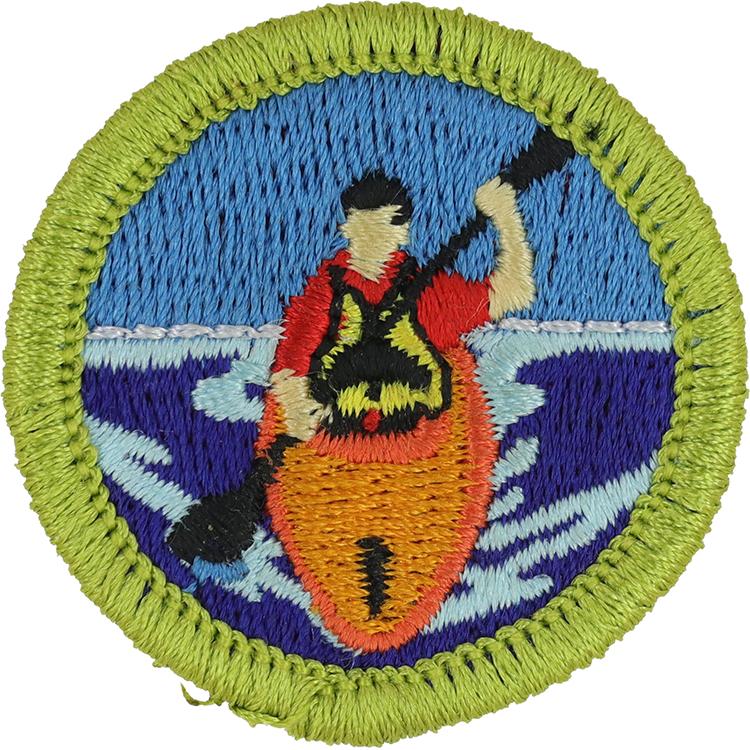
Fig. 1: Kayaki-K-Front
- Embroidery: Rayon thread
- Border: Merrowed

Fig. 2: Kayaki-K-Reverse
- Back: 100th Anniversary imprint
Item Name: Kayaking 2013
Item ID: Kayaki-K
Collector Rating: 1
Pamphlets Used to Earn this Badge

Requirements January 2013 until Current
1. Do the following:
- Explain to your counselor the hazards you are most likely to encounter were participating in kayaking activities, including whether and water related hazards, and what you should do to anticipate, help prevent, mitigate, and respond to these hazards.
- Review prevention, symptoms, and first aid treatment for the following injuries or illnesses that can occur while kayaking: blisters, coal-water shock and hypothermia, heat-related illnesses, dehydration, sunburn, sprains, and strains.
- Review the BSA Safety Afloat policy. Explain to your counselor how this applies to kayaking.
2. Before doing requirement 3 through eight, successfully complete the BSA swimmer test: Jump feet first into water over the head in depth. Level off and swim 75 yards in a strong manner using one or more the following strokes: sidestroke, breaststroke, trudgen, or crawl; then swim 25 yards using an easy, resting backstroke. The 100 yards must be completed in one swim without stops and must include at least one sharp turn. After completing the swim, rest by floating.
3. Do the following:
- Review the characteristics of lifejackets most appropriate for kayaking and understand why one must always be worn while paddling. Then demonstrate how to select and fit a lifejacket for kayaking.
- Review the importance of safety equipment such as a signal device, extra paddle, sponge, bilge pump, and throw bag.
4. Do the following:
- Name and point out the major parts of a kayak.
- Review the differences in design between recreational, Whitewater, and see or touring kayaks. Include hell length, width, stability, and rocker are involved in the design of each type.
- Review the advantages and disadvantages of intros most commonly used to make kayaks. Explain the care, maintenance, and storage of a kayak.
- Using the trucker’s hitch and bowline, demonstrate how to secure a kayak to a rack on a vehicle or a trailer, or to a rack on land.
5. Discuss the following:
- How to choose a kayak paddle.
- The different materials from which paddles are made, parts of a paddle, in the care and maintenance of a paddle.
6. Using a properly equipped kayak with an open cockpit, a sit-on-top, or an inflatable kayak, do the following:
- Safely capsize and perform a wet exit.
- Reenter the kayak with assistance from a buddy boat.
- Demonstrate a kayak over kayak rescue.
- Demonstrate the HELP position.
- Capsize the kayak, swim it and the paddle to shore, an empty water from the kayak with assistance, if needed.
7. As a solo paddler, use a properly equipped kayak to demonstrate the following:
- Forward stroke
- Backstroke
- Ford sweep
- Reverse sweep
- Draw stroke
- Stern draw
8. As a solo paddler, use a properly equipped kayak to demonstrate the following:
- Paddle a straight line for 25 yards, make a sharp turn and return 25 yards in a straight line.
- Spin or pivot 360 degrees to the right and 360 degrees to the left.
- Move abeam to the right 10 feet and to the left 10 feet.
- Stop the boat in one boat length.
- Paddle a buoyed course of a link determined by your counselor and includes to right turns into left terms performed while underway.