-
Merit Badges
- Legend to identify Merit Badges
- 1910 British Merit Badges
- Square 1911 - 33
- Wide Crimped 1934 & 35
-
Narrow Tan Crimped 1936 - 42
- Tan Heavyweight Cloth with Silk Embroidery and Printed Back 1936 - 37
- Tan Heavyweight Cloth with Silk Embroidery and Plain Back 1937 - 38
- Tan Lightweight Cloth with Silk Embroidery and Plain Back 1938 - 39
- Tan Lightweight Cloth with Cotton Continuous Loop Embroidery and Plain Back 1939 - 42
- Tan Lightweight Cloth with Cotton Lockstitch Embroidery and Plain Back 1939 - 42
- Blue Background 1942 - 46
- Wartime 1942 - 46
- Khaki Narrow Crimped 1946 - 59
- Green Twill Gauze Back 1960 - 68
- Fully Embroidered Merrowed Edge 1960 - 72
- Unprinted Plastic Back 1972 - 01
- Printed Plastic Back 2002 - Current
-
Merit Badge Paper
- Merit Badge Applications
- Merit Badge Cards
-
Merit Badge Pamphlets
- Type 1 White Cover - Rectangle Drawing On Cover
- Type 2 White Cover 5-375" x 8" Title at Top
- Type 3A Tan Cover - 200 Fifth Avenue
- Type 3B Tan Cover - 2 line address New York City
- Type 3C Tan Cover - 2 line address New York N.Y.
- Type 3D Tan Cover - 1 line address New York N.Y.
- Type 4 Standing Scout Cover
- Type 5A War Cover
- Type 5B Red and White
- Type 6 Photo-Red Cover
- Type 7 Full Photo Cover or Bulls-eye Cover
- Type 8 Full Photo - Green Stripe Cover
- Type 9 Full Photo - Red Stripe Cover
- Type 10A Blue Stripe - Logo above bottom blue stripe - FDL centered
- Type 10B - Blue Stripe in bottom of photo area. FDL to left of text
- Special Covers
- Boy Craft Helps
- Merit Badge Counselor's Guides
-
Youth Position
- Junior Assistant Scoutmaster
- Senior Patrol Leader
- Assistant Senior Patrol Leader
- Patrol Leader
- Assistant Patrol Leader
- Troop Guide
- Scribe
- Quartermaster
- Instructor
- Chaplain Aide
- Den Chief
- Librarian
- Musician
- Webmaster
- Bugler
- Troop Historian
- Troop Representative
- Unit Representative
- Leadership Corps
- Honor Guard
- Leave No Trace Trainer
- Outdoor Ethics Guide
-
Patrol Medallions
- Patrol Medallions Introduction
- Legend to identify Patrol Medallions
- Patrol Shoulder Knot-Ribbons
- Felt Handmade Patrol Medallions
- Square Felt Patrol Medallions
- Round Broadcloth Patrol Medallions
- Red Twill Patrol Medallions
- Multi-Color Cloth Patrol Medallions
- Tan Cloth Patrol Medallions
- Patrol Medallion Back Patches
- Woodbadge Patrol Medallion

Fig. 1: LanArc-L1-Front
- Embroidery: Rayon thread
- Border: Merrowed
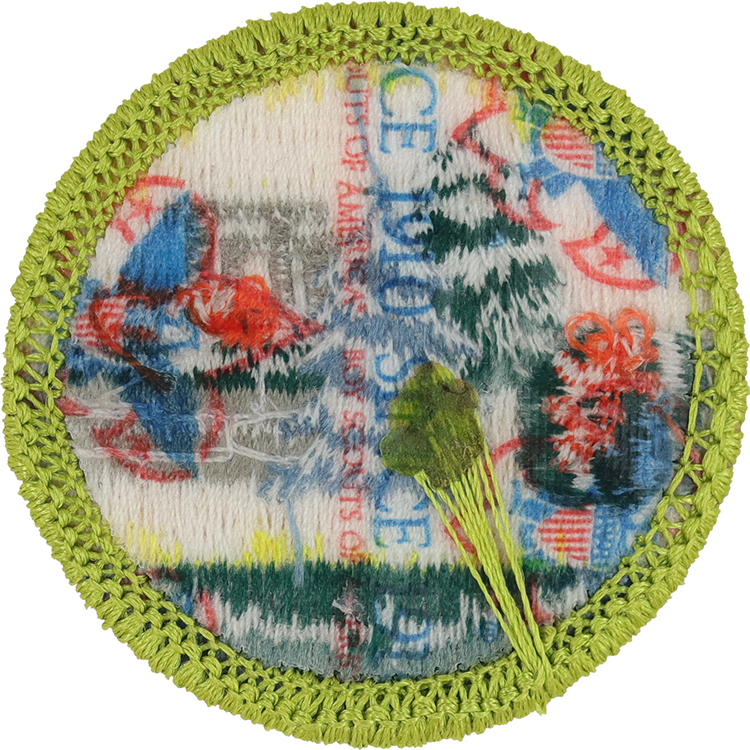
Fig. 2: LanArc-L1-Reverse
- Back: Since 1910 imprint with large Tenderfoot image
Item Name: Landscape Architecture 2014 - Current
Item ID: LanArc-L1
Collector Rating: 1
Pamphlets Used to Earn this Badge

Requirements January 2010 until January 2017
1. Go to a completed landscape project that a landscape architect has designed. Before you visit the site, obtain a plan of the design from the landscape architect if one is available.
2. After completing requirement 1, discuss the following with your merit badge counselor:
- Tell whether the design had separate spaces, a clear path system, and sun and shade variety.
- Discuss how the designated seating, eating, or parking areas suited the overall design.
- Explain how the design reflected consideration for the comfort, shelter, and security of the users.
- Discuss how the choice of trees, shrubs, and ground covers used in the project contributed to its appeal and function.
3. entify five shrubs, five trees, and one ground cover, being sure that you select examples of different shapes, sizes, and textures. With the help of your counselor or a local nursery, choose plants that will grow in your area. Bring pictures of the different planting materials or, if possible, examples of their branches, leaves, or flowers to a group such as your troop or class at school. Be prepared to tell how you might use each in the design of a landscape.
4. Look at and study a place of worship or school grounds to find the place where most people arrive by bus or car. Show you can do the following:
- Using a measuring tape, measure and draw the entry and its nearby area using a scale of 1/8 inch equals 1 foot on an 11-by-17-inch piece of paper. Be sure to include the driveway and the wall and door where people enter the school or place of worship. Indicate any sidewalks, structures, trees, and plants within the study area. Make two copies of this plan to save the original, then do 4b and 4c using the copies.
- On one copy, use directional arrows to indicate where the water drains across the site, where ditches occur, and where water stands for a longer period of time.
- Decide how you can make the place safer and more comfortable for those using it. Redesign the area on another copy of the plan. You may want to include new walks, covered waiting areas, benches, space-defining plantings of trees and shrubs, and drainage structures.
5. Find out about three career opportunities in landscape architecture. Pick one and find out the education, training, and experience required for this profession. Discuss this with your counselor, and explain why this profession might interest you.
Requirements January 2017 until Current
1. Go to a completed landscape project that a landscape architect has designed. Before you visit the site, obtain a plan of the design from the landscape architect if one is available.
2. After completing requirement 1, discuss the following with your merit badge counselor:
- Tell whether the design had separate spaces, a defined point of entry, a clear path system, and sun and shade variety.
- Discuss how any structures, the designated seating, eating, or parking areas suited the overall design.
- Explain how the design reflected consideration for the comfort, shelter, and security of the users.
- Discuss how the choice of trees, shrubs, and ground covers used in the project contributed to its appeal and function.
3. entify five shrubs, five trees, and one ground cover, being sure that you select examples of different shapes, sizes, and textures. With the help of your counselor or a local nursery, choose plants that will grow in your area. Bring pictures of the different planting materials or, if possible, examples of their branches, leaves, or flowers to a group such as your troop or class at school. Be prepared to tell how you might use each in the design of a landscape.
4. Look at and study a place of worship or school grounds to find the place where most people arrive by bus or car. Show you can do the following:
- Using a measuring tape, measure and draw the entry and its nearby area. Define the scale of your drawing. Be sure to include the driveway and sidewalk or path that leads to the building’s main entry. Indicate any sidewalks, structures, trees, and plants, lights, drains, utilities, or other furnishings within the study area. Make two copies of this plan and save the original, then do 4b and 4c using the copies
- On one copy of your site plan, use directional arrows to indicate where the water drains across the site, where ditches occur, and where water stands for a longer period of time.
- Decide how you can make the place safer and more comfortable for those using it. Redesign the area on another copy of the plan. You may want to include new walks, covered waiting areas, benches, space-defining plantings of trees and shrubs, and drainage structures.
5. Find out about three career opportunities in landscape architecture. Pick one and find out the education, training, and experience required for this profession. Discuss this with your counselor, and explain why this profession might interest you.