-
Merit Badges
- Legend to identify Merit Badges
- 1910 British Merit Badges
- Square 1911 - 33
- Wide Crimped 1934 & 35
-
Narrow Tan Crimped 1936 - 42
- Tan Heavyweight Cloth with Silk Embroidery and Printed Back 1936 - 37
- Tan Heavyweight Cloth with Silk Embroidery and Plain Back 1937 - 38
- Tan Lightweight Cloth with Silk Embroidery and Plain Back 1938 - 39
- Tan Lightweight Cloth with Cotton Continuous Loop Embroidery and Plain Back 1939 - 42
- Tan Lightweight Cloth with Cotton Lockstitch Embroidery and Plain Back 1939 - 42
- Blue Background 1942 - 46
- Wartime 1942 - 46
- Khaki Narrow Crimped 1946 - 59
- Green Twill Gauze Back 1960 - 68
- Fully Embroidered Merrowed Edge 1960 - 72
- Unprinted Plastic Back 1972 - 01
- Printed Plastic Back 2002 - Current
-
Merit Badge Paper
- Merit Badge Applications
- Merit Badge Cards
-
Merit Badge Pamphlets
- Type 1 White Cover - Rectangle Drawing On Cover
- Type 2 White Cover 5-375" x 8" Title at Top
- Type 3A Tan Cover - 200 Fifth Avenue
- Type 3B Tan Cover - 2 line address New York City
- Type 3C Tan Cover - 2 line address New York N.Y.
- Type 3D Tan Cover - 1 line address New York N.Y.
- Type 4 Standing Scout Cover
- Type 5A War Cover
- Type 5B Red and White
- Type 6 Photo-Red Cover
- Type 7 Full Photo Cover or Bulls-eye Cover
- Type 8 Full Photo - Green Stripe Cover
- Type 9 Full Photo - Red Stripe Cover
- Type 10A Blue Stripe - Logo above bottom blue stripe - FDL centered
- Type 10B - Blue Stripe in bottom of photo area. FDL to left of text
- Special Covers
- Boy Craft Helps
- Merit Badge Counselor's Guides
-
Youth Position
- Junior Assistant Scoutmaster
- Senior Patrol Leader
- Assistant Senior Patrol Leader
- Patrol Leader
- Assistant Patrol Leader
- Troop Guide
- Scribe
- Quartermaster
- Instructor
- Chaplain Aide
- Den Chief
- Librarian
- Musician
- Webmaster
- Bugler
- Troop Historian
- Troop Representative
- Unit Representative
- Leadership Corps
- Honor Guard
- Leave No Trace Trainer
- Outdoor Ethics Guide
-
Patrol Medallions
- Patrol Medallions Introduction
- Legend to identify Patrol Medallions
- Patrol Shoulder Knot-Ribbons
- Felt Handmade Patrol Medallions
- Square Felt Patrol Medallions
- Round Broadcloth Patrol Medallions
- Red Twill Patrol Medallions
- Multi-Color Cloth Patrol Medallions
- Tan Cloth Patrol Medallions
- Patrol Medallion Back Patches
- Woodbadge Patrol Medallion

Fig. 1: Leathe-L1-Front
- Embroidery: Rayon thread
- Border: Merrowed
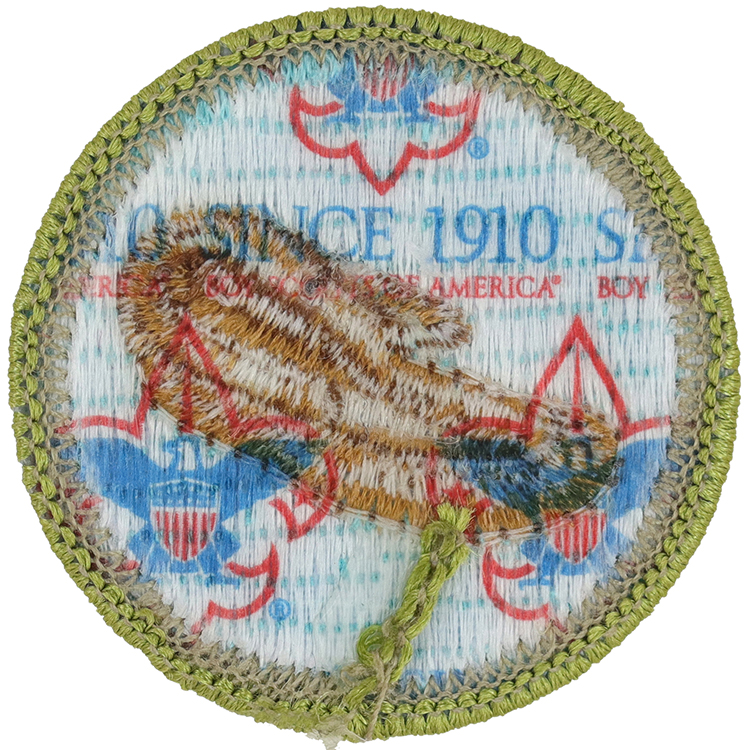
Fig. 2: Leathe-L1-Reverse
- Back: Since 1910 imprint with large Tenderfoot image
Item Name: Leatherwork 2014 - Current
Item ID: Leathe-L1
Collector Rating: 1
Pamphlets Used to Earn this Badge

Requirements January 2014 until January 2017
1. Do the following:
(a) Explain to your counselor the hazards you are most likely to encounter while using leatherwork tools and materials, and what you should do to anticipate, help prevent, mitigate, or lessen these hazards.
(b) Show that you know first aid for injuries or illnesses that could occur while working with leather, including minor cuts and scratches, puncture wounds, ingested poisoning, and reactions from exposure to chemicals such as dyes, cements, and finishes used in leatherworking.
2. Explain to your counselor:
(a) Where leather comes from
(b) What kinds of hides are used to make leather
(c) What are five types of leather
(d) What are the best uses for each type of leather
3. Make one or more articles of leather that use at least five of the following steps:
(a) Pattern layout and transfer
(b) Cutting leather
(c) Punching holes
(d) Carving or stamping surface design
(e) Applying dye or stain and finish to the project
(f) Assembly by lacing or stitching
(g) Setting snaps and rivets
(h) Dressing edges
4. Recondition or show that you can take proper care of your shoes, a baseball glove, a saddle, furniture, or other articles of leather.
5. Do ONE of the following:
(a) Learn about the commercial tanning process. Report about it to your merit badge counselor.
(b) Tan the skin of a small animal. Describe th safety precautions you will take and the tanning method that you used.
(c) Braid or plait an article out of leather or vinyl lace.
(d) Visit a leather-related business. This could be a leacthercraft supply company, a tannery, a leather goods or shoe factory, or a saddle shop. Report on your visit to your counselor.
Requirements January 2017 until Current
1. Do the following:
(a) Explain to your counselor the hazards you are most likely to encounter while using leatherwork tools and materials, and what you should do to anticipate, help prevent, mitigate, or lessen these hazards.
(b) Show that you know first aid for injuries or illnesses that could occur while working with leather, including minor cuts and scratches, puncture wounds, ingested poisoning, and reactions from exposure to chemicals such as dyes, cements, and finishes used in leatherworking.
2. Explain to your counselor:
(a) Where leather comes from
(b) What kinds of hides are used to make leather
(c) What are five types of leather
(d) What are the best uses for each type of leather
3. Make one or more articles of leather that use at least five of the following steps:
(a) Pattern layout and transfer
(b) Cutting leather
(c) Punching holes
(d) Carving or stamping surface design
(e) Applying dye or stain and finish to the project
(f) Assembly by lacing or stitching
(g) Setting snaps and rivets
(h) Dressing edges
4. Braid or plait an article out of leather, vinyl lace, or paracord.
5. Do ONE of the following:
(a) Learn about the commercial tanning process. Report about it to your merit badge counselor.
(b) Tan the skin of a small animal. Describe th safety precautions you will take and the tanning method that you used.
(c) Recondition or show that you can take proper care of your shoes, a baseball glove, a saddle, furniture, or other articles of leather. Discuss with your counselor the advantages or disadvantages of leather vs. synthetic materials.
(d) Visit a leather-related business. This could be a leacthercraft supply company, a tannery, a leather goods or shoe factory, or a saddle shop. Report on your visit to your counselor.