-
Merit Badges
- Legend to identify Merit Badges
- 1910 British Merit Badges
- Square 1911 - 33
- Wide Crimped 1934 & 35
-
Narrow Tan Crimped 1936 - 42
- Tan Heavyweight Cloth with Silk Embroidery and Printed Back 1936 - 37
- Tan Heavyweight Cloth with Silk Embroidery and Plain Back 1937 - 38
- Tan Lightweight Cloth with Silk Embroidery and Plain Back 1938 - 39
- Tan Lightweight Cloth with Cotton Continuous Loop Embroidery and Plain Back 1939 - 42
- Tan Lightweight Cloth with Cotton Lockstitch Embroidery and Plain Back 1939 - 42
- Blue Background 1942 - 46
- Wartime 1942 - 46
- Khaki Narrow Crimped 1946 - 59
- Green Twill Gauze Back 1960 - 68
- Fully Embroidered Merrowed Edge 1960 - 72
- Unprinted Plastic Back 1972 - 01
- Printed Plastic Back 2002 - Current
-
Merit Badge Paper
- Merit Badge Applications
- Merit Badge Cards
-
Merit Badge Pamphlets
- Type 1 White Cover - Rectangle Drawing On Cover
- Type 2 White Cover 5-375" x 8" Title at Top
- Type 3A Tan Cover - 200 Fifth Avenue
- Type 3B Tan Cover - 2 line address New York City
- Type 3C Tan Cover - 2 line address New York N.Y.
- Type 3D Tan Cover - 1 line address New York N.Y.
- Type 4 Standing Scout Cover
- Type 5A War Cover
- Type 5B Red and White
- Type 6 Photo-Red Cover
- Type 7 Full Photo Cover or Bulls-eye Cover
- Type 8 Full Photo - Green Stripe Cover
- Type 9 Full Photo - Red Stripe Cover
- Type 10A Blue Stripe - Logo above bottom blue stripe - FDL centered
- Type 10B - Blue Stripe in bottom of photo area. FDL to left of text
- Special Covers
- Boy Craft Helps
- Merit Badge Counselor's Guides
-
Youth Position
- Junior Assistant Scoutmaster
- Senior Patrol Leader
- Assistant Senior Patrol Leader
- Patrol Leader
- Assistant Patrol Leader
- Troop Guide
- Scribe
- Quartermaster
- Instructor
- Chaplain Aide
- Den Chief
- Librarian
- Musician
- Webmaster
- Bugler
- Troop Historian
- Troop Representative
- Unit Representative
- Leadership Corps
- Honor Guard
- Leave No Trace Trainer
- Outdoor Ethics Guide
-
Patrol Medallions
- Patrol Medallions Introduction
- Legend to identify Patrol Medallions
- Patrol Shoulder Knot-Ribbons
- Felt Handmade Patrol Medallions
- Square Felt Patrol Medallions
- Round Broadcloth Patrol Medallions
- Red Twill Patrol Medallions
- Multi-Color Cloth Patrol Medallions
- Tan Cloth Patrol Medallions
- Patrol Medallion Back Patches
- Woodbadge Patrol Medallion
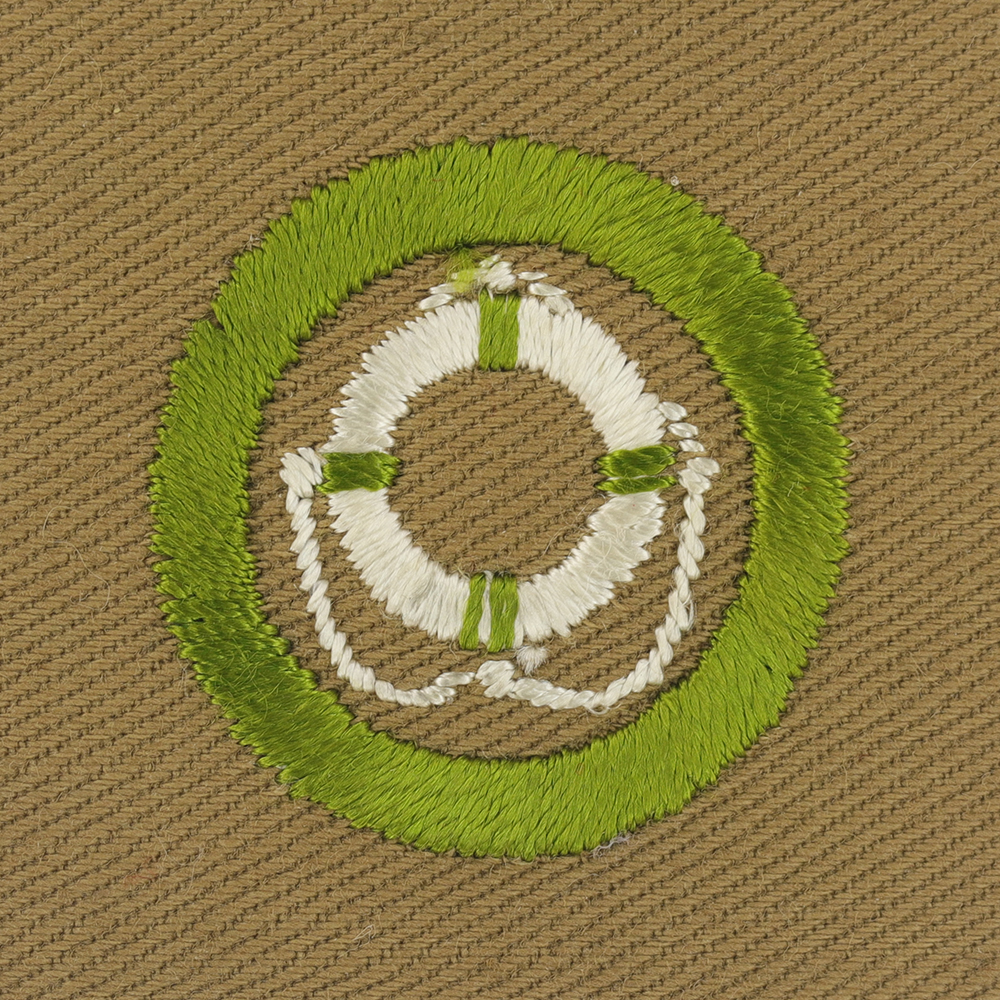
Fig. 1: LifSav-AT2-Front
- Cloth: Heavyweight tan right twill
- Embroidery: Silk continuous
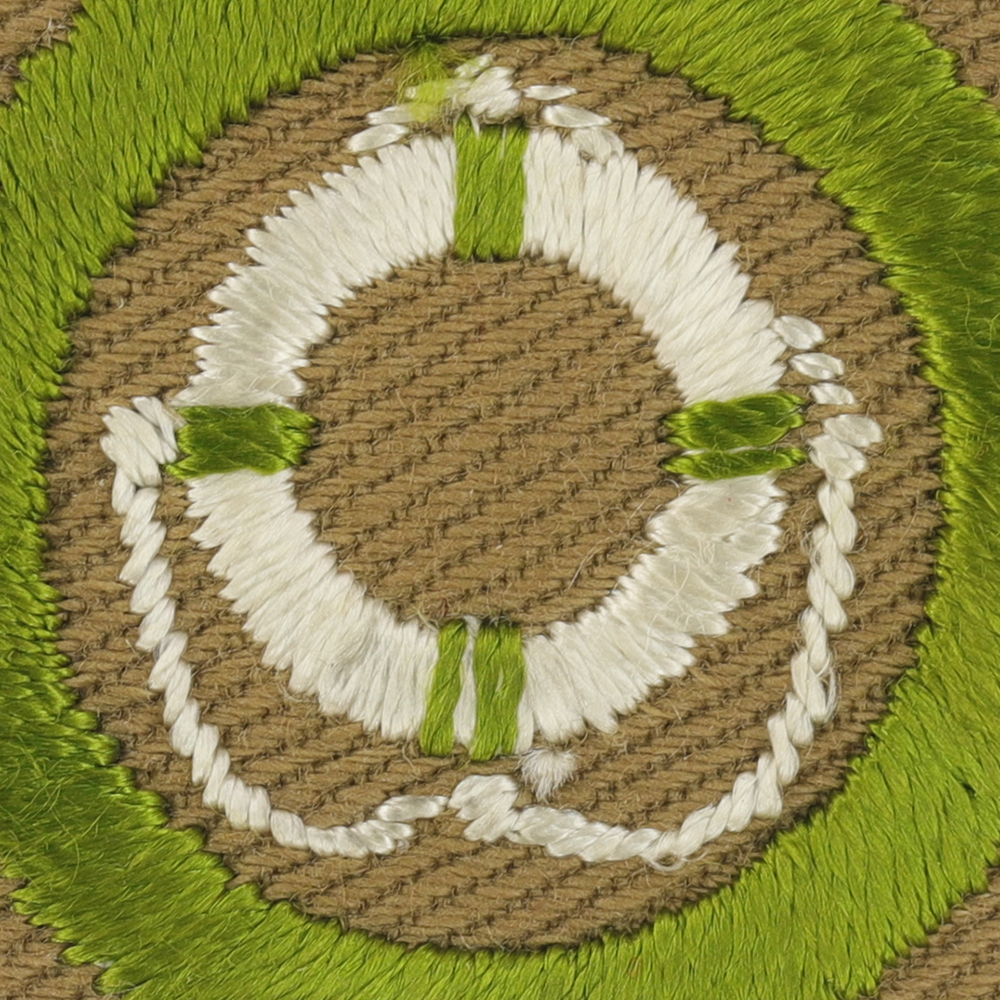
Fig. 2: LifSav-AT2-Magnified
- Design: White buoy with green stripes
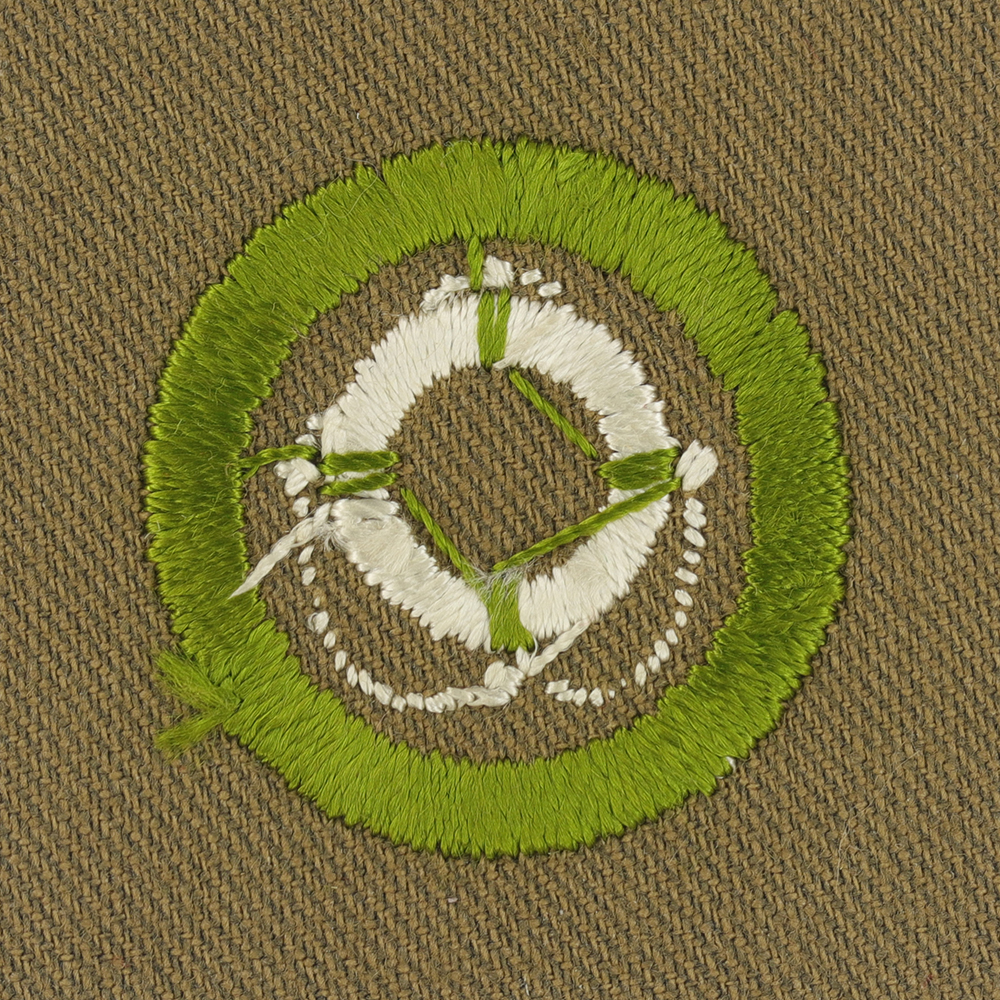
Fig. 3: LifSav-AT2-Reverse
- Back: Black imprint
Item Name: Life Saving 1920 - 1933
Item ID: LifSav-AT2
Collector Rating: 1
Pamphlets Used to Earn this Badge
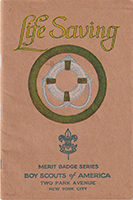
Requirements October 1914 until February 1922
1. Go down from the surface of the water at least seven feet deep and bring up an object twelve inches or more in diameter, weighing not less than ten pounds.
2. Swim twenty yards carrying a person of his own weight:
(a) By a two-hand carry, using feet only for propulsion;
(b) By a one-arm carry, using side stroke.
3. Dressed in trousers, coat, and shoes swim fifty yards, and undress before reaching shore.
4. In deep water, demonstrate three approved methods of releasing death drip.
5. Demonstrate Schaefer (prone pressure) method of resuscitation.
Requirements February 1922 until May 1925
To obtain a merit badge for Life Saving, a scout must first have passed the merit badge for swimming and
1. Go down from the surface of the water at least seven feet deep and bring up an object twelve inches or more in diameter, weighing not less than ten pounds.
2. Tow a person of his own weight for 10 yards by each of the following methods:
(a) Head carry. (b) Cross chest carry.
(c) Hair carry. (d) Tired swimmer's carry.
3. Undress in water and swim 100 yards.
4. He must be able to demonstrate in the water the methods of releasing himself from people in peril of drowning, if grasped by:
Wrist-hold Front strangle-hold. Back strangle-hold.
5. Demonstrate Schaefer Prone Pressure method of resuscitation.
Requirements May 1925 until April 1929
1. Go down from the surface of the water at least seven feet deep and bring up an object twelve inches or more in diameter, weighing not less than ten pounds.
2. Tow a person of his own weight for 10 yards by each of the following methods:
(a) Head carry. (b) Cross chest carry.
(c) Hair carry. (d) Tired swimmer's carry.
3. Undress in water and swim 100 yards.
4. Demonstrate in the water the methods of releasing himself from people in peril of drowning, if grasped by:
Wrist-hold Front strangle-hold. Back strangle-hold.
5. Demonstrate Schaefer Prone Pressure method of resuscitation.
Requirements August 1929 until September 7, 1937. Between September 7, 1937 and January 1, 1938 these requirements were optional.
To obtain a Merit Badge for Life Saving, a Scout must first have met the Merit Badge Requirements for Swimming, must have spent at least six hours in preparation and practice, and must demonstrate the following:
1. In deep water, disrobe and swim 100 yards.
2. Surface dive in 6 to 8 feet, recovering various objects three times, and a 10-pound weight once.
3. Correct approach, 30 feet, and head carry, 30 feet.
4. Correct approach, 30 feet, and cross-chest carry, 30 feet.
5. Correct approach, 30 feet, and hair or arm-lock carry, 30 feet.
6. Tired swimmer's carry, 30 feet, preceded by 30-foot approach.
7. Release double grip on one wrist. Left and right.
8. Release front strangle hold. Left and right.
9. Release back strangle hold. Left and right.
10. Resuscitation 1-1/2 minutes' demonstration, prone pressure method.