-
Merit Badges
- Legend to identify Merit Badges
- 1910 British Merit Badges
- Square 1911 - 33
- Wide Crimped 1934 & 35
-
Narrow Tan Crimped 1936 - 42
- Tan Heavyweight Cloth with Silk Embroidery and Printed Back 1936 - 37
- Tan Heavyweight Cloth with Silk Embroidery and Plain Back 1937 - 38
- Tan Lightweight Cloth with Silk Embroidery and Plain Back 1938 - 39
- Tan Lightweight Cloth with Cotton Continuous Loop Embroidery and Plain Back 1939 - 42
- Tan Lightweight Cloth with Cotton Lockstitch Embroidery and Plain Back 1939 - 42
- Blue Background 1942 - 46
- Wartime 1942 - 46
- Khaki Narrow Crimped 1946 - 59
- Green Twill Gauze Back 1960 - 68
- Fully Embroidered Merrowed Edge 1960 - 72
- Unprinted Plastic Back 1972 - 01
- Printed Plastic Back 2002 - Current
-
Merit Badge Paper
- Merit Badge Applications
- Merit Badge Cards
-
Merit Badge Pamphlets
- Type 1 White Cover - Rectangle Drawing On Cover
- Type 2 White Cover 5-375" x 8" Title at Top
- Type 3A Tan Cover - 200 Fifth Avenue
- Type 3B Tan Cover - 2 line address New York City
- Type 3C Tan Cover - 2 line address New York N.Y.
- Type 3D Tan Cover - 1 line address New York N.Y.
- Type 4 Standing Scout Cover
- Type 5A War Cover
- Type 5B Red and White
- Type 6 Photo-Red Cover
- Type 7 Full Photo Cover or Bulls-eye Cover
- Type 8 Full Photo - Green Stripe Cover
- Type 9 Full Photo - Red Stripe Cover
- Type 10A Blue Stripe - Logo above bottom blue stripe - FDL centered
- Type 10B - Blue Stripe in bottom of photo area. FDL to left of text
- Special Covers
- Boy Craft Helps
- Merit Badge Counselor's Guides
-
Youth Position
- Junior Assistant Scoutmaster
- Senior Patrol Leader
- Assistant Senior Patrol Leader
- Patrol Leader
- Assistant Patrol Leader
- Troop Guide
- Scribe
- Quartermaster
- Instructor
- Chaplain Aide
- Den Chief
- Librarian
- Musician
- Webmaster
- Bugler
- Troop Historian
- Troop Representative
- Unit Representative
- Leadership Corps
- Honor Guard
- Leave No Trace Trainer
- Outdoor Ethics Guide
-
Patrol Medallions
- Patrol Medallions Introduction
- Legend to identify Patrol Medallions
- Patrol Shoulder Knot-Ribbons
- Felt Handmade Patrol Medallions
- Square Felt Patrol Medallions
- Round Broadcloth Patrol Medallions
- Red Twill Patrol Medallions
- Multi-Color Cloth Patrol Medallions
- Tan Cloth Patrol Medallions
- Patrol Medallion Back Patches
- Woodbadge Patrol Medallion
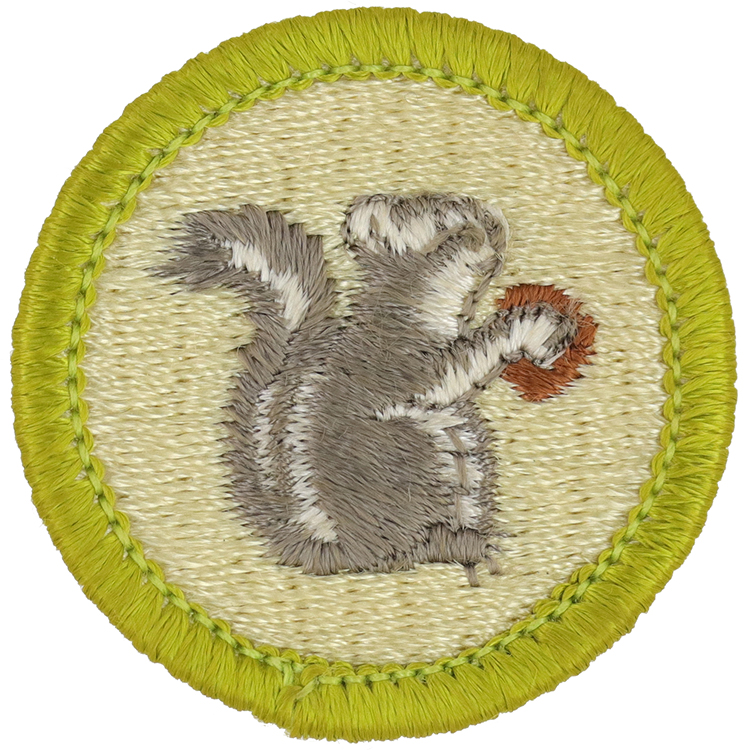
Fig. 1: MamStu-H4-Front
- Embroidery: Cotton thread, dull sheen
- Border: Lt green merrowed
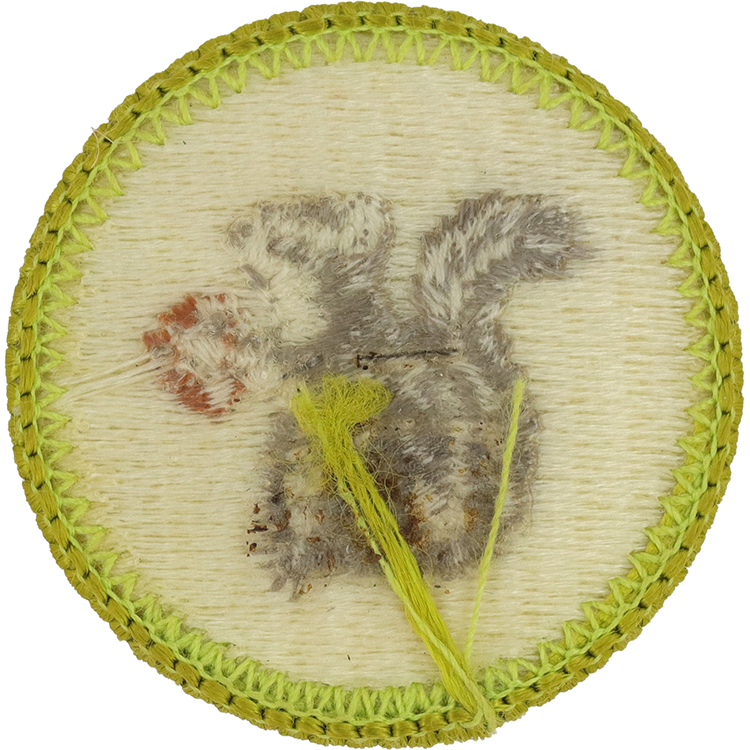
Fig. 2: MamStu-H4-Reverse
- Back: Lt green lock stitch, molded plastic
Item Name: Mammal Study 1985 - 1990
Item ID: MamStu-H4
Collector Rating: 1
Pamphlets Used to Earn this Badge
Requirements September 1987 January 2004
1. Explain the meaning of "animal," "invertebrate," "vertebrate," and "mammal." Name three characteristics that distinguish mammals from all other animals.
2. Explain how the animal kingdom is classified. Explain where mammals fit in the classification of animals. Classify three mammals from phylum through species.
3. Do ONE of the following:
(a) Spend 3 hours in each of two different kinds of natural habitats or at different elevations. List the different mammal species and individual members that you identified by sight or sign. Tell why all mammals do not live in the same kind of habitat.
(b) Spend 3 hours on each of 5 days on at least a 25-acre area. List the mammal species you identified by sight or sign.
(c) From study and reading, write a simple life history of one nongame mammal that lives in your area. Tell how this mammal lived before its habitat was affected in any way by man. Tell how it reproduces, what it eats, what eats it, and its natural habitat. Describe its dependency upon plants, upon other animals (including man), and how they depend upon it. Tell how it is helpful or harmful to man.
4. Do ONE of the following:
(a) Under the guidance of a nature center or natural history museum, make two study skins of rats or mice. Tell the uses of study skins and mounted specimens respectively.
(b) Take good pictures of two kinds of mammals in the wild. Record light conditions, film used, exposure, and other factors, including notes on the activities of the pictured animals.
(c) Write a life history of a native game mammal that lives in your area, covering the points outlined in requirement 3c. List sources for this information.
(d) Make and bait a tracking pit. Report what mammals and other animals came to the bait.
(e) Visit a natural history museum. Report on how specimens are prepared and catalogued. Explain the purposes of museums.
(f) Write a report of 500 words on a book about a mammal species.
(g) Trace two possible food chains of carnivorous mammals from soil through four stages to the mammal.
5. Working with your counselor, select and carry out one project that will influence the numbers of one or more mammals.