-
Merit Badges
- Legend to identify Merit Badges
- 1910 British Merit Badges
- Square 1911 - 33
- Wide Crimped 1934 & 35
-
Narrow Tan Crimped 1936 - 42
- Tan Heavyweight Cloth with Silk Embroidery and Printed Back 1936 - 37
- Tan Heavyweight Cloth with Silk Embroidery and Plain Back 1937 - 38
- Tan Lightweight Cloth with Silk Embroidery and Plain Back 1938 - 39
- Tan Lightweight Cloth with Cotton Continuous Loop Embroidery and Plain Back 1939 - 42
- Tan Lightweight Cloth with Cotton Lockstitch Embroidery and Plain Back 1939 - 42
- Blue Background 1942 - 46
- Wartime 1942 - 46
- Khaki Narrow Crimped 1946 - 59
- Green Twill Gauze Back 1960 - 68
- Fully Embroidered Merrowed Edge 1960 - 72
- Unprinted Plastic Back 1972 - 01
- Printed Plastic Back 2002 - Current
-
Merit Badge Paper
- Merit Badge Applications
- Merit Badge Cards
-
Merit Badge Pamphlets
- Type 1 White Cover - Rectangle Drawing On Cover
- Type 2 White Cover 5-375" x 8" Title at Top
- Type 3A Tan Cover - 200 Fifth Avenue
- Type 3B Tan Cover - 2 line address New York City
- Type 3C Tan Cover - 2 line address New York N.Y.
- Type 3D Tan Cover - 1 line address New York N.Y.
- Type 4 Standing Scout Cover
- Type 5A War Cover
- Type 5B Red and White
- Type 6 Photo-Red Cover
- Type 7 Full Photo Cover or Bulls-eye Cover
- Type 8 Full Photo - Green Stripe Cover
- Type 9 Full Photo - Red Stripe Cover
- Type 10A Blue Stripe - Logo above bottom blue stripe - FDL centered
- Type 10B - Blue Stripe in bottom of photo area. FDL to left of text
- Special Covers
- Boy Craft Helps
- Merit Badge Counselor's Guides
-
Youth Position
- Junior Assistant Scoutmaster
- Senior Patrol Leader
- Assistant Senior Patrol Leader
- Patrol Leader
- Assistant Patrol Leader
- Troop Guide
- Scribe
- Quartermaster
- Instructor
- Chaplain Aide
- Den Chief
- Librarian
- Musician
- Webmaster
- Bugler
- Troop Historian
- Troop Representative
- Unit Representative
- Leadership Corps
- Honor Guard
- Leave No Trace Trainer
- Outdoor Ethics Guide
-
Patrol Medallions
- Patrol Medallions Introduction
- Legend to identify Patrol Medallions
- Patrol Shoulder Knot-Ribbons
- Felt Handmade Patrol Medallions
- Square Felt Patrol Medallions
- Round Broadcloth Patrol Medallions
- Red Twill Patrol Medallions
- Multi-Color Cloth Patrol Medallions
- Tan Cloth Patrol Medallions
- Patrol Medallion Back Patches
- Woodbadge Patrol Medallion
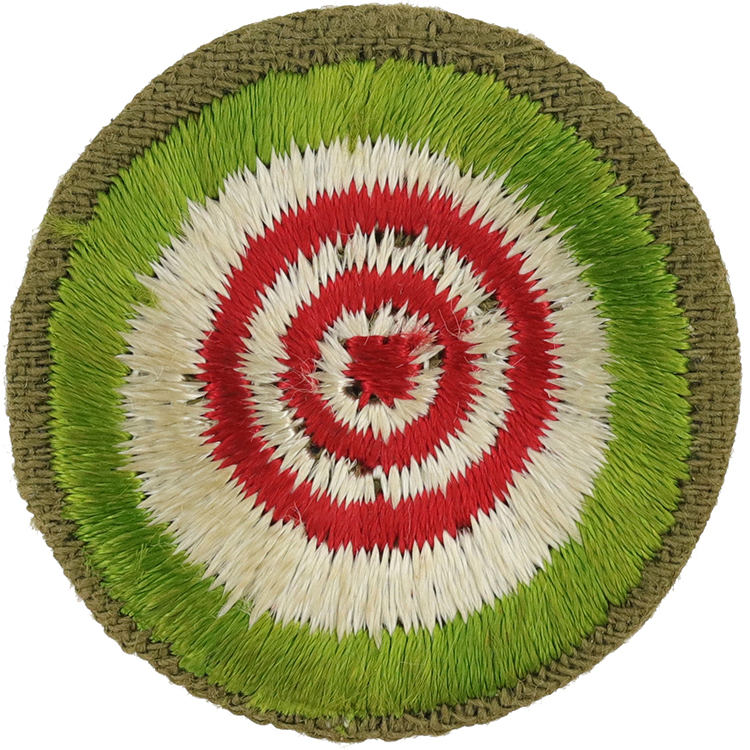
Fig. 1: Marksm-D4-Front
- Cloth: War
- Embroidery: Cotton lock stitch
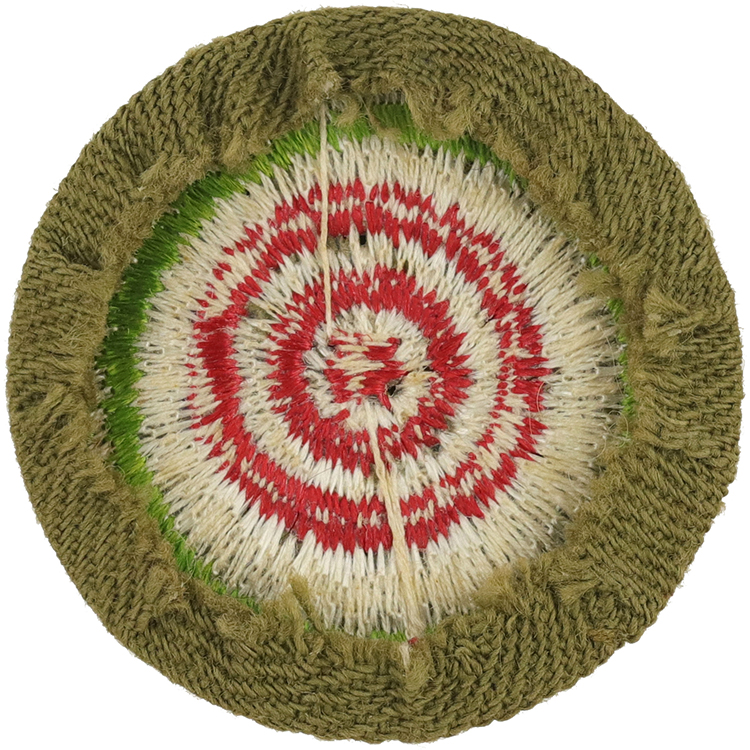
Fig. 2: Marksm-D4-Reverse
- Back: Plain NO imprint with starch
Item Name: Marksmanship 1942 - 1945
Item ID: Marksm-D4
Collector Rating: 1
Pamphlets Used to Earn this Badge

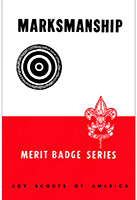
Requirements September 1934 until June 1953
1. (a) Make not less than 30 points in the off-hand position (standing) out of a possible 50 points, in 5 shots, on each of four targets, at a distance of fifty feet from firing point to target.
(b) Make a score of not less than 40 points in the prone position out of a possible 50 points, in 5 shots, on each of six targets, at a distance of fifty feet from firing point to target.
(c) All shooting must be witnessed and targets signed by a range officer whose appointment has been approved by the Local or National Council.
2. (a) Pledge his word that he will live up to the Boy Scout Marksman's Code.
(b) Explain his understanding of the meaning of the first four rules of safety in the Boy Scout Marksman's Code, and demonstrate Nos. 2, 3, and 4.
3. (a). Demonstrate with a rifle:
1. The proper way to clean it after using;
2. What rifling is, and explain the function of rifling;
3. In what direction the rear sight should be moved, to move the striking point of the bullet (a) from right to left; (b) from below the target upward to the target (sights need not be actually moved for this demonstration).
(b) Explain the proper method of removing rust and leading from the bore of a rifle.
Boy Scout Marksman's Code
1. A Scout considers every gun as being loaded, even though he has personally unloaded it.
2. A Scout points the muzzle of a gun in a safe direction on picking it up.
3. A Scout opens the action of a gun immediately and makes sure that it is not loaded.
4. A Scout opens the action of the gun before he passes it to another person.
5. A Scout takes care not to heedlessly point a gun at any human being under any circumstances.
6. A Scout turns the muzzle of a firearm away from every person when loading it.
7. A Scout strives to preserve harmless animals and birds, and does not wantonly shoot or kill merely for the sake of killing.
8. A Scout takes every precaution for the safety of others before shooting in the open.
9. A Scout cares for a firearm properly before he lays it aside.
10. A Scout is sportsmanlike when engaged in contests of skill with firearms and whenever handling firearms.
Conditions
RIFLE: Any .22 caliber rimfire.
SIGHTS: Any not containing glass.
TARGETS: Fifty-foot official Boy Scout Marksman or N.R.A. Target, 2 to 10 Count.
RANGE: Fifty feet from firing point to target.
GUN SLING: Gun sling may be used in connection with one arm only. It may not be placed around any other portion of the body. It may be attached only to fore end and butt.
POSITIONS--Standing: Erect on both feet, all other portions of body free from all artificial support. Use of sling allowed.
Military or hip rest position with elbow on hip and rifle resting on tips of fingers optional. The use of belt to assist in holding elbow in this position is not permitted.
Prone: Body extended on the ground, head toward target; no portion of arms except the elbows shall rest on ground, floor, or any artificial support, rifle to be free from any artificial support. Use of sling allowed.