-
Merit Badges
- Legend to identify Merit Badges
- 1910 British Merit Badges
- Square 1911 - 33
- Wide Crimped 1934 & 35
-
Narrow Tan Crimped 1936 - 42
- Tan Heavyweight Cloth with Silk Embroidery and Printed Back 1936 - 37
- Tan Heavyweight Cloth with Silk Embroidery and Plain Back 1937 - 38
- Tan Lightweight Cloth with Silk Embroidery and Plain Back 1938 - 39
- Tan Lightweight Cloth with Cotton Continuous Loop Embroidery and Plain Back 1939 - 42
- Tan Lightweight Cloth with Cotton Lockstitch Embroidery and Plain Back 1939 - 42
- Blue Background 1942 - 46
- Wartime 1942 - 46
- Khaki Narrow Crimped 1946 - 59
- Green Twill Gauze Back 1960 - 68
- Fully Embroidered Merrowed Edge 1960 - 72
- Unprinted Plastic Back 1972 - 01
- Printed Plastic Back 2002 - Current
-
Merit Badge Paper
- Merit Badge Applications
- Merit Badge Cards
-
Merit Badge Pamphlets
- Type 1 White Cover - Rectangle Drawing On Cover
- Type 2 White Cover 5-375" x 8" Title at Top
- Type 3A Tan Cover - 200 Fifth Avenue
- Type 3B Tan Cover - 2 line address New York City
- Type 3C Tan Cover - 2 line address New York N.Y.
- Type 3D Tan Cover - 1 line address New York N.Y.
- Type 4 Standing Scout Cover
- Type 5A War Cover
- Type 5B Red and White
- Type 6 Photo-Red Cover
- Type 7 Full Photo Cover or Bulls-eye Cover
- Type 8 Full Photo - Green Stripe Cover
- Type 9 Full Photo - Red Stripe Cover
- Type 10A Blue Stripe - Logo above bottom blue stripe - FDL centered
- Type 10B - Blue Stripe in bottom of photo area. FDL to left of text
- Special Covers
- Boy Craft Helps
- Merit Badge Counselor's Guides
-
Youth Position
- Junior Assistant Scoutmaster
- Senior Patrol Leader
- Assistant Senior Patrol Leader
- Patrol Leader
- Assistant Patrol Leader
- Troop Guide
- Scribe
- Quartermaster
- Instructor
- Chaplain Aide
- Den Chief
- Librarian
- Musician
- Webmaster
- Bugler
- Troop Historian
- Troop Representative
- Unit Representative
- Leadership Corps
- Honor Guard
- Leave No Trace Trainer
- Outdoor Ethics Guide
-
Patrol Medallions
- Patrol Medallions Introduction
- Legend to identify Patrol Medallions
- Patrol Shoulder Knot-Ribbons
- Felt Handmade Patrol Medallions
- Square Felt Patrol Medallions
- Round Broadcloth Patrol Medallions
- Red Twill Patrol Medallions
- Multi-Color Cloth Patrol Medallions
- Tan Cloth Patrol Medallions
- Patrol Medallion Back Patches
- Woodbadge Patrol Medallion
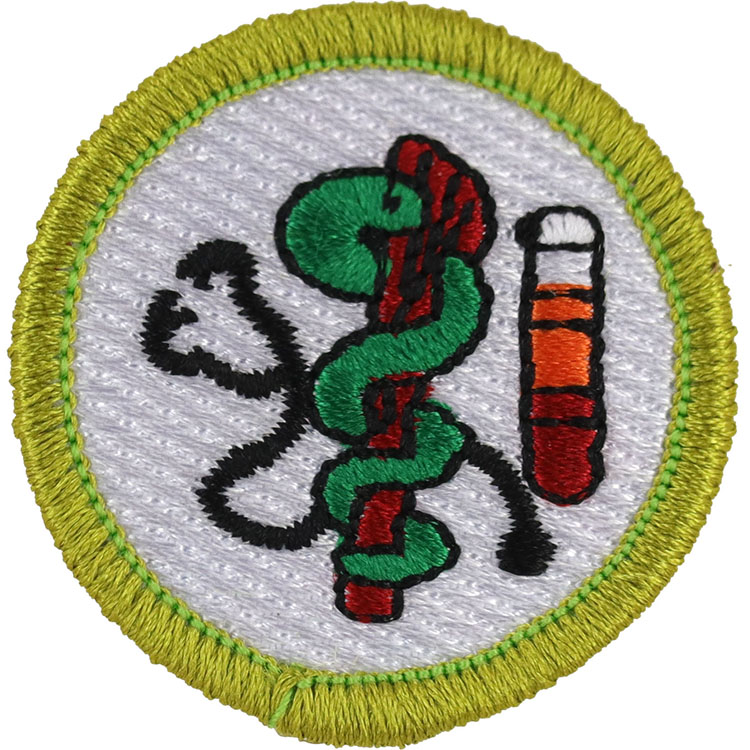
Fig. 1: Medici-L1-Front
- Embroidery: Rayon thread
- Border: Merrowed
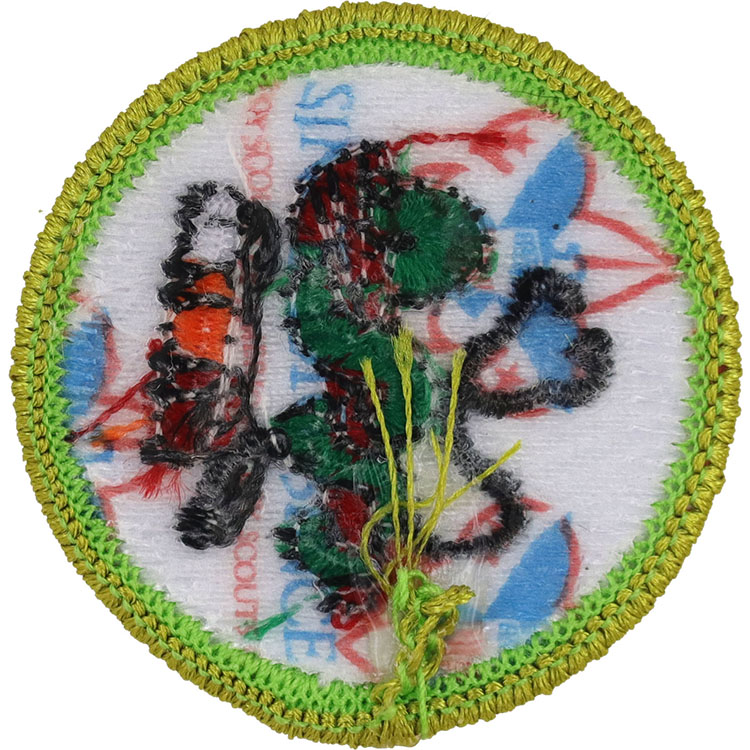
Fig. 2: Medici-L1-Reverse
- Back: Since 1910 imprint with large Tenderfoot image
Item Name: Medicine 2014 - Current
Item ID: Medici-L1
Collector Rating: 1
Pamphlets Used to Earn this Badge

Requirements January 2010 until Current
1. Discuss with your counselor the influence that EIGHT of the following people or events had on the history of medicine:
(a) Hippocrates
(b) William Harvey
(c) Antonie van Leeuwenhoek
(d) Edward Jenner
(e) Florence Nightingale
(f) Louis Pasteur
(g) Gregor Mendel
(h) Joseph Lister
(i) Robert Koch
(j) Daniel Hale Williams
(k) William Conrad Roentgen
(l) Marie and Pierre Curie
(m) Walter Reed
(n) Karl Landsteiner
(o) Alexander Fleming
(p) Charles Richard Drew
(q) Helen Raussig
(r) James Watson and Francis Crick
(s) Jonas Salk
2. Explain the Hippocratic Oath to your counselor, and compare the original version to a more modern one. Discuss to whom those subscribing to the original version of the oath owe the greatest allegiance.
3. Discuss the health-care provider-patient relationship with your counselor, and the importance of such a relationship in the delivery of quality care to the patient. Describe the role of confidentiality in this relationship.
4. Do the following:
(a) Describe the roles the following people play in the delivery of health care in your state. (Note: Not all may exist in your state.)
(1) Allopathic physician
(2) Chiropractor
(3) Emergency medical technician
(4) Licensed practical/vocational nurse
(5) Medical assistant
(6) Medical laboratory technologist
(7) Nurse-midwife
(8) Nurse practitioner
(9) Occupational therapist
(10) Optometrist
(11) Osteopathic physican
(12) Pharmacist
(13) Physical therapist
(14) Physician’s assistant
(15) Podiatrist
(16) Psychologist
(17) Radiologic technologist
(18) Registered nurse
(19) Respiratory therapist
(b) Describe the educational and licensing requirements for FIVE of those in 4(a)_-other than 4(a)(1)_-practicing health care in your state.
5.(a) Tell what is meant by the term "primary care" with regard to a medical specialty. Briefly describe the types of work done by physicians in the following "core" specialties:
(1) Internal medicine*
(2) Family practice*
(3) Obstetrics/gynecology*
(4) Pediatrics*
(5) Psychiatry
(6) Surgery
(b) Describe the additional educational requirements for those specialties.
6.(a) Briefly describe the types of work performed by physicians in FIVE of the following specialties or subspecialties:
(1) Allergy/immunology
(2) Anesthesiology
(3) Cardiology
(4) Colon and rectal surgery
(5) Dermatology
(6) Emergency medicine
(7) Endocrinology
(8) Gastroenterology
(9) Geriatric medicine
(10) Hematology/oncology
(11) Infectious disease
(12) Nephrology
(13) Neuro surgery
(14) Neurology
(15) Nuclear medicine
(16) Ophthalmology
(17) Orthopedic surgery
(18) Otolaryngology/head and neck surgery
(19) Pathology
(20) Physical medicine and rehabilitation medicine
(21) Plastic, reconstructive, and maxillofacial surgery
(22) Preventive medicine
(23) Radiology
(24) Rheumatology
(25) Thoracic/cardiothoracic surgery
(26) Urology
(27) Vascular surgery
(b) Describe the additional educational requirements for the FIVE specialties or subspecialties you chose in 6(a).
7. (a) Visit a physician's office†, preferably one who delivers "primary care." (This may be that of your counselor.) Discuss the components of a medical history and physical examination (an official BSA health form may be used to guide this discussion), and become familiar with the instruments used.
(b) Describe the characteristics of a good diagnostic test to screen for disease (e.g., routing blood pressure measurement). Explain briefly why diagnostic tests are not perfect.
(c) Show how to take a blood pressure and a pulse reading.
8. Do the following:
(a) Discuss the roles medical societies, employers, the insurance industry, and the government play in influencing the practice of medicine in the United States.
(b) Briefly tell how your state monitors the quality of health care within its borders, and how it provides care to those who do not have health insurance.
9. Discuss with your counselor the health-care delivery systems in the United States, Sweden, and China.
10. Serve as a volunteer at a health-related event or facility in your community (e.g., blood drive, "health fair," blood pressure screening, etc.) approved by your counselor.
* "Primary care specialties
† If this cannot be arranged, demonstrate to your counselor that you understand the components of a medical history and physical, and discuss the instruments involved.