-
Merit Badges
- Legend to identify Merit Badges
- 1910 British Merit Badges
- Square 1911 - 33
- Wide Crimped 1934 & 35
-
Narrow Tan Crimped 1936 - 42
- Tan Heavyweight Cloth with Silk Embroidery and Printed Back 1936 - 37
- Tan Heavyweight Cloth with Silk Embroidery and Plain Back 1937 - 38
- Tan Lightweight Cloth with Silk Embroidery and Plain Back 1938 - 39
- Tan Lightweight Cloth with Cotton Continuous Loop Embroidery and Plain Back 1939 - 42
- Tan Lightweight Cloth with Cotton Lockstitch Embroidery and Plain Back 1939 - 42
- Blue Background 1942 - 46
- Wartime 1942 - 46
- Khaki Narrow Crimped 1946 - 59
- Green Twill Gauze Back 1960 - 68
- Fully Embroidered Merrowed Edge 1960 - 72
- Unprinted Plastic Back 1972 - 01
- Printed Plastic Back 2002 - Current
-
Merit Badge Paper
- Merit Badge Applications
- Merit Badge Cards
-
Merit Badge Pamphlets
- Type 1 White Cover - Rectangle Drawing On Cover
- Type 2 White Cover 5-375" x 8" Title at Top
- Type 3A Tan Cover - 200 Fifth Avenue
- Type 3B Tan Cover - 2 line address New York City
- Type 3C Tan Cover - 2 line address New York N.Y.
- Type 3D Tan Cover - 1 line address New York N.Y.
- Type 4 Standing Scout Cover
- Type 5A War Cover
- Type 5B Red and White
- Type 6 Photo-Red Cover
- Type 7 Full Photo Cover or Bulls-eye Cover
- Type 8 Full Photo - Green Stripe Cover
- Type 9 Full Photo - Red Stripe Cover
- Type 10A Blue Stripe - Logo above bottom blue stripe - FDL centered
- Type 10B - Blue Stripe in bottom of photo area. FDL to left of text
- Special Covers
- Boy Craft Helps
- Merit Badge Counselor's Guides
-
Youth Position
- Junior Assistant Scoutmaster
- Senior Patrol Leader
- Assistant Senior Patrol Leader
- Patrol Leader
- Assistant Patrol Leader
- Troop Guide
- Scribe
- Quartermaster
- Instructor
- Chaplain Aide
- Den Chief
- Librarian
- Musician
- Webmaster
- Bugler
- Troop Historian
- Troop Representative
- Unit Representative
- Leadership Corps
- Honor Guard
- Leave No Trace Trainer
- Outdoor Ethics Guide
-
Patrol Medallions
- Patrol Medallions Introduction
- Legend to identify Patrol Medallions
- Patrol Shoulder Knot-Ribbons
- Felt Handmade Patrol Medallions
- Square Felt Patrol Medallions
- Round Broadcloth Patrol Medallions
- Red Twill Patrol Medallions
- Multi-Color Cloth Patrol Medallions
- Tan Cloth Patrol Medallions
- Patrol Medallion Back Patches
- Woodbadge Patrol Medallion

Fig. 1: MetEng-H4-Front
- Embroidery: Cotton thread, dull sheen
- Border: Lt green merrowed

Fig. 2: MetEng-H4-Reverse
- Back: Lt green lock stitch, molded plastic
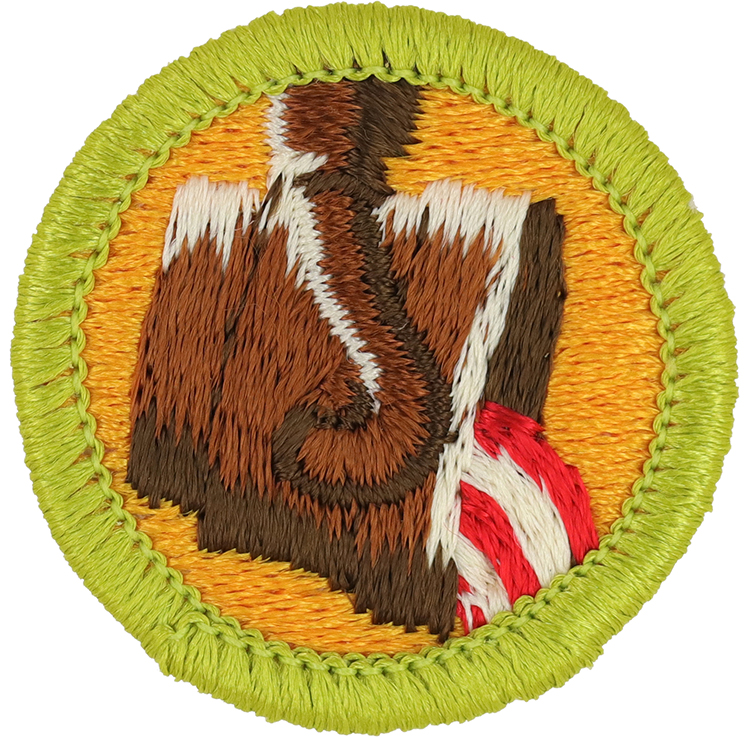
Fig. 3: MetEng-H4-mve1-front
- Minor variation: Yellow border
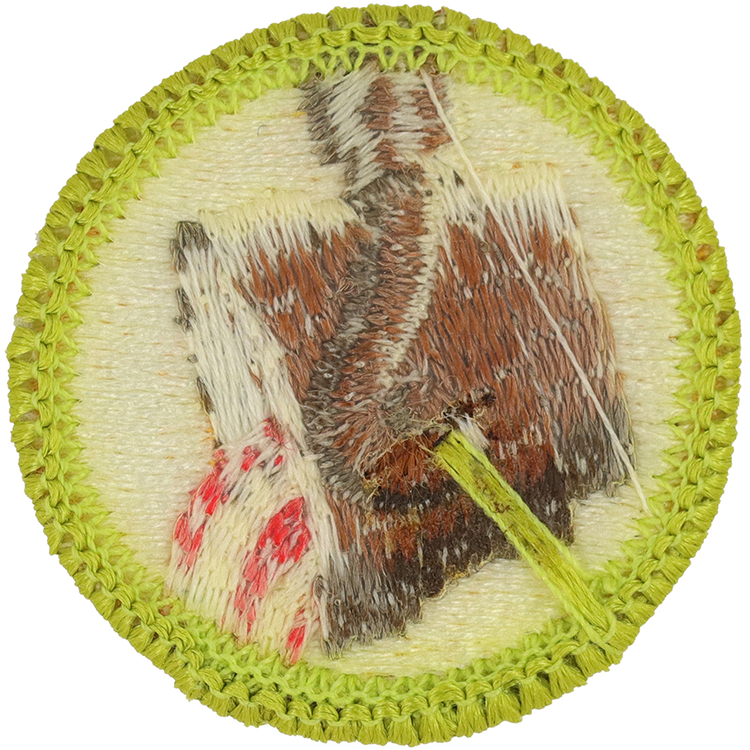
Fig. 4: MetEng-H4-mve1-reverse
- Minor variation: Lt green lock stitch, molded plastic
Item Name: Metals Engineering 1978 - 1990
Item ID: MetEng-H4
Collector Rating: 1
Pamphlets Used to Earn this Badge
Requirements June 1972 until January 1995
1. Do the following:
(a) Name three metals found by early man. Tell how they were probably discovered. Tell how they were used.
(b) Collect three rocks that contain a different recoverable metal in each. Show them. Tell how the metal in each might be recovered.
(c) Explain what a metal is. List from around your home examples of five different kinds of metals or their alloys.
2. Name four different fields of metallurgy. Describe what two of the fields include.
3. Pick three different industries which require metals and alloys having highly specialized properties. Tell how the properties of that metal made the industry possible.
4. Do ONE of the following:
(a) Show three of the following mechanical properties of metals: strength, elasticity, ductility, hardness, malleability. use a different material for each demonstration.
(b) Show strengthening of metals by cold working and by heat treatment.
5. Do any TWO of the following:
(a) Collect a sample of alloys from each of the following groups; tell what metals are part of each: carbon steel, stainless steel, cast iron, brass, solder, aluminum alloys, bronze, pewter. Describe the main properties of the alloys. Tell what property is most desirable for each.
(b) Compare the properties of common household materials such as plastics, porcelain, wood, and glass with the properties of metallic alloys like steel and brass.
(c) Explain what is meant by corrosion and protective coatings. Put in a glass of strong salt water four pieces of steel, three of which have been protected from corrosion by: (1) galvanizing or coating with zinc, (2) painting, (3) tin plating. Put a scratch that cuts through the coating on each. After a few days write a brief report on what took place and why.
(d) Pick a metal article commonly used around the home. Find out what metal or alloy is used in making it. Tell the main steps in making it.