-
Merit Badges
- Legend to identify Merit Badges
- 1910 British Merit Badges
- Square 1911 - 33
- Wide Crimped 1934 & 35
-
Narrow Tan Crimped 1936 - 42
- Tan Heavyweight Cloth with Silk Embroidery and Printed Back 1936 - 37
- Tan Heavyweight Cloth with Silk Embroidery and Plain Back 1937 - 38
- Tan Lightweight Cloth with Silk Embroidery and Plain Back 1938 - 39
- Tan Lightweight Cloth with Cotton Continuous Loop Embroidery and Plain Back 1939 - 42
- Tan Lightweight Cloth with Cotton Lockstitch Embroidery and Plain Back 1939 - 42
- Blue Background 1942 - 46
- Wartime 1942 - 46
- Khaki Narrow Crimped 1946 - 59
- Green Twill Gauze Back 1960 - 68
- Fully Embroidered Merrowed Edge 1960 - 72
- Unprinted Plastic Back 1972 - 01
- Printed Plastic Back 2002 - Current
-
Merit Badge Paper
- Merit Badge Applications
- Merit Badge Cards
-
Merit Badge Pamphlets
- Type 1 White Cover - Rectangle Drawing On Cover
- Type 2 White Cover 5-375" x 8" Title at Top
- Type 3A Tan Cover - 200 Fifth Avenue
- Type 3B Tan Cover - 2 line address New York City
- Type 3C Tan Cover - 2 line address New York N.Y.
- Type 3D Tan Cover - 1 line address New York N.Y.
- Type 4 Standing Scout Cover
- Type 5A War Cover
- Type 5B Red and White
- Type 6 Photo-Red Cover
- Type 7 Full Photo Cover or Bulls-eye Cover
- Type 8 Full Photo - Green Stripe Cover
- Type 9 Full Photo - Red Stripe Cover
- Type 10A Blue Stripe - Logo above bottom blue stripe - FDL centered
- Type 10B - Blue Stripe in bottom of photo area. FDL to left of text
- Special Covers
- Boy Craft Helps
- Merit Badge Counselor's Guides
-
Youth Position
- Junior Assistant Scoutmaster
- Senior Patrol Leader
- Assistant Senior Patrol Leader
- Patrol Leader
- Assistant Patrol Leader
- Troop Guide
- Scribe
- Quartermaster
- Instructor
- Chaplain Aide
- Den Chief
- Librarian
- Musician
- Webmaster
- Bugler
- Troop Historian
- Troop Representative
- Unit Representative
- Leadership Corps
- Honor Guard
- Leave No Trace Trainer
- Outdoor Ethics Guide
-
Patrol Medallions
- Patrol Medallions Introduction
- Legend to identify Patrol Medallions
- Patrol Shoulder Knot-Ribbons
- Felt Handmade Patrol Medallions
- Square Felt Patrol Medallions
- Round Broadcloth Patrol Medallions
- Red Twill Patrol Medallions
- Multi-Color Cloth Patrol Medallions
- Tan Cloth Patrol Medallions
- Patrol Medallion Back Patches
- Woodbadge Patrol Medallion
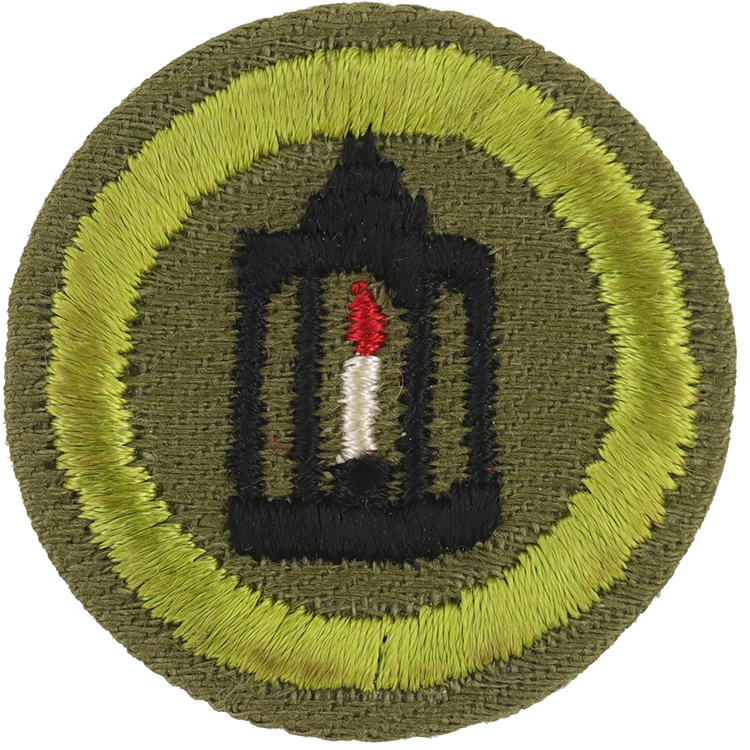
Fig. 1: MetWor-E2-Front
- Cloth: Khaki right twill
- Embroidery: Cotton lock stitch
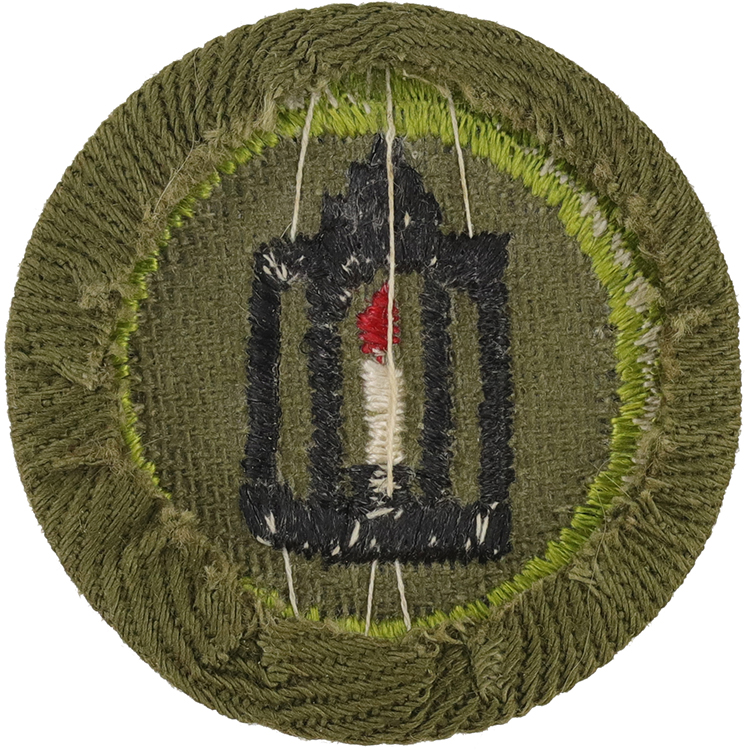
Fig. 2: MetWor-E2-Reverse
- Back: Plain NO imprint with starch
Item Name: Metal Work 1947 - 1952
Item ID: MetWor-E2
Collector Rating: 1
Pamphlets Used to Earn this Badge

Requirements January 1928 until January 1952
1. Design and make some simple object in which the operation of soldering is employed: such as box corners, a desk set, candlestick, ink-well.
2. Design and make some simple object in which the operation is riveting is employed: such as a candlestick, candle shade, Paul Revere lantern, stationery holder.
3. Design and make some simple object in which the operation of sawing or piercing is employed: such as a watch-fob, escutcheon plate, hinges, candle shade.
4. Design and shape some simple object by heating metal: such as a tray, bowl, spoon, ink-well.
Metalwork combines Blacksmithing, Foundry Practice & Metal Work
Requirements January 1952 until November 1969
1. (a) Collect and label samples of ten metals or alloys and describe the source, chief qualities, and most important uses of each. (b) Learn how ores are mined and how the metals are extracted, reduced, and refined. (c) Explain how metals are shaped for shipment to industry.
2. Make three useful articles from tin cans.
3. (a) Make one or more simple articles of metal in which you use at least six of the following operations: annealing, bending, casting, coloring, cutting, drilling, filing, grinding, hammering, pickling, piercing, planishing, polishing, riveting, sawing, soldering, stamping, welding. (b) Take proper care of the tools used. (c) Keep a record of time and costs involved.
4. Do any two of the following projects:
(a) Forge a chain hook ring, and at least three links of round iron or soft steel; join the parts by welding.
(b) Make a cold chisel of at least 5/8-inch hexagonal tool steel; harden and temper.
(c) From a working drawing, make a pattern of a small machine part. Make a satisfactory benchwork mold from this pattern using any convenient flask. Make proper allowances for draft and machining. Pour the metal; remove and clean the casting. Submit drawing, pattern, and casting to counselor.
(d) Make or repair three metal toys (or metal parts of toys) and, after submitting them to your counselor, contribute them to needy children.
(e) Visit a metalcraft, forge, foundry, machine, or similar shop, or a mill. Observe and report on its operations from beginning to end. Note what safety precautions are taken to protect the workers.
(f) Operate one piece of metal machining equipment (such as lathe, planer, or drill press), carefully practicing all safety precautions.
(g) Find out what lifework opportunities there are in the metal trades. Choose one specific job in which you are interested and report on the qualifications you must have for the job and what the working conditions are.