-
Merit Badges
- Legend to identify Merit Badges
- 1910 British Merit Badges
- Square 1911 - 33
- Wide Crimped 1934 & 35
-
Narrow Tan Crimped 1936 - 42
- Tan Heavyweight Cloth with Silk Embroidery and Printed Back 1936 - 37
- Tan Heavyweight Cloth with Silk Embroidery and Plain Back 1937 - 38
- Tan Lightweight Cloth with Silk Embroidery and Plain Back 1938 - 39
- Tan Lightweight Cloth with Cotton Continuous Loop Embroidery and Plain Back 1939 - 42
- Tan Lightweight Cloth with Cotton Lockstitch Embroidery and Plain Back 1939 - 42
- Blue Background 1942 - 46
- Wartime 1942 - 46
- Khaki Narrow Crimped 1946 - 59
- Green Twill Gauze Back 1960 - 68
- Fully Embroidered Merrowed Edge 1960 - 72
- Unprinted Plastic Back 1972 - 01
- Printed Plastic Back 2002 - Current
-
Merit Badge Paper
- Merit Badge Applications
- Merit Badge Cards
-
Merit Badge Pamphlets
- Type 1 White Cover - Rectangle Drawing On Cover
- Type 2 White Cover 5-375" x 8" Title at Top
- Type 3A Tan Cover - 200 Fifth Avenue
- Type 3B Tan Cover - 2 line address New York City
- Type 3C Tan Cover - 2 line address New York N.Y.
- Type 3D Tan Cover - 1 line address New York N.Y.
- Type 4 Standing Scout Cover
- Type 5A War Cover
- Type 5B Red and White
- Type 6 Photo-Red Cover
- Type 7 Full Photo Cover or Bulls-eye Cover
- Type 8 Full Photo - Green Stripe Cover
- Type 9 Full Photo - Red Stripe Cover
- Type 10A Blue Stripe - Logo above bottom blue stripe - FDL centered
- Type 10B - Blue Stripe in bottom of photo area. FDL to left of text
- Special Covers
- Boy Craft Helps
- Merit Badge Counselor's Guides
-
Youth Position
- Junior Assistant Scoutmaster
- Senior Patrol Leader
- Assistant Senior Patrol Leader
- Patrol Leader
- Assistant Patrol Leader
- Troop Guide
- Scribe
- Quartermaster
- Instructor
- Chaplain Aide
- Den Chief
- Librarian
- Musician
- Webmaster
- Bugler
- Troop Historian
- Troop Representative
- Unit Representative
- Leadership Corps
- Honor Guard
- Leave No Trace Trainer
- Outdoor Ethics Guide
-
Patrol Medallions
- Patrol Medallions Introduction
- Legend to identify Patrol Medallions
- Patrol Shoulder Knot-Ribbons
- Felt Handmade Patrol Medallions
- Square Felt Patrol Medallions
- Round Broadcloth Patrol Medallions
- Red Twill Patrol Medallions
- Multi-Color Cloth Patrol Medallions
- Tan Cloth Patrol Medallions
- Patrol Medallion Back Patches
- Woodbadge Patrol Medallion
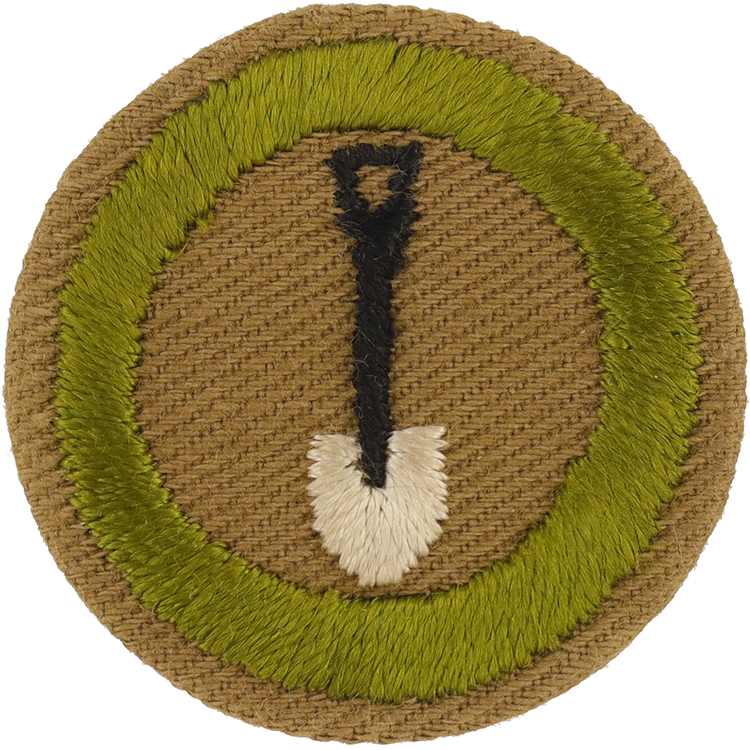
Fig. 1: Mining-C1-Front
- Cloth: Heavyweight tan right twill
- Embroidery: Continuous loop silk
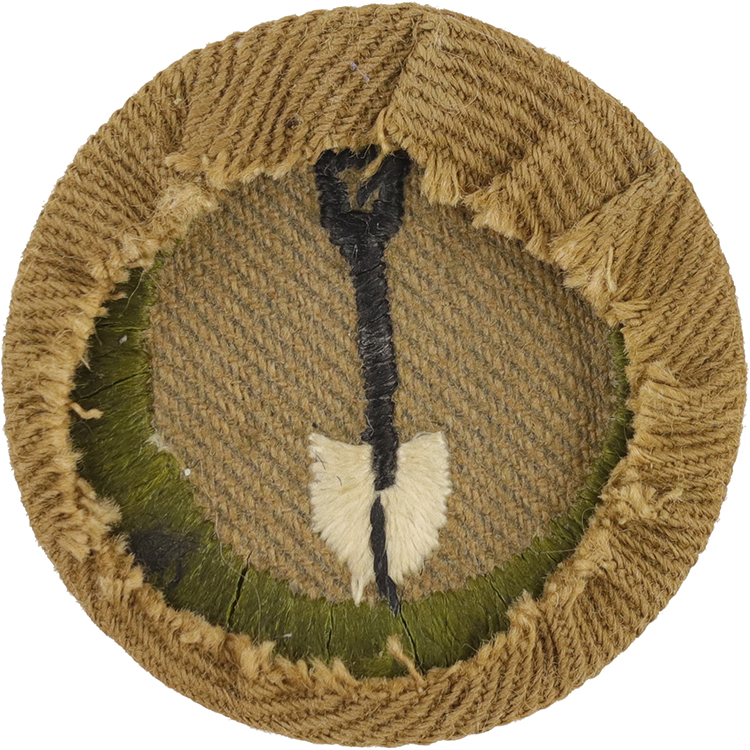
Fig. 2: Mining-C1-Reverse
- Back: Black imprint with starch
Item Name: Mining 1936 - 1937
Item ID: Mining-C1
Collector Rating: 1
Pamphlets Used to Earn this Badge
Requirements January 1930 until September 7, 1937. Between September 7, 1937 and January 1, 1938 these requirements were optional
Requirements January 1930 until September 7, 1937, between September 7, 1937 and January 1, 1938 these requirements were optional

1. Make a collection of twenty-five minerals, labelled and prepared for display.
2. Explain what he means by a mineral. What tests he applies in identifying a new specimen when it is given him.
3. Describe the following: noting under the ores what metal each contains, and recording where and how he obtained his specimen.
Ores--12 specimens in all: Limonite or brown iron ore, Hematite either red or specular, and magnetite. Copper ores, pyrites or iron sulphide or fools' gold. Galena--lead ores, zinc ores.
Rock makers--Produce and label 3 of each:--quartz, calcite, feldspar, mica, hornblende.
4. Rock formations: Tell what the following are:
(Igneous): Granite, basalt:
(Sedimentary): Sandstone, conglomerate, limestone:
(Metamorphic): Slate, marble, gneiss.
5. Explain the following: What is a dike? What is a bed, a stratum? What is an anticlinal fold: a synclinal fold? What is a fault, how many common kinds?
6. Explain the following: What is a placer deposit? What metals do we obtain from placers? How are they mined? Why are these particular minerals found in placers?
7. Explain how rock or ore is mined on surface.
8. Explain how and when we mine coal by stripping; how and when by underground working; what is meant by an entry, a chamber, an air-course; "robbing pillars"; the room and pillar system of coal mining; the "Long-wall system of mining."
9. Tell what other ores are mined in beds and how these are mined.
10. Explain how we locate petroleum and natural gas pools, and how we obtain the oil and gas.
11. Tell what we mean by "milling," "ore-dressing" or "concentration," and why we practice it. Give an example.
12. Make a test of three kinds of ore and three rocks.
13. Describe the principal machinery used in a quarry or in a mine.
14. Give five rules of safety in and around mines.
15. Make up two lists of all the mineral substances that are used in and around his home. In the first list, he must put those that are permanently useful, like silverware, and in the second list, those that are destroyed in use, like coal