-
Merit Badges
- Legend to identify Merit Badges
- 1910 British Merit Badges
- Square 1911 - 33
- Wide Crimped 1934 & 35
-
Narrow Tan Crimped 1936 - 42
- Tan Heavyweight Cloth with Silk Embroidery and Printed Back 1936 - 37
- Tan Heavyweight Cloth with Silk Embroidery and Plain Back 1937 - 38
- Tan Lightweight Cloth with Silk Embroidery and Plain Back 1938 - 39
- Tan Lightweight Cloth with Cotton Continuous Loop Embroidery and Plain Back 1939 - 42
- Tan Lightweight Cloth with Cotton Lockstitch Embroidery and Plain Back 1939 - 42
- Blue Background 1942 - 46
- Wartime 1942 - 46
- Khaki Narrow Crimped 1946 - 59
- Green Twill Gauze Back 1960 - 68
- Fully Embroidered Merrowed Edge 1960 - 72
- Unprinted Plastic Back 1972 - 01
- Printed Plastic Back 2002 - Current
-
Merit Badge Paper
- Merit Badge Applications
- Merit Badge Cards
-
Merit Badge Pamphlets
- Type 1 White Cover - Rectangle Drawing On Cover
- Type 2 White Cover 5-375" x 8" Title at Top
- Type 3A Tan Cover - 200 Fifth Avenue
- Type 3B Tan Cover - 2 line address New York City
- Type 3C Tan Cover - 2 line address New York N.Y.
- Type 3D Tan Cover - 1 line address New York N.Y.
- Type 4 Standing Scout Cover
- Type 5A War Cover
- Type 5B Red and White
- Type 6 Photo-Red Cover
- Type 7 Full Photo Cover or Bulls-eye Cover
- Type 8 Full Photo - Green Stripe Cover
- Type 9 Full Photo - Red Stripe Cover
- Type 10A Blue Stripe - Logo above bottom blue stripe - FDL centered
- Type 10B - Blue Stripe in bottom of photo area. FDL to left of text
- Special Covers
- Boy Craft Helps
- Merit Badge Counselor's Guides
-
Youth Position
- Junior Assistant Scoutmaster
- Senior Patrol Leader
- Assistant Senior Patrol Leader
- Patrol Leader
- Assistant Patrol Leader
- Troop Guide
- Scribe
- Quartermaster
- Instructor
- Chaplain Aide
- Den Chief
- Librarian
- Musician
- Webmaster
- Bugler
- Troop Historian
- Troop Representative
- Unit Representative
- Leadership Corps
- Honor Guard
- Leave No Trace Trainer
- Outdoor Ethics Guide
-
Patrol Medallions
- Patrol Medallions Introduction
- Legend to identify Patrol Medallions
- Patrol Shoulder Knot-Ribbons
- Felt Handmade Patrol Medallions
- Square Felt Patrol Medallions
- Round Broadcloth Patrol Medallions
- Red Twill Patrol Medallions
- Multi-Color Cloth Patrol Medallions
- Tan Cloth Patrol Medallions
- Patrol Medallion Back Patches
- Woodbadge Patrol Medallion

Fig. 1: ModBui-K-Front
- Embroidery: Rayon thread
- Border: Merrowed
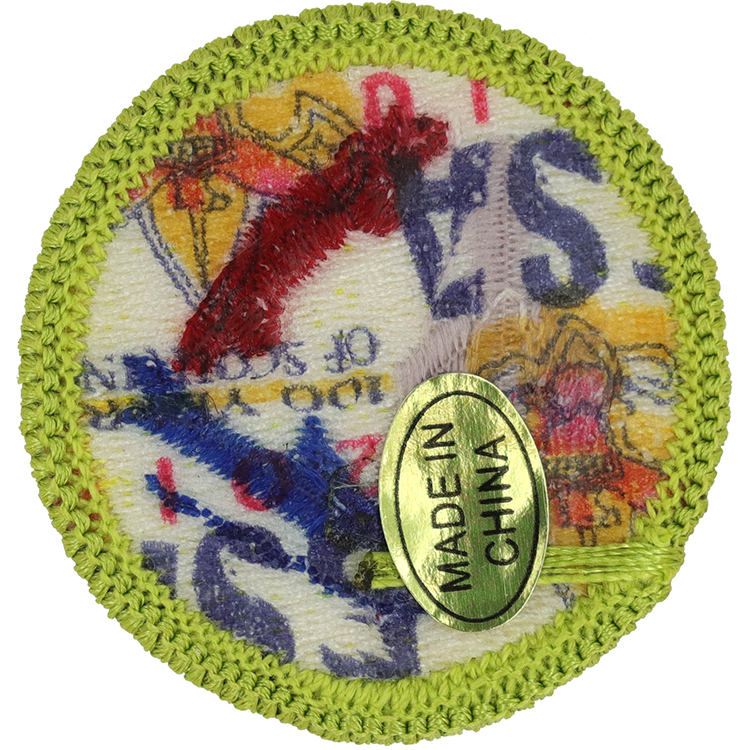
Fig. 2: ModBui-K-Reverse
- Back: 100th Anniversary imprint
Item Name: Model Design and Building 2010 - 2013
Item ID: ModBui-K
Collector Rating: 1
Pamphlets Used to Earn this Badge

August January 2004 until Current
1. Study and understand the requirements for personal safety when using such modelmaker hand tools as knives, vises,files, hammer, screwdriver, hand drills and drill bits, pliers, and portable power tools, and when to use proper protective equipment such as goggles when grinding or drilling. Know what precautions to take when using flammable or hazardous products such as glue, epoxy, paint, thinners. Discuss these with your counselor before you begin your modelmaking project and tell why they are important.
2. Explain the uses for each of the following types of models: architectural, structural, process, mechanical, and industrial. Do research into the different types of materials that could be used in making these models.
3. With your counselor's advice, select a subject from requirement 4 for your model project (no kits). Prepare the necessary plans to the proper scale. Make a list of materials and a list of the required tools. This model should be your own original work. Tell why you selected this subject.
4. Do one of the following:
(a) Make an architectural model. Build a model of a house you select to a scale of 1/4"-1'-0" (50:1 Metric). Discuss with your counselor the materials you intend to use, the amount of detail required, outside treatment (finish shrubbery, walks, etc.) and color selections. After completion of the model, present it to your counselor for approval.
(b) Build a structural model. Construct a model showing corner construction of a wood frame building to a scale of 1 1/2"=1'-0" (8:1 Metric). All structures shown must be to scale. Cardboard or flat sheet wood stock may be used for sheeting or flooring on the model. Review with your counselor the problems you encountered in gathering the materials and supporting the structure. Be able to name the parts of the floor and wall frames, such as intermediate girder, joist, bridging, subfloor, sill, sole plate, stud, and rafter.
(c) Make a process model. Build a model showing the plumbing system in your house. Show hot and cold water supply, all waste returns, and venting to a scale of 3/4"=1'-0" (15:1 Metric). Talk to your counselor about how to begin this model, present the scale and the materials you will use. After completion, present the model to your counselor and be prepared to discuss any problems you had building this model.
(d) Complete a mechanical model. Build a model of a mechanical device that uses at least two of the six simple machines. After completion of the model, present it to your counselor. Be prepared to discuss materials used, the machine's function and use, and any particular difficulty you may have encountered.
(e) Make an industrial model. Build a model of an actual passenger-carrying vehicle to a scale of 1"=1'-0" or 1/2"=1'-0" (10:1 or 25:1 Metric). Take the dimensions of the vehicle and record the important dimensions. Draw the top, front, rear, and sides of the vehicle to scale. From your plans, build a model of the vehicle and finish it in a craftsmanlike manner. Discuss with your counselor the most difficult part of completing this model.
5. Build a special-effects model of a fantasy spacecraft that might appear in a Hollywood science-fiction movie. Determine an appropriate scale for your design – one that makes practical sense. Include a cockpit or control area, living space, storage unit, engineering spaces, and propulsion systems. As you plan and build your model, do the following:
(a) Study aircraft, submarines, and naval ships for design ideas.
(b) Arrange and assemble the parts.
(c) Sketch your completed model.
(d) Write a short essay in which you discuss your design, scale, and materials choices. Describe how you engineered your model and discuss any difficulties you encountered and what you learned.
6. List at least six occupations in which modelmaking is used and discuss with your counselor some career opportunities in this field.