-
Merit Badges
- Legend to identify Merit Badges
- 1910 British Merit Badges
- Square 1911 - 33
- Wide Crimped 1934 & 35
-
Narrow Tan Crimped 1936 - 42
- Tan Heavyweight Cloth with Silk Embroidery and Printed Back 1936 - 37
- Tan Heavyweight Cloth with Silk Embroidery and Plain Back 1937 - 38
- Tan Lightweight Cloth with Silk Embroidery and Plain Back 1938 - 39
- Tan Lightweight Cloth with Cotton Continuous Loop Embroidery and Plain Back 1939 - 42
- Tan Lightweight Cloth with Cotton Lockstitch Embroidery and Plain Back 1939 - 42
- Blue Background 1942 - 46
- Wartime 1942 - 46
- Khaki Narrow Crimped 1946 - 59
- Green Twill Gauze Back 1960 - 68
- Fully Embroidered Merrowed Edge 1960 - 72
- Unprinted Plastic Back 1972 - 01
- Printed Plastic Back 2002 - Current
-
Merit Badge Paper
- Merit Badge Applications
- Merit Badge Cards
-
Merit Badge Pamphlets
- Type 1 White Cover - Rectangle Drawing On Cover
- Type 2 White Cover 5-375" x 8" Title at Top
- Type 3A Tan Cover - 200 Fifth Avenue
- Type 3B Tan Cover - 2 line address New York City
- Type 3C Tan Cover - 2 line address New York N.Y.
- Type 3D Tan Cover - 1 line address New York N.Y.
- Type 4 Standing Scout Cover
- Type 5A War Cover
- Type 5B Red and White
- Type 6 Photo-Red Cover
- Type 7 Full Photo Cover or Bulls-eye Cover
- Type 8 Full Photo - Green Stripe Cover
- Type 9 Full Photo - Red Stripe Cover
- Type 10A Blue Stripe - Logo above bottom blue stripe - FDL centered
- Type 10B - Blue Stripe in bottom of photo area. FDL to left of text
- Special Covers
- Boy Craft Helps
- Merit Badge Counselor's Guides
-
Youth Position
- Junior Assistant Scoutmaster
- Senior Patrol Leader
- Assistant Senior Patrol Leader
- Patrol Leader
- Assistant Patrol Leader
- Troop Guide
- Scribe
- Quartermaster
- Instructor
- Chaplain Aide
- Den Chief
- Librarian
- Musician
- Webmaster
- Bugler
- Troop Historian
- Troop Representative
- Unit Representative
- Leadership Corps
- Honor Guard
- Leave No Trace Trainer
- Outdoor Ethics Guide
-
Patrol Medallions
- Patrol Medallions Introduction
- Legend to identify Patrol Medallions
- Patrol Shoulder Knot-Ribbons
- Felt Handmade Patrol Medallions
- Square Felt Patrol Medallions
- Round Broadcloth Patrol Medallions
- Red Twill Patrol Medallions
- Multi-Color Cloth Patrol Medallions
- Tan Cloth Patrol Medallions
- Patrol Medallion Back Patches
- Woodbadge Patrol Medallion
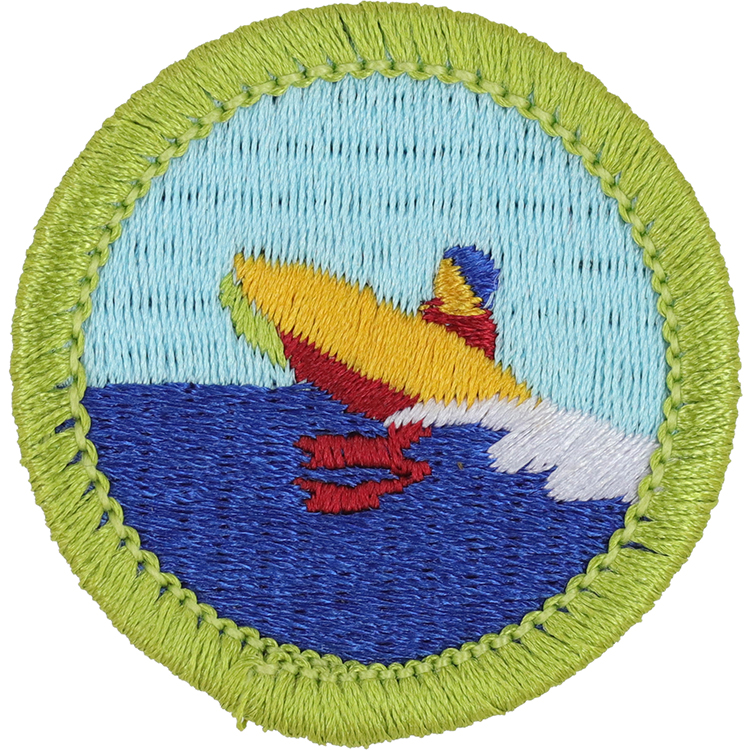
Fig. 1: Motorb-L1-Front
- Embroidery: Rayon thread
- Border: Merrowed
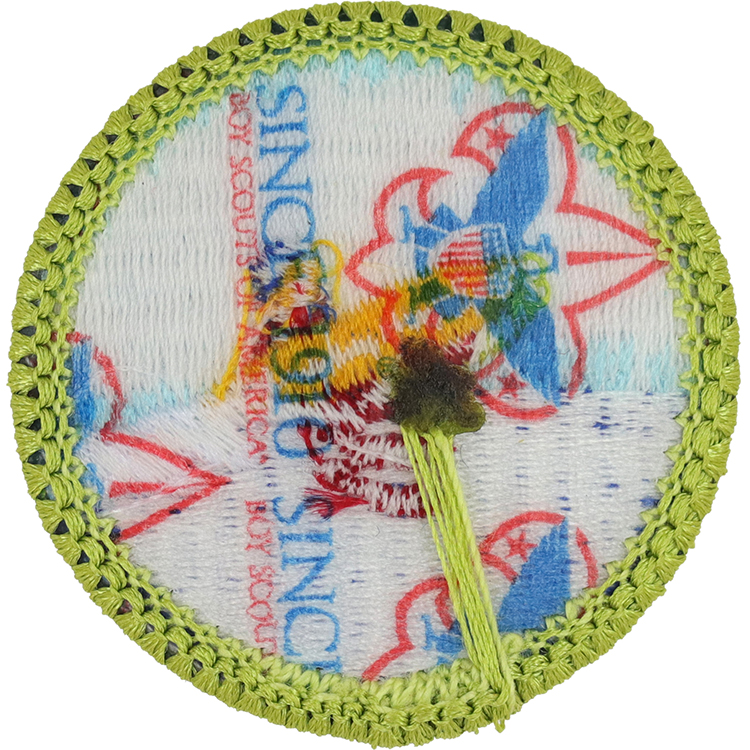
Fig. 2: Motorb-L1-Reverse
"
- Back: Since 1910 imprint with large Tenderfoot image
Item Name: Motorboating 2014 - Current
Item ID: Motorb-L1
Collector Rating: 1
Pamphlets Used to Earn this Badge

Requirements January 2012 until Current
1. Do the following:
- Explain to your counselor the most likely hazards you may encounter while motorboating, and what you should do to anticipate, help prevent, mitigate, and respond to these hazards.
- Explain first aid for injuries or illnesses that could occur while motorboating, including hypothermia, heat reactions, dehydration, motion sickness, insect stings, tick bites, and blisters.
- Identify the conditions that must exist before performing CPR on a person, and explain how such conditions are recognized. Demonstrate proper technique for performing CPR using a training device approved by your counselor.
2. Do the following:
- Before doing requirements 3 through 6, successfully complete the BSA swimmer test.*
- Name the different types of personal flotation devices (PFDs), and explain when each type should be used. Show how to choose and properly fit a PFD.
3. Do the following:
- Explain inboard, L board, and inboard/outboard motors, and the uses and advantages of each. Discuss the special features of a bass boat and a ski boat.
- Explain the safety procedures and precautions involving handling fuel and engine servicing, and equipment storage and placement.
- Explain how to winterize a boat motor and tell why this procedure is necessary.
- Explain the safety procedures and precautions involving swimmers and skiers in the water, passenger positions under way, and boat wakes.
4. Show you know safety laws for motorboating by doing the following:
- Have a permit to run a motorboat, if needed.
- Explain the rules or laws that apply to recreational boating in your area or state.
- Discuss how the hazards of weather and heavy water conditions can affect both safety and performance in motorboating.
- Promise that you will follow the BSA Safety Afloat guidelines. Explain the meaning of each point.
- Discuss with your counselor the nautical rules of the road and describe the national and your state’s aids to navigation.
- Explain and show the correct use of equipment required by both state and federal regulations to be carried aboard a motorboat.
- Explain federal and state rules for a ventilation system, and tell why these rules are required.
5. Demonstrate proper boat handling procedures and skills by doing the following:
- Board and assist others in boarding.
- Fuel the boat and complete a safety check.
- Get under way from dockside or from a beach launch.
- Run a course for at least a mile, showing procedures for overtaking and passing slower craft, yielding right-of-way, passing oncoming traffic, making turns, reversing direction, and using navigation aids.
*See the swimming merit badge requirements for details about the BSA swimmer test.