-
Merit Badges
- Legend to identify Merit Badges
- 1910 British Merit Badges
- Square 1911 - 33
- Wide Crimped 1934 & 35
-
Narrow Tan Crimped 1936 - 42
- Tan Heavyweight Cloth with Silk Embroidery and Printed Back 1936 - 37
- Tan Heavyweight Cloth with Silk Embroidery and Plain Back 1937 - 38
- Tan Lightweight Cloth with Silk Embroidery and Plain Back 1938 - 39
- Tan Lightweight Cloth with Cotton Continuous Loop Embroidery and Plain Back 1939 - 42
- Tan Lightweight Cloth with Cotton Lockstitch Embroidery and Plain Back 1939 - 42
- Blue Background 1942 - 46
- Wartime 1942 - 46
- Khaki Narrow Crimped 1946 - 59
- Green Twill Gauze Back 1960 - 68
- Fully Embroidered Merrowed Edge 1960 - 72
- Unprinted Plastic Back 1972 - 01
- Printed Plastic Back 2002 - Current
-
Merit Badge Paper
- Merit Badge Applications
- Merit Badge Cards
-
Merit Badge Pamphlets
- Type 1 White Cover - Rectangle Drawing On Cover
- Type 2 White Cover 5-375" x 8" Title at Top
- Type 3A Tan Cover - 200 Fifth Avenue
- Type 3B Tan Cover - 2 line address New York City
- Type 3C Tan Cover - 2 line address New York N.Y.
- Type 3D Tan Cover - 1 line address New York N.Y.
- Type 4 Standing Scout Cover
- Type 5A War Cover
- Type 5B Red and White
- Type 6 Photo-Red Cover
- Type 7 Full Photo Cover or Bulls-eye Cover
- Type 8 Full Photo - Green Stripe Cover
- Type 9 Full Photo - Red Stripe Cover
- Type 10A Blue Stripe - Logo above bottom blue stripe - FDL centered
- Type 10B - Blue Stripe in bottom of photo area. FDL to left of text
- Special Covers
- Boy Craft Helps
- Merit Badge Counselor's Guides
-
Youth Position
- Junior Assistant Scoutmaster
- Senior Patrol Leader
- Assistant Senior Patrol Leader
- Patrol Leader
- Assistant Patrol Leader
- Troop Guide
- Scribe
- Quartermaster
- Instructor
- Chaplain Aide
- Den Chief
- Librarian
- Musician
- Webmaster
- Bugler
- Troop Historian
- Troop Representative
- Unit Representative
- Leadership Corps
- Honor Guard
- Leave No Trace Trainer
- Outdoor Ethics Guide
-
Patrol Medallions
- Patrol Medallions Introduction
- Legend to identify Patrol Medallions
- Patrol Shoulder Knot-Ribbons
- Felt Handmade Patrol Medallions
- Square Felt Patrol Medallions
- Round Broadcloth Patrol Medallions
- Red Twill Patrol Medallions
- Multi-Color Cloth Patrol Medallions
- Tan Cloth Patrol Medallions
- Patrol Medallion Back Patches
- Woodbadge Patrol Medallion
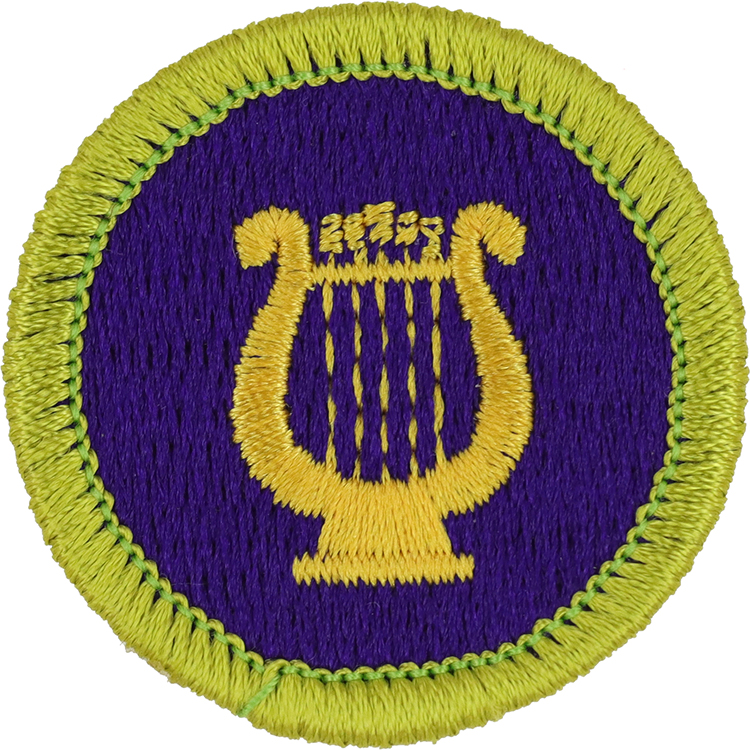
Fig. 1: Music-K-Front
- Embroidery: Rayon thread
- Border: Merrowed
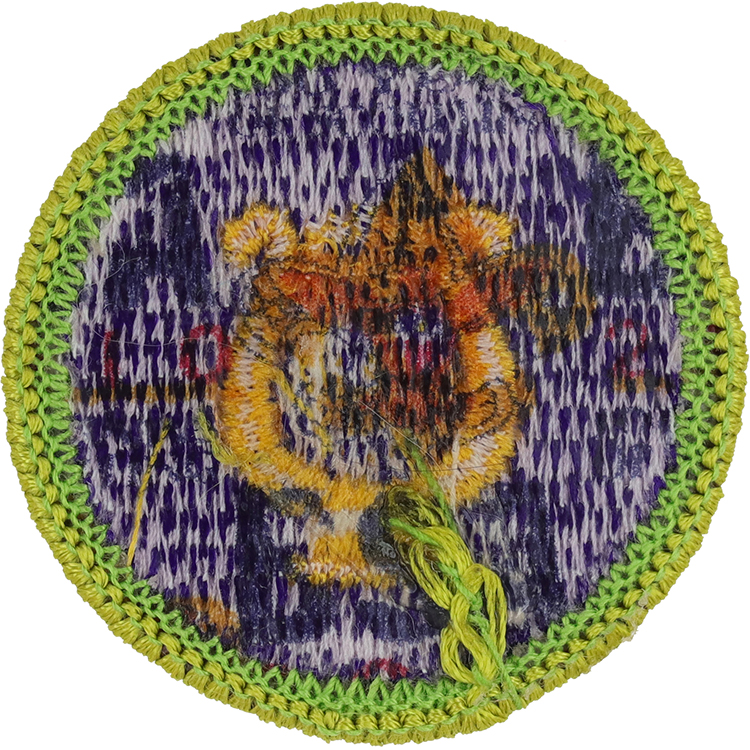
Fig. 2: Music-K-Reverse
- Back: 100th Anniversary imprint
Item Name: Music 2010 - 2013
Item ID: Music-K
Collector Rating: 1
Pamphlets Used to Earn this Badge

Requirements January 2004 until January 2012
1. Sing, or play a simple song or hymn chosen by your counselor, using good technique, phrasing, tone, rhythm, and dynamics. Read all the signs and terms of the score.
2. Name the five general groups of musical instruments. Create an illustration that shows how tones are generated and how instruments produce sound.
3. Do Two of the following:
(a) Attend a live performance, or listen to three hours of recordings from any two of the following musical styles: blues, jazz, classical, country, bluegrass, ethnic, gospel, musical theater, opera. Describe the sound of the music and the instruments used. Identify the composers or songwriters, the performers, and the titles of the pieces you heard. If it was a live performance, describe the setting and the reaction of the audience. Discuss your thoughts about the music.
(b) Interview your parents and grandparents about music. Find out what the most popular music was when they were your age. Find out what their favorite music is now, and listen to three of their favorite tunes with them. How do their favorites sound to you? Had you ever heard any of them? Play three of your favorite songs for them, and explain to them why you like these songs. Ask them what they think of your favorite music.
(c) Serve for six months as a member of a school band, choir, or other local musical group, or perform as a soloist in public six times.
(d) List five people who are important in the history of American music and explain to your counselor why they continue to be influential. Include at least one composer, one performer, one innovator, and one person born more than 100 years ago.
4. Do ONE of the following:
(a) Teach three songs to a group of people. Lead them in singing the songs, using proper hand motions.
(b) Compose and write the score for a piece of music of 12 measures or more.
(c) Make a traditional instrument and learn to play it.
(d) Catalog your own or your family’s collection of 12 or more compact discs, tapes, or records. Show how to handle and store them.
Requirements January 2012 until January 2017
1. Sing, or play a simple song or hymn chosen by your counselor, using good technique, phrasing, tone, rhythm, and dynamics. Read all the signs and terms of the score.
2. Name the five general groups of musical instruments. Create an illustration that shows how tones are generated and how instruments produce sound.
3. Do TWO of the following:
(a) Attend a live performance, or listen to three hours of recordings from any two of the following musical styles: blues, jazz, classical, country, bluegrass, ethnic, gospel, musical theater, opera. Describe the sound of the music and the instruments used. Identify the composers or songwriters, the performers, and the titles of the pieces you heard. If it was a live performance, describe the setting and the reaction of the audience. Discuss your thoughts about the music.
(b) Interview an adult member of your family about music. Find out what the most popular music was when he or she was your age. Find out what his or her favorite music is now, and listen to three of your relative’s favorite tunes with him or her. How do these favorites sound to you? Had you ever heard any of them? Play three of your favorite songs for your relative, and explain why you like these songs. Ask what he or she thinks of your favorite music.
(c) Serve for six months as a member of a school band, choir, or other organized musical group, or perform as a soloist in public six times.
(d) List five people who are important in the history of American music and explain to your counselor why they continue to be influential. Include at least one composer, one performer, one innovator, and one person born more than 100 years ago.
4. Do ONE of the following:
(a) Teach three songs to a group of people. Lead them in singing the songs, using proper hand motions.
(b) Compose and write the score for a piece of music of 12 measures or more, and play this music on an instrument.
(c) Make a traditional instrument and learn to play it.
(d) Catalog your own or your family’s collection of 12 or more compact discs, tapes, records, or other recorded music. Show how to handle and store them.