-
Merit Badges
- Legend to identify Merit Badges
- 1910 British Merit Badges
- Square 1911 - 33
- Wide Crimped 1934 & 35
-
Narrow Tan Crimped 1936 - 42
- Tan Heavyweight Cloth with Silk Embroidery and Printed Back 1936 - 37
- Tan Heavyweight Cloth with Silk Embroidery and Plain Back 1937 - 38
- Tan Lightweight Cloth with Silk Embroidery and Plain Back 1938 - 39
- Tan Lightweight Cloth with Cotton Continuous Loop Embroidery and Plain Back 1939 - 42
- Tan Lightweight Cloth with Cotton Lockstitch Embroidery and Plain Back 1939 - 42
- Blue Background 1942 - 46
- Wartime 1942 - 46
- Khaki Narrow Crimped 1946 - 59
- Green Twill Gauze Back 1960 - 68
- Fully Embroidered Merrowed Edge 1960 - 72
- Unprinted Plastic Back 1972 - 01
- Printed Plastic Back 2002 - Current
-
Merit Badge Paper
- Merit Badge Applications
- Merit Badge Cards
-
Merit Badge Pamphlets
- Type 1 White Cover - Rectangle Drawing On Cover
- Type 2 White Cover 5-375" x 8" Title at Top
- Type 3A Tan Cover - 200 Fifth Avenue
- Type 3B Tan Cover - 2 line address New York City
- Type 3C Tan Cover - 2 line address New York N.Y.
- Type 3D Tan Cover - 1 line address New York N.Y.
- Type 4 Standing Scout Cover
- Type 5A War Cover
- Type 5B Red and White
- Type 6 Photo-Red Cover
- Type 7 Full Photo Cover or Bulls-eye Cover
- Type 8 Full Photo - Green Stripe Cover
- Type 9 Full Photo - Red Stripe Cover
- Type 10A Blue Stripe - Logo above bottom blue stripe - FDL centered
- Type 10B - Blue Stripe in bottom of photo area. FDL to left of text
- Special Covers
- Boy Craft Helps
- Merit Badge Counselor's Guides
-
Youth Position
- Junior Assistant Scoutmaster
- Senior Patrol Leader
- Assistant Senior Patrol Leader
- Patrol Leader
- Assistant Patrol Leader
- Troop Guide
- Scribe
- Quartermaster
- Instructor
- Chaplain Aide
- Den Chief
- Librarian
- Musician
- Webmaster
- Bugler
- Troop Historian
- Troop Representative
- Unit Representative
- Leadership Corps
- Honor Guard
- Leave No Trace Trainer
- Outdoor Ethics Guide
-
Patrol Medallions
- Patrol Medallions Introduction
- Legend to identify Patrol Medallions
- Patrol Shoulder Knot-Ribbons
- Felt Handmade Patrol Medallions
- Square Felt Patrol Medallions
- Round Broadcloth Patrol Medallions
- Red Twill Patrol Medallions
- Multi-Color Cloth Patrol Medallions
- Tan Cloth Patrol Medallions
- Patrol Medallion Back Patches
- Woodbadge Patrol Medallion
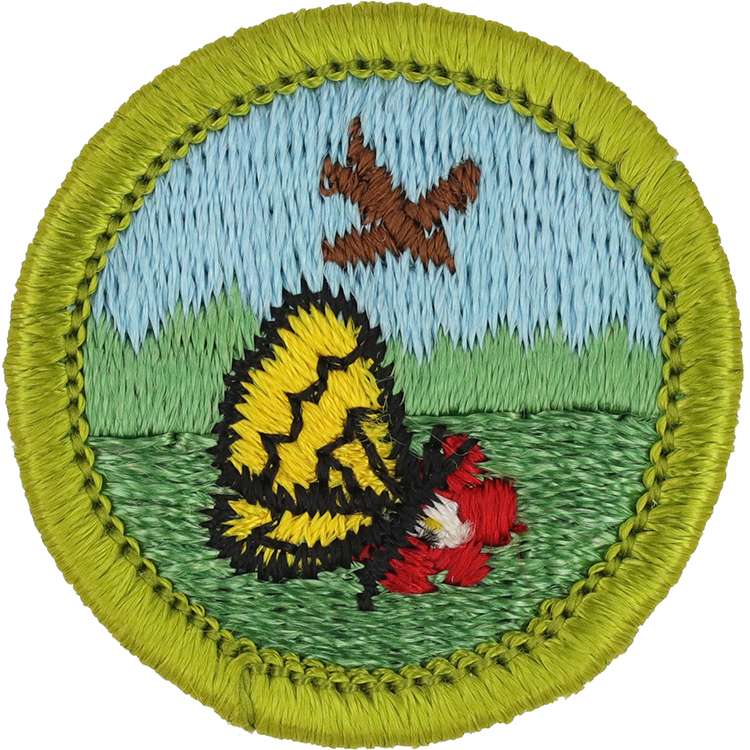
Fig. 1: Nature-H3-Front
- Embroidery: Cotton thread, dull sheen
- Border: Dk green merrowed
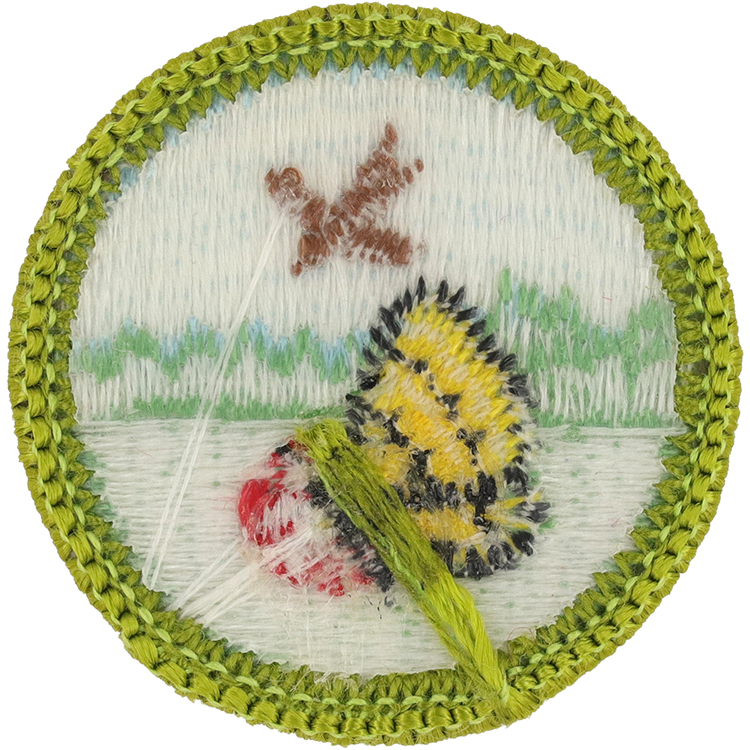
Fig. 2: Nature-H3-Reverse
- Back: Molded plastic
Item Name: Nature 1976 - 1978
Item ID: Nature-H3
Collector Rating: 1
Pamphlets Used to Earn this Badge
Requirements January 1975 until December 1977
1. Name three ways in which plants are important to animals.
2. Name three ways in which animals are important to plants.
3. Explain the term "food chain." Give an example of a four-step land food chain and a four-step water food chain.
4. Do all of the requirements in FIVE of the following fields:
Birds
(a) In the field, identify eight species of birds.
(b) Make and set out a birdhouse; OR a feeding station; OR a birdbath. List what birds used it during a period of 1 month.
Mammals
(a) In the field, identify three species of wild mammals.
(b) Make plaster casts of the tracks of a wild mammal.
Reptiles or Amphibians
(a) Show that you can recognize the poisonous snakes in your area. Identify in the field three species of reptiles or amphibians.
(b) Recognize one species of toad or frog by voice; OR identify one reptile or amphibian by eggs, den, burrow, or other signs.
Insects or Spiders
(a) Collect, mount, and label 10 species of insects or spiders.
(b) Hatch an insect from the pupa or cocoon; OR hatch adults from nymphs; OR keep larvae until they form pupae or cocoons; OR keep a colony of ants or bees through one season.
Fish
(a) Catch and identify two species of fish.
(b) Collect four kinds of animal food eaten by fish in the wild.
Mollusks and Crustaceans
(a) Identify five species of mollusks and crustaceans.
(b) Collect, mount, and label six shells.
Plants
(a) In the field, identify 15 species of wild plants.
(b) Collect and label seeds of six plants; OR the leaves of 12 plants.
Soils and Rocks
(a) Collect and identify soils found in different layers of a soil profile.
(b) Collect and identify five different types of rocks from your area.
5. Do ONE of the following:
(a) Raise tadpoles from eggs; OR raise adults from tadpoles; OR keep an adult reptile or amphibian so it stays healthy for 1 month.
(b) Develop a simple aquarium with fish and plant life. Keep it so they stay healthy for 1 month.
(c) Develop an aquarium. Keep in it two species of mollusks or crustaceans so they stay healthy for 1 month.
(d) Build a terrarium with three species of plants. Keep it so the plants stay healthy for 1 month.
(e) Grow seeds of 1 month in two kinds of soil. Describe difference in rate of growth.
Requirements December 1977 until January 2004
1. Name three ways in which plants are important to animals.
2. Name three ways in which animals are important to plants.
3. Explain the term "food chain." Give an example of a four-step land food chain and a four-step water food chain.
4. Do all of the requirements in FIVE of the following fields:
Birds
(a) In the field, identify eight species of birds.
(b) Make and set out a birdhouse; OR a feeding station; OR a birdbath. List what birds used it during a period of 1 month.
Mammals
(a) In the field, identify three species of wild mammals.
(b) Make plaster casts of the tracks of a wild mammal.
Reptiles or Amphibians
(a) Show that you can recognize the poisonous snakes in your area. Identify in the field three species of reptiles or amphibians.
(b) Recognize one species of toad or frog by voice; OR identify one reptile or amphibian by eggs, den, burrow, or other signs.
Insects or Spiders
(a) Collect, mount, and label 10 species of insects or spiders.
(b) Hatch an insect from the pupa or cocoon; OR hatch adults from nymphs; OR keep larvae until they form pupae or cocoons; OR keep a colony of ants or bees through one season.
Fish
(a) Catch and identify two species of fish.
(b) Collect four kinds of animal food eaten by fish in the wild.
Mollusks and Crustaceans
(a) Identify five species of mollusks and crustaceans.
(b) Collect, mount, and label six shells.
Plants
(a) In the field, identify 15 species of wild plants.
(b) Collect and label seeds of six plants; OR the leaves of 12 plants.
Soils and Rocks
(a) Collect and identify soils found in different layers of a soil profile.
(b) Collect and identify five different types of rocks from your area.
5. Do ONE of the following:
(a) Raise tadpoles from eggs; OR raise adults from tadpoles; OR keep an adult reptile or amphibian so it stays healthy for 1 month.
(b) Develop a simple aquarium with fish and plant life. Keep it so they stay healthy for 1 month.
(c) Develop an aquarium. Keep in it two species of mollusks or crustaceans so they stay healthy for 1 month.
(d) Build a terrarium with three species of plants. Keep it so the plants stay healthy for 1 month.
(e) Grow seeds of 1 month in two kinds of soil. Describe difference in rate of growth.
Note: Under the Endangered Species Act of 1973, some plants and animals are or may be protected by federal law. The same ones and/or others may be protected by state law. Be sure that you do not collect protected species.