-
Merit Badges
- Legend to identify Merit Badges
- 1910 British Merit Badges
- Square 1911 - 33
- Wide Crimped 1934 & 35
-
Narrow Tan Crimped 1936 - 42
- Tan Heavyweight Cloth with Silk Embroidery and Printed Back 1936 - 37
- Tan Heavyweight Cloth with Silk Embroidery and Plain Back 1937 - 38
- Tan Lightweight Cloth with Silk Embroidery and Plain Back 1938 - 39
- Tan Lightweight Cloth with Cotton Continuous Loop Embroidery and Plain Back 1939 - 42
- Tan Lightweight Cloth with Cotton Lockstitch Embroidery and Plain Back 1939 - 42
- Blue Background 1942 - 46
- Wartime 1942 - 46
- Khaki Narrow Crimped 1946 - 59
- Green Twill Gauze Back 1960 - 68
- Fully Embroidered Merrowed Edge 1960 - 72
- Unprinted Plastic Back 1972 - 01
- Printed Plastic Back 2002 - Current
-
Merit Badge Paper
- Merit Badge Applications
- Merit Badge Cards
-
Merit Badge Pamphlets
- Type 1 White Cover - Rectangle Drawing On Cover
- Type 2 White Cover 5-375" x 8" Title at Top
- Type 3A Tan Cover - 200 Fifth Avenue
- Type 3B Tan Cover - 2 line address New York City
- Type 3C Tan Cover - 2 line address New York N.Y.
- Type 3D Tan Cover - 1 line address New York N.Y.
- Type 4 Standing Scout Cover
- Type 5A War Cover
- Type 5B Red and White
- Type 6 Photo-Red Cover
- Type 7 Full Photo Cover or Bulls-eye Cover
- Type 8 Full Photo - Green Stripe Cover
- Type 9 Full Photo - Red Stripe Cover
- Type 10A Blue Stripe - Logo above bottom blue stripe - FDL centered
- Type 10B - Blue Stripe in bottom of photo area. FDL to left of text
- Special Covers
- Boy Craft Helps
- Merit Badge Counselor's Guides
-
Youth Position
- Junior Assistant Scoutmaster
- Senior Patrol Leader
- Assistant Senior Patrol Leader
- Patrol Leader
- Assistant Patrol Leader
- Troop Guide
- Scribe
- Quartermaster
- Instructor
- Chaplain Aide
- Den Chief
- Librarian
- Musician
- Webmaster
- Bugler
- Troop Historian
- Troop Representative
- Unit Representative
- Leadership Corps
- Honor Guard
- Leave No Trace Trainer
- Outdoor Ethics Guide
-
Patrol Medallions
- Patrol Medallions Introduction
- Legend to identify Patrol Medallions
- Patrol Shoulder Knot-Ribbons
- Felt Handmade Patrol Medallions
- Square Felt Patrol Medallions
- Round Broadcloth Patrol Medallions
- Red Twill Patrol Medallions
- Multi-Color Cloth Patrol Medallions
- Tan Cloth Patrol Medallions
- Patrol Medallion Back Patches
- Woodbadge Patrol Medallion
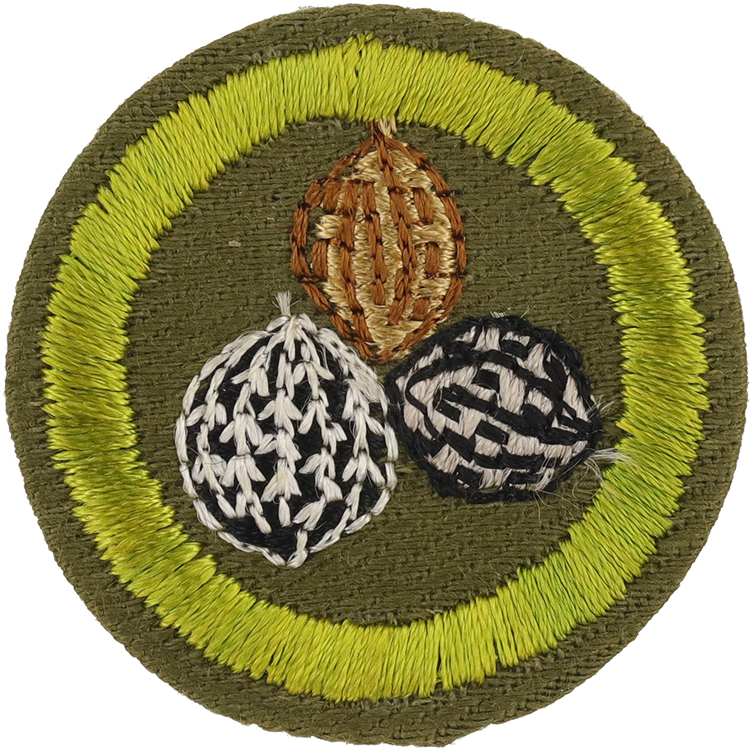
Fig. 1: NutCul-E2-Front
- Cloth: Khaki right twill
- Embroidery: Cotton lock stitch
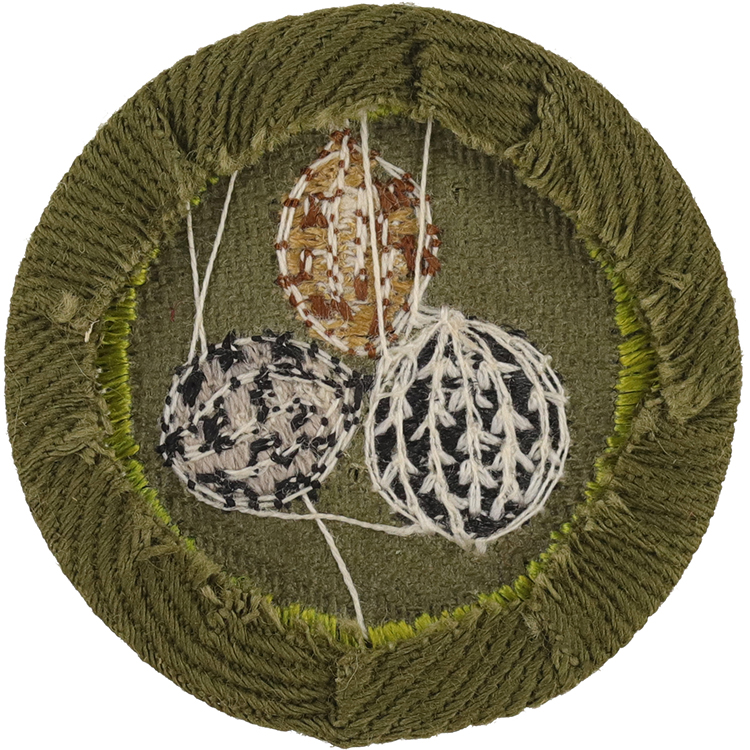
Fig. 2: NutCul-E2-Reverse
- Back: Plain NO imprint with starch
Item Name: Nut Culture 1947 - 1954
Item ID: NutCul-E2
Collector Rating: 1
Pamphlets Used to Earn this Badge

Requirements January 1928 until June 1953
1. Know the methods used in the propagation of at least four of the following nuts which involve the practices of budding, grafting, layering, and growth of seedlings: Pecan, Persian Walnut, Almond, Hazel, Black Walnut, Chestnut, Butternut, Hickory, Japanese Walnut.
2. Know the principles underlying the practice of grafting and the methods used in topworking nut trees.
3. Know the characteristics of the root systems of at least two kinds of nut trees in each of the following two groups:
Groups One
1. Hickory
2. Pecan
3. Black Walnut
4. Persian Walnut
Group Two
1. Butternut
2. Japanese Walnut
3. Hazel
4. Almond
4. Know the essential features of successful nut tree planting--i.e., the time of year for the region concerned, the necessary pruning at planting, etc., and the reasons for the practices involved.
5. Know the most injurious pests and diseases which affect the most important kinds of nut trees grown in his section of the country and the measures necessary for their control.
6. Know how properly to care for nut trees not grown in orchards. Or, if the Scout is in a region where nuts are grown commercially, know the methods of soil management practiced in successful commercial orchards.
7. Grow at least one kind of nut tree from seeds, the seedling to be used either as a stock for budding or grafting, or as a tree to be set out.
8. Either bud or graft a living tree successfully with some superior variety of nut so that the bud or graft lives at least one growing season.
9. Plant at least two nut trees which start growth and live for at least one growing season.
10. Practice the removal of limbs in pruning so as to be able to demonstrate the way to make cuts properly.
11. Take care of one or more black walnut or other trees during the summer, keeping them free from worms or other caterpillars that can be controlled without spraying apparatus. Or, if the Scout lives in a region where nut orchards are sprayed, keep an accurate record of the spraying method used in a commercial orchard, giving dates of spraying, materials used and pests and diseases the spray is intended to control.
12. Make a collection of eight kinds of nuts including several varieties of each kind. Or, if the Scout is in a section where nuts are commercially grown, make a collection of eight named varieties of the most important kind of nut for the region, and be able to identify the varieties. Gather specimens of nuts which represent parent tree and nut seed such as he would recommend for planting