-
Merit Badges
- Legend to identify Merit Badges
- 1910 British Merit Badges
- Square 1911 - 33
- Wide Crimped 1934 & 35
-
Narrow Tan Crimped 1936 - 42
- Tan Heavyweight Cloth with Silk Embroidery and Printed Back 1936 - 37
- Tan Heavyweight Cloth with Silk Embroidery and Plain Back 1937 - 38
- Tan Lightweight Cloth with Silk Embroidery and Plain Back 1938 - 39
- Tan Lightweight Cloth with Cotton Continuous Loop Embroidery and Plain Back 1939 - 42
- Tan Lightweight Cloth with Cotton Lockstitch Embroidery and Plain Back 1939 - 42
- Blue Background 1942 - 46
- Wartime 1942 - 46
- Khaki Narrow Crimped 1946 - 59
- Green Twill Gauze Back 1960 - 68
- Fully Embroidered Merrowed Edge 1960 - 72
- Unprinted Plastic Back 1972 - 01
- Printed Plastic Back 2002 - Current
-
Merit Badge Paper
- Merit Badge Applications
- Merit Badge Cards
-
Merit Badge Pamphlets
- Type 1 White Cover - Rectangle Drawing On Cover
- Type 2 White Cover 5-375" x 8" Title at Top
- Type 3A Tan Cover - 200 Fifth Avenue
- Type 3B Tan Cover - 2 line address New York City
- Type 3C Tan Cover - 2 line address New York N.Y.
- Type 3D Tan Cover - 1 line address New York N.Y.
- Type 4 Standing Scout Cover
- Type 5A War Cover
- Type 5B Red and White
- Type 6 Photo-Red Cover
- Type 7 Full Photo Cover or Bulls-eye Cover
- Type 8 Full Photo - Green Stripe Cover
- Type 9 Full Photo - Red Stripe Cover
- Type 10A Blue Stripe - Logo above bottom blue stripe - FDL centered
- Type 10B - Blue Stripe in bottom of photo area. FDL to left of text
- Special Covers
- Boy Craft Helps
- Merit Badge Counselor's Guides
-
Youth Position
- Junior Assistant Scoutmaster
- Senior Patrol Leader
- Assistant Senior Patrol Leader
- Patrol Leader
- Assistant Patrol Leader
- Troop Guide
- Scribe
- Quartermaster
- Instructor
- Chaplain Aide
- Den Chief
- Librarian
- Musician
- Webmaster
- Bugler
- Troop Historian
- Troop Representative
- Unit Representative
- Leadership Corps
- Honor Guard
- Leave No Trace Trainer
- Outdoor Ethics Guide
-
Patrol Medallions
- Patrol Medallions Introduction
- Legend to identify Patrol Medallions
- Patrol Shoulder Knot-Ribbons
- Felt Handmade Patrol Medallions
- Square Felt Patrol Medallions
- Round Broadcloth Patrol Medallions
- Red Twill Patrol Medallions
- Multi-Color Cloth Patrol Medallions
- Tan Cloth Patrol Medallions
- Patrol Medallion Back Patches
- Woodbadge Patrol Medallion
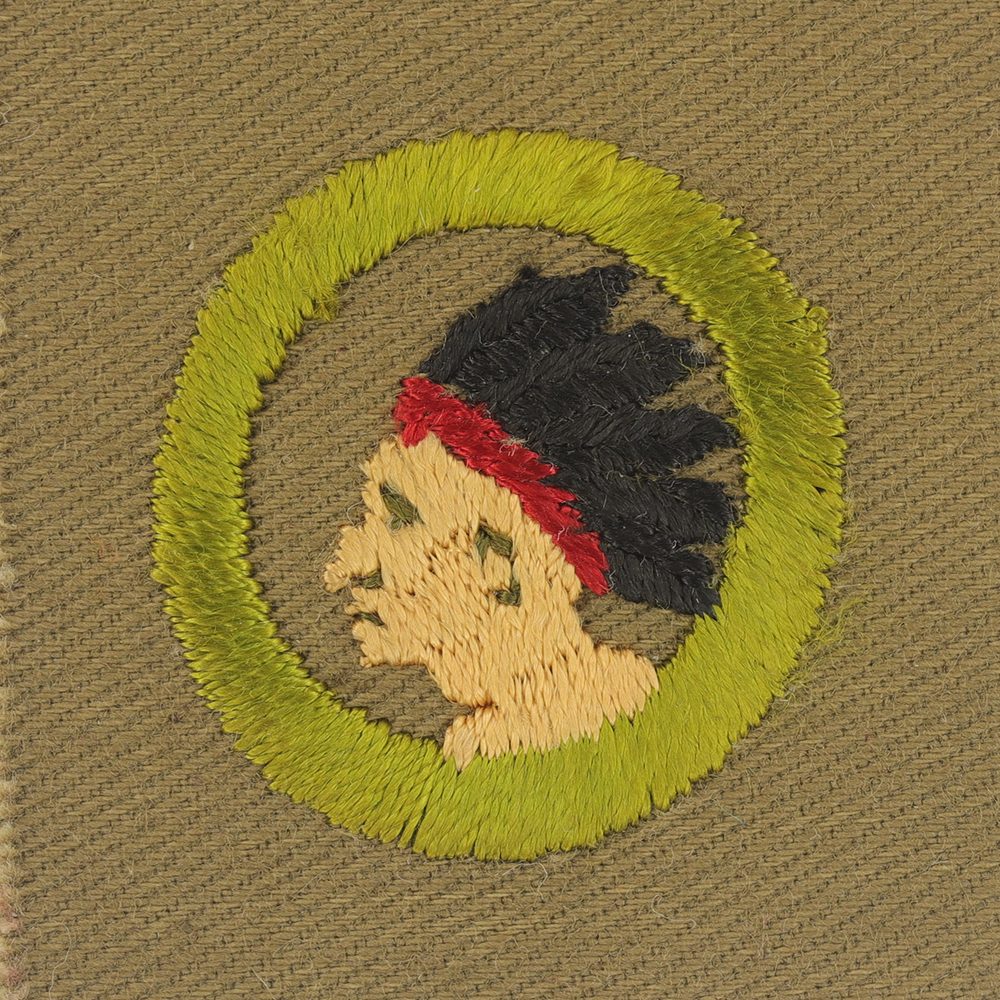
Fig. 1: Pathfi-AT1-Front
- Cloth: Heavyweight tan right twill
- Embroidery: Silk continuous
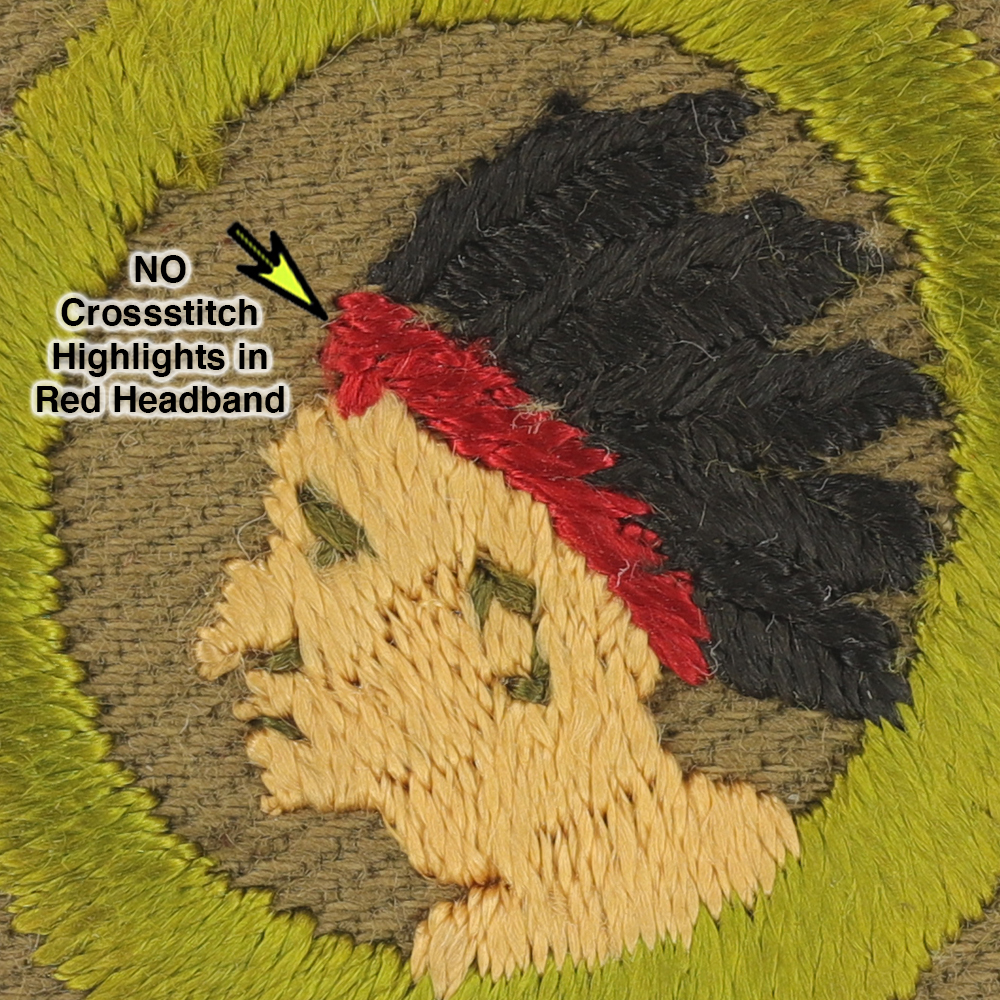
Fig. 2: Pathfi-AT1-Magnified
- Design: Five feathers, NO cross stich highlights in red headband
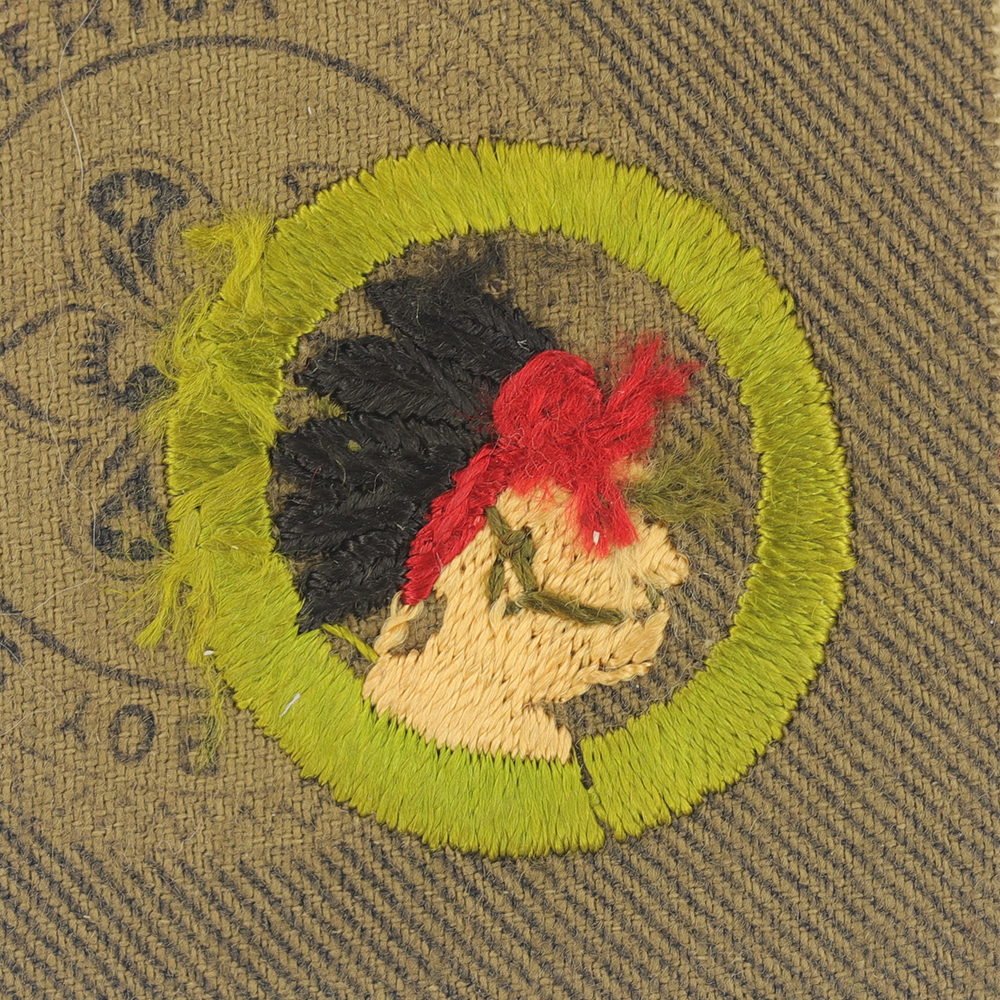
Fig. 3: Pathfi-AT1-Reverse
- Back: Black imprint
Item Name: Pathfinding 1920 - 1933
Item ID: Pathfi-AT1
Collector Rating: 1
Pamphlets Used to Earn this Badge
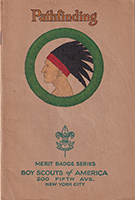
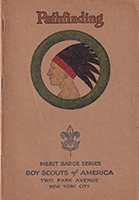
Requirements October 1914 until July 1926
1. In the country, know every lane, bypath, and short cut for a distance of at least two miles in every direction around the local scout headquarters; or in a city, have a general knowledge of the district within a three-mile radius of the local scout headquarters, so as to be able to guide people at any time, by day or by night.
2. Know the population of the five principal neighboring towns, their general direction from his scout headquarters, and be able to give strangers correct directions how to reach them.
3. If in the country, know in a two-mile radius, the approximate number of horses, cattle, sheep, and pigs owned on the five neighboring farms; or, if in a town, know, in a half-mile radius, the location of livery stables, garages, and blacksmith shops.
4. Know the location of the nearest meat markets, bakeries, groceries, and drug stores.
5. Know the location of the nearest police station, hospital, doctor, fire alarm, fire hydrant, telegraph and telephone offices, and railroad stations.
6. Know something of the history of his place; and know the location of its principal public buildings, such as the town or city hall, post-office, schools and churches.
7. Present a large scale map showing as much as possible of the above required information.
Requirements July 1926 until August 1929
1. In the country, know every lane, bypath, and short-cut for a distance of at least two miles in every direction around the local scout headquarters; or in a city, have a general knowledge of the district within a three-mile radius of the local scout headquarters, so as to be able to guide people at any time, by day or by night.
2. Know the population of the five principal neighboring towns, their general direction from his scout headquarters, and be able to give strangers correct directions how to reach them.
3. If in the country, know in a two-mile radius, the approximate number of horses, cattle, sheep and pigs owned on the five neighboring farms; or, if in a town, know, in a half-mile radius, the location of livery stables, garages, and blacksmith shops.
4. Know the location of the nearest meat markets, bakeries, groceries, and drug stores.
5. Know the location of the nearest police station, hospital, doctor, fire alarm, fire hydrant, telegraph and telephone offices, and railroad stations.
6. Know something of the history of his place; and know the location of its principal public buildings, such as the town or city hall, post-office, schools and churches.
7. Submit a scale map, not necessarily drawn by himself, upon which he has personally indicated as much as possible of the above-required information.
Requirements August 1929 until June 1952
1. Demonstrate a general knowledge of the district within a three-mile radius of the local Scout Headquarters, or his house so as to be able to guide people at any time day or night to points within this area.
2. Know the population of the five principal neighboring towns and cities as selected by his Guide or Counselor. Demonstrate directions for reaching them from Scout Headquarters or his house.
3. If in the country, know the breeds of horses, cattle, sheep and hogs owned on the five neighboring farms; if in the city, demonstrate directions to tourist camp and to five places for purchasing food supplies.
4. Demonstrate how to direct tourists from his home to gas, oil, tire and general auto repair service.
5. Give telephone number, if any, and directions for reaching the nearest police station, fire-fighting apparatus, Court House or Municipal Building, the nearest County Farm Agent's office, doctor, veterinarian and hospital.
6. Know something of the history of his community and the location of its principal places of interest and public buildings.
7. Submit a scale map, not necessarily drawn by himself, upon which he has personally indicated as much as possible of the above-required information.