-
Merit Badges
- Legend to identify Merit Badges
- 1910 British Merit Badges
- Square 1911 - 33
- Wide Crimped 1934 & 35
-
Narrow Tan Crimped 1936 - 42
- Tan Heavyweight Cloth with Silk Embroidery and Printed Back 1936 - 37
- Tan Heavyweight Cloth with Silk Embroidery and Plain Back 1937 - 38
- Tan Lightweight Cloth with Silk Embroidery and Plain Back 1938 - 39
- Tan Lightweight Cloth with Cotton Continuous Loop Embroidery and Plain Back 1939 - 42
- Tan Lightweight Cloth with Cotton Lockstitch Embroidery and Plain Back 1939 - 42
- Blue Background 1942 - 46
- Wartime 1942 - 46
- Khaki Narrow Crimped 1946 - 59
- Green Twill Gauze Back 1960 - 68
- Fully Embroidered Merrowed Edge 1960 - 72
- Unprinted Plastic Back 1972 - 01
- Printed Plastic Back 2002 - Current
-
Merit Badge Paper
- Merit Badge Applications
- Merit Badge Cards
-
Merit Badge Pamphlets
- Type 1 White Cover - Rectangle Drawing On Cover
- Type 2 White Cover 5-375" x 8" Title at Top
- Type 3A Tan Cover - 200 Fifth Avenue
- Type 3B Tan Cover - 2 line address New York City
- Type 3C Tan Cover - 2 line address New York N.Y.
- Type 3D Tan Cover - 1 line address New York N.Y.
- Type 4 Standing Scout Cover
- Type 5A War Cover
- Type 5B Red and White
- Type 6 Photo-Red Cover
- Type 7 Full Photo Cover or Bulls-eye Cover
- Type 8 Full Photo - Green Stripe Cover
- Type 9 Full Photo - Red Stripe Cover
- Type 10A Blue Stripe - Logo above bottom blue stripe - FDL centered
- Type 10B - Blue Stripe in bottom of photo area. FDL to left of text
- Special Covers
- Boy Craft Helps
- Merit Badge Counselor's Guides
-
Youth Position
- Junior Assistant Scoutmaster
- Senior Patrol Leader
- Assistant Senior Patrol Leader
- Patrol Leader
- Assistant Patrol Leader
- Troop Guide
- Scribe
- Quartermaster
- Instructor
- Chaplain Aide
- Den Chief
- Librarian
- Musician
- Webmaster
- Bugler
- Troop Historian
- Troop Representative
- Unit Representative
- Leadership Corps
- Honor Guard
- Leave No Trace Trainer
- Outdoor Ethics Guide
-
Patrol Medallions
- Patrol Medallions Introduction
- Legend to identify Patrol Medallions
- Patrol Shoulder Knot-Ribbons
- Felt Handmade Patrol Medallions
- Square Felt Patrol Medallions
- Round Broadcloth Patrol Medallions
- Red Twill Patrol Medallions
- Multi-Color Cloth Patrol Medallions
- Tan Cloth Patrol Medallions
- Patrol Medallion Back Patches
- Woodbadge Patrol Medallion

Fig. 1: PerHea-E2-Front
- Cloth: Khaki right twill
- Embroidery: Cotton lock stitch
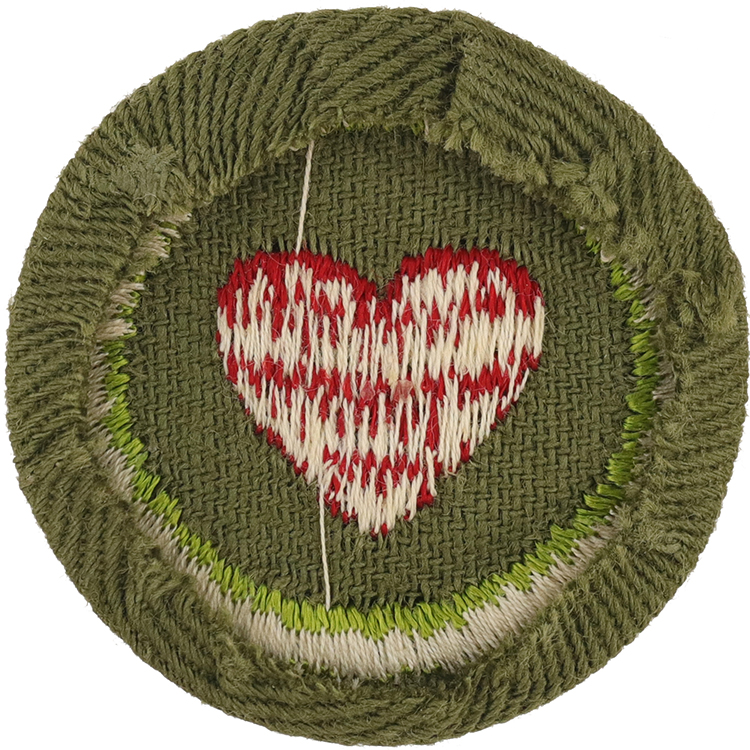
Fig. 2: PerHea-E2-Reverse
- Back: Plain NO imprint with starch

Fig. 3: PerHea-E2-mve1-front
- Minor variation: Medium wide light border

Fig. 4: PerHea-E2-mve1-reverse
- Back: Plain NO imprint with starch
Item Name: Personal Health 1947 - 1952
Item ID: PerHea-E2
Collector Rating: 1
Pamphlets Used to Earn this Badge
Requirements January 1938 until June 1948
1. Submit evidence of having had a medical examination within one year.
2. (a) Show proper method of brushing teeth and discuss the importance of dental care to general health.
(b) Give evidence of and discuss proper care of hands and feet; tell how to care for the feet on a hike; how to guard against infection known as "Athlete's Foot"; explain the value of (1) a shoe made on a Munson last and (2) wool stockings for winter wear and in wet weather.
(c) Explain importance (1) washing hands after leaving toilet as well as before eating; (2) frequent soap baths, particularly after hard exercise; (3) daily elimination, and discuss methods by which the body disposes of its wastes.
3. (a) Make up a bed on the ground or floor showing how to get the most benefit from (1) ground cloth and two blankets; (2) ground cloth and one blanket.
(b) Name at least five devices (other than bed clothes) for maintaining body heat while sleeping in cold weather; discuss methods of ventilating a sleeping-room.
(c) Give number of hours of sleep considered necessary for a person his age; tell why a person should sleep by himself, and what distance should separate the beds of sleepers.
4. Demonstrate proper breathing and explain how it affects health.
5. Explain how disease is transmitted by: drinking water, common drinking cups, dirty dishes, dirty dish towels, soiled bath towels, unpasteurized milk, personal contact.
6. Explain what foods are considered essential in the daily diet of a person his age; explain the harm of eating between meals, eating irregularly, too much candy, rich or excessively sweetened food.
7. Explain danger of (1) taking a laxative when suffering from pain in stomach; (2) neglecting any break in the surface of the skin; (3) opening or squeezing a pimple.
8. Give three good reasons why alcohol and tobacco are harmful to a growing boy.
9. Discuss the value of self-control to general health.
Requirements June 1948 until June 1952
1. Submit evidence of having had a medical examination within a year. State what has been done or will be done to correct any remediable condition found.
2. (a) State whether examination by a dentist has been made within one year and show what has been done to correct any remediable conditions found. If no examination has been made within one year, explain how to care for teeth properly, and show by general condition of his teeth that he practices such care; (b) show by condition of his own hands and feet that he takes proper care of them. Tell briefly what that care is. Tell how to care for his feet on a hike; how to guard against "Athlete's Foot." Explain the value of (1) a show made on a Munson last and (2) wool stockings in winter and wet weather; (c) explain importance of (1) washing hands after leaving a toilet, as well as before eating; (2) soap baths at least once each week and always after hard exercise, and (3) daily elimination. Describe how the body disposes of its wastes.
3. (a) Make up a bed on the ground or floor, showing how to get the most warmth and comfort from ground cloth and two blankets, and ground cloth and one blanket; (b) explain five ways, other than using bed clothes, of keeping warm while sleeping outdoors; (c) tell how to ventilate a sleeping room properly. Give number of hours of sleep needed by a person his age. Tell why a person should sleep by himself, and what distance should separate his bed from others.
4. Demonstrate proper breathing and explain how it affects health.
5. Explain how disease is spread by drinking water, common drinking cups, dirty dishes, dirty dish towels, soiled bath towels, unpasteurized milk, personal contact.
6. (a) Name the basic foods essential to the daily diet of a person his age. Tell what food elements each contains. Explain why he should not eat between meals, eat irregularly, or eat too much candy, rich food or very sweet foods; (b) bring in, or write out, at time of examination a list of foods eaten at each meal over the previous three day period.
7. Explain the danger of taking a laxative when suffering from pain in the stomach; neglecting a break in the surface of the skin; opening or squeezing a pimple.
8. Give three reasons why alcohol and tobacco are harmful to a growing boy.
9. Discuss the value of clean moral habits to general health.