-
Merit Badges
- Legend to identify Merit Badges
- 1910 British Merit Badges
- Square 1911 - 33
- Wide Crimped 1934 & 35
-
Narrow Tan Crimped 1936 - 42
- Tan Heavyweight Cloth with Silk Embroidery and Printed Back 1936 - 37
- Tan Heavyweight Cloth with Silk Embroidery and Plain Back 1937 - 38
- Tan Lightweight Cloth with Silk Embroidery and Plain Back 1938 - 39
- Tan Lightweight Cloth with Cotton Continuous Loop Embroidery and Plain Back 1939 - 42
- Tan Lightweight Cloth with Cotton Lockstitch Embroidery and Plain Back 1939 - 42
- Blue Background 1942 - 46
- Wartime 1942 - 46
- Khaki Narrow Crimped 1946 - 59
- Green Twill Gauze Back 1960 - 68
- Fully Embroidered Merrowed Edge 1960 - 72
- Unprinted Plastic Back 1972 - 01
- Printed Plastic Back 2002 - Current
-
Merit Badge Paper
- Merit Badge Applications
- Merit Badge Cards
-
Merit Badge Pamphlets
- Type 1 White Cover - Rectangle Drawing On Cover
- Type 2 White Cover 5-375" x 8" Title at Top
- Type 3A Tan Cover - 200 Fifth Avenue
- Type 3B Tan Cover - 2 line address New York City
- Type 3C Tan Cover - 2 line address New York N.Y.
- Type 3D Tan Cover - 1 line address New York N.Y.
- Type 4 Standing Scout Cover
- Type 5A War Cover
- Type 5B Red and White
- Type 6 Photo-Red Cover
- Type 7 Full Photo Cover or Bulls-eye Cover
- Type 8 Full Photo - Green Stripe Cover
- Type 9 Full Photo - Red Stripe Cover
- Type 10A Blue Stripe - Logo above bottom blue stripe - FDL centered
- Type 10B - Blue Stripe in bottom of photo area. FDL to left of text
- Special Covers
- Boy Craft Helps
- Merit Badge Counselor's Guides
-
Youth Position
- Junior Assistant Scoutmaster
- Senior Patrol Leader
- Assistant Senior Patrol Leader
- Patrol Leader
- Assistant Patrol Leader
- Troop Guide
- Scribe
- Quartermaster
- Instructor
- Chaplain Aide
- Den Chief
- Librarian
- Musician
- Webmaster
- Bugler
- Troop Historian
- Troop Representative
- Unit Representative
- Leadership Corps
- Honor Guard
- Leave No Trace Trainer
- Outdoor Ethics Guide
-
Patrol Medallions
- Patrol Medallions Introduction
- Legend to identify Patrol Medallions
- Patrol Shoulder Knot-Ribbons
- Felt Handmade Patrol Medallions
- Square Felt Patrol Medallions
- Round Broadcloth Patrol Medallions
- Red Twill Patrol Medallions
- Multi-Color Cloth Patrol Medallions
- Tan Cloth Patrol Medallions
- Patrol Medallion Back Patches
- Woodbadge Patrol Medallion
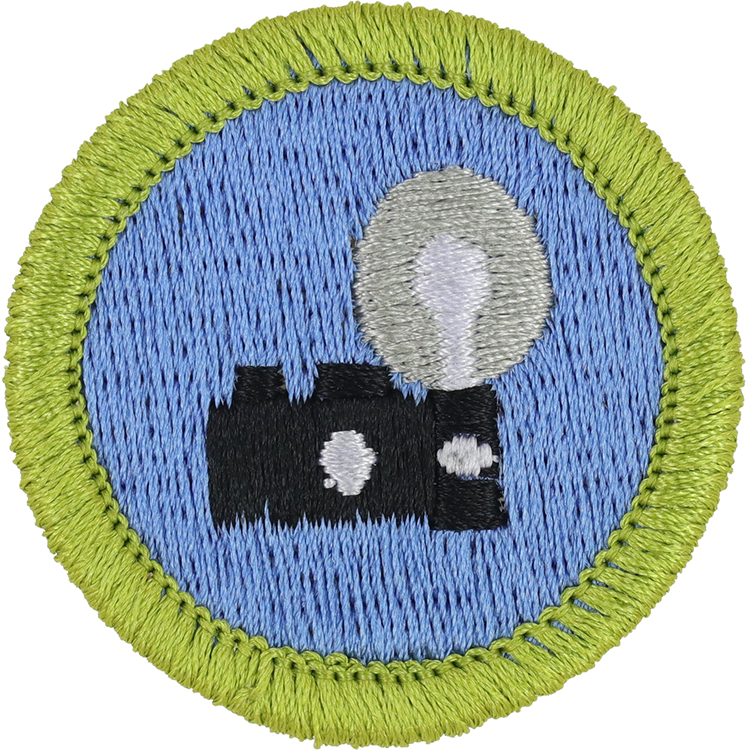
Fig. 1: Photog-L1-Front
- Embroidery: Rayon thread
- Border: Merrowed
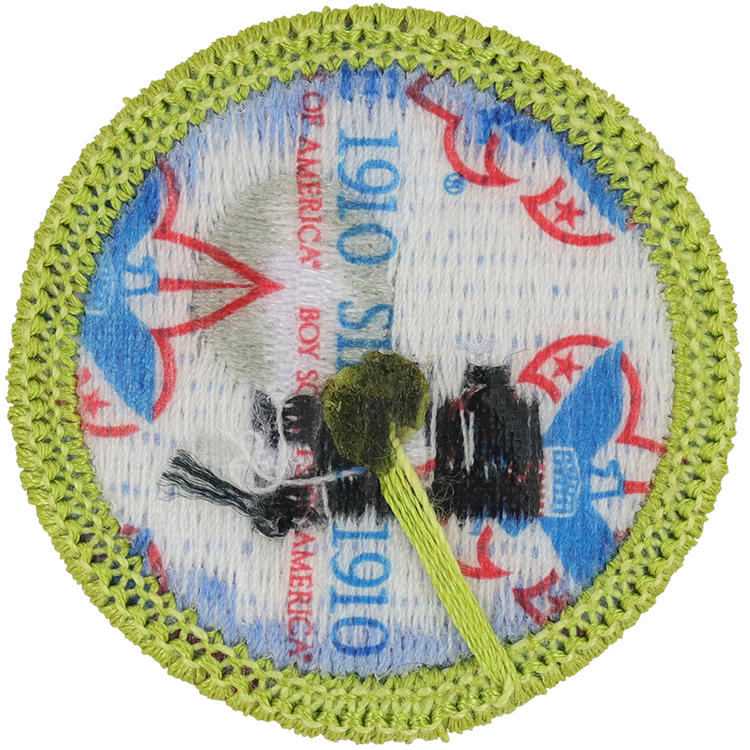
Fig. 2: Photog-L1-Reverse
- Back: Since 1910 imprint with large Tenderfoot image
Item Name: Photography 2014 - Current
Item ID: Photog-L1
Collector Rating: 1
Pamphlets Used to Earn this Badge

Requirements January 2013 until January 2016
1. Explain how the following elements and terms affect the quality of a picture:
- Light – natural light/ambient, flash
- Exposure – aperture (f-stops), shutter, speed, depth of field
- Composition – rule of thirds, leading lines, framing, depth
- Angle of view
- Stopping action
2. Explain the basic parts and operation of a film camera or digital camera. Explain how an exposure is made when you take a picture.
3. Discuss with your counselor the difference between a film camera and a digital camera. Describe how computer software allows you to make adjustments to a digital photograph after it is taken.
4. Do ONE of the following:
- Produce a picture story using the photojournalistic technique of documenting an event. Share your plan with your counselor and get your counselor’s input and approval before you proceed. Then, using either a film camera or a digital camera, produce your approved picture story. Process your images and select eight to 12 images that best tell your story. Arrange your images in order, then mount the prints on a poster board. If you are using digital images, you may create a slide show on your computer or produce printouts for your poster board. Share your picture story with your counselor.
- Choose a topic that interests you to photograph for an exhibit or display. Get your counselor’s approval, then photograph (digital or film) your topic. Process you images. Choose 20 of your favorite images and mount them on poster board. Share your display with your counselor. If you are using digital images, you may create a slide show on your computer or produce printouts for your poster board.
5. Discuss with your counselor the career opportunities in photography. Pick one that interest you and explain how to prepare for such a career. Discuss with your counselor the education and training such a career would require.
Requirements January 2016 until Current
1. Do the following:
- Explain to your counselor the most likely hazards you may encounter while working with photography and what you should do to anticipate, mitigate, prevent, and respond to these hazards. Explain how you would prepare for exposure to environmental situations such as weather, son, and water.
- Show your counselor your current, up-to-date Cyber Chip.
2. Explain how the following elements and terms can affect the quality of a picture:
- Light - natural light (ambient/existing), lowlight (such as night), and artificial light (such as from a flash)
- Exposure - aperture (f-stops), shutter speed, ISO
- Depth of field
- Composition - rule of thirds, leading lines, framing, depth
- Angle of view
- Stop action and blur of motion
- Timing
3. Explain the basic parts and operation of a camera. Explain how an exposure is made when you take a picture.
4. Do TWO of the following, then share your work with your counselor.
- Photograph one subject from two different angles or perspectives.
- Photograph one subject from two different light sources - artificial and natural.
- Photograph one subject with two different depth of fields.
- Photograph one subject with two different compositional techniques.
5. hotograph THREE of the following, then share your work with your counselor.
- Close-up of a person
- Two to three people interacting
- Action shot
- Animal shot
- Nature shot
- Picture of a person - candid, posed, or camera aware
6. Describe how software allows you to enhance your photograph after it is taken.
- Crop your photograph.
- Adjust the exposure or make a color correction.
- Show another way you could improve your picture for impact.
7. Using images other than those created for requirement 4, 5 or 6, produce a visual story to document an event to photograph OR choose a topic that interest you to photograph. Do the following:
- Plan the images you need to photograph for your photo story.
- Share your plan with your counselor, and get your counselor’s input and approval before you proceed.
- Select eight to 12 images that best tell your story. Arranger images in order and Mount the prints on a poster board, OR create an electronic presentation. Share your visual story with your counselor.
8. Identify three career opportunities in photography. Pick one and explain to your counselor how to prepare for such a career. Discuss what education and training required, and why this profession might interest you.