-
Merit Badges
- Legend to identify Merit Badges
- 1910 British Merit Badges
- Square 1911 - 33
- Wide Crimped 1934 & 35
-
Narrow Tan Crimped 1936 - 42
- Tan Heavyweight Cloth with Silk Embroidery and Printed Back 1936 - 37
- Tan Heavyweight Cloth with Silk Embroidery and Plain Back 1937 - 38
- Tan Lightweight Cloth with Silk Embroidery and Plain Back 1938 - 39
- Tan Lightweight Cloth with Cotton Continuous Loop Embroidery and Plain Back 1939 - 42
- Tan Lightweight Cloth with Cotton Lockstitch Embroidery and Plain Back 1939 - 42
- Blue Background 1942 - 46
- Wartime 1942 - 46
- Khaki Narrow Crimped 1946 - 59
- Green Twill Gauze Back 1960 - 68
- Fully Embroidered Merrowed Edge 1960 - 72
- Unprinted Plastic Back 1972 - 01
- Printed Plastic Back 2002 - Current
-
Merit Badge Paper
- Merit Badge Applications
- Merit Badge Cards
-
Merit Badge Pamphlets
- Type 1 White Cover - Rectangle Drawing On Cover
- Type 2 White Cover 5-375" x 8" Title at Top
- Type 3A Tan Cover - 200 Fifth Avenue
- Type 3B Tan Cover - 2 line address New York City
- Type 3C Tan Cover - 2 line address New York N.Y.
- Type 3D Tan Cover - 1 line address New York N.Y.
- Type 4 Standing Scout Cover
- Type 5A War Cover
- Type 5B Red and White
- Type 6 Photo-Red Cover
- Type 7 Full Photo Cover or Bulls-eye Cover
- Type 8 Full Photo - Green Stripe Cover
- Type 9 Full Photo - Red Stripe Cover
- Type 10A Blue Stripe - Logo above bottom blue stripe - FDL centered
- Type 10B - Blue Stripe in bottom of photo area. FDL to left of text
- Special Covers
- Boy Craft Helps
- Merit Badge Counselor's Guides
-
Youth Position
- Junior Assistant Scoutmaster
- Senior Patrol Leader
- Assistant Senior Patrol Leader
- Patrol Leader
- Assistant Patrol Leader
- Troop Guide
- Scribe
- Quartermaster
- Instructor
- Chaplain Aide
- Den Chief
- Librarian
- Musician
- Webmaster
- Bugler
- Troop Historian
- Troop Representative
- Unit Representative
- Leadership Corps
- Honor Guard
- Leave No Trace Trainer
- Outdoor Ethics Guide
-
Patrol Medallions
- Patrol Medallions Introduction
- Legend to identify Patrol Medallions
- Patrol Shoulder Knot-Ribbons
- Felt Handmade Patrol Medallions
- Square Felt Patrol Medallions
- Round Broadcloth Patrol Medallions
- Red Twill Patrol Medallions
- Multi-Color Cloth Patrol Medallions
- Tan Cloth Patrol Medallions
- Patrol Medallion Back Patches
- Woodbadge Patrol Medallion
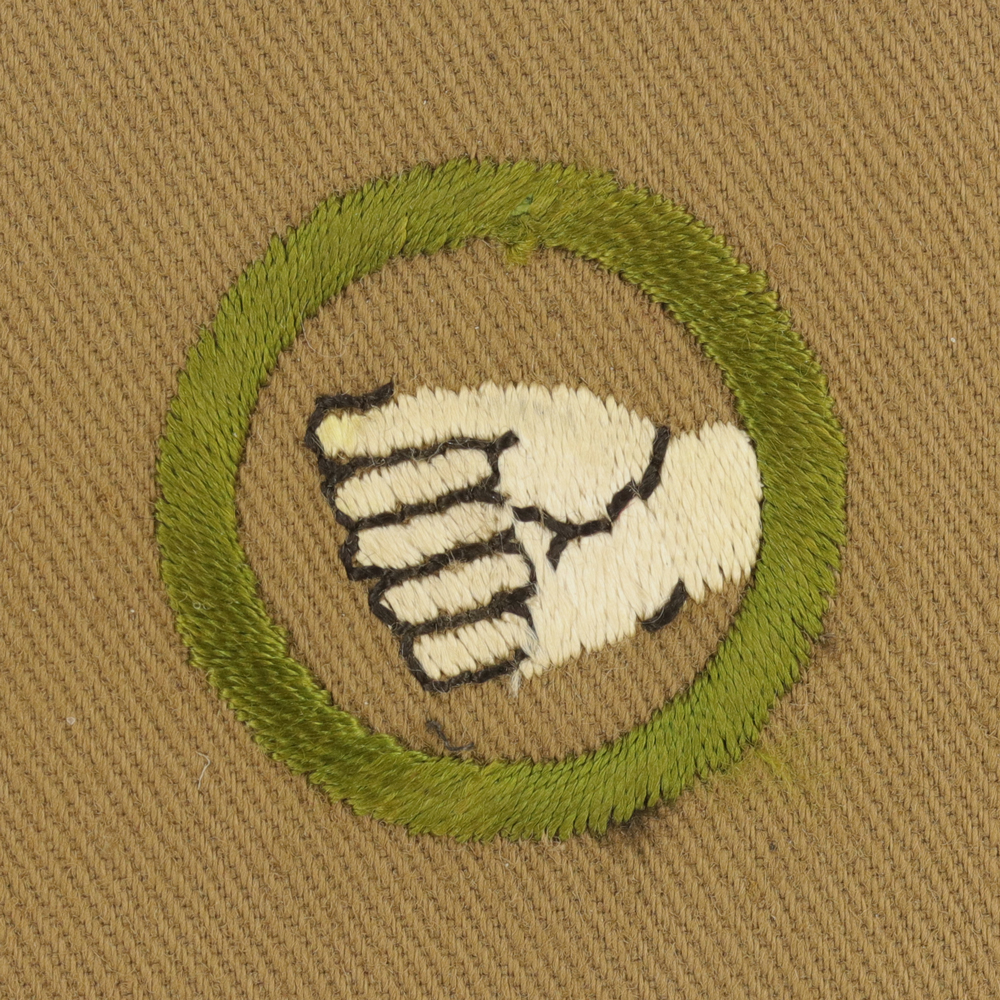
Fig. 1: PhyDev-AH5-Front
- Cloth: Heavyweight tan right twill
- Embroidery: Silk continuous
- Border: Clockwise, round & dense
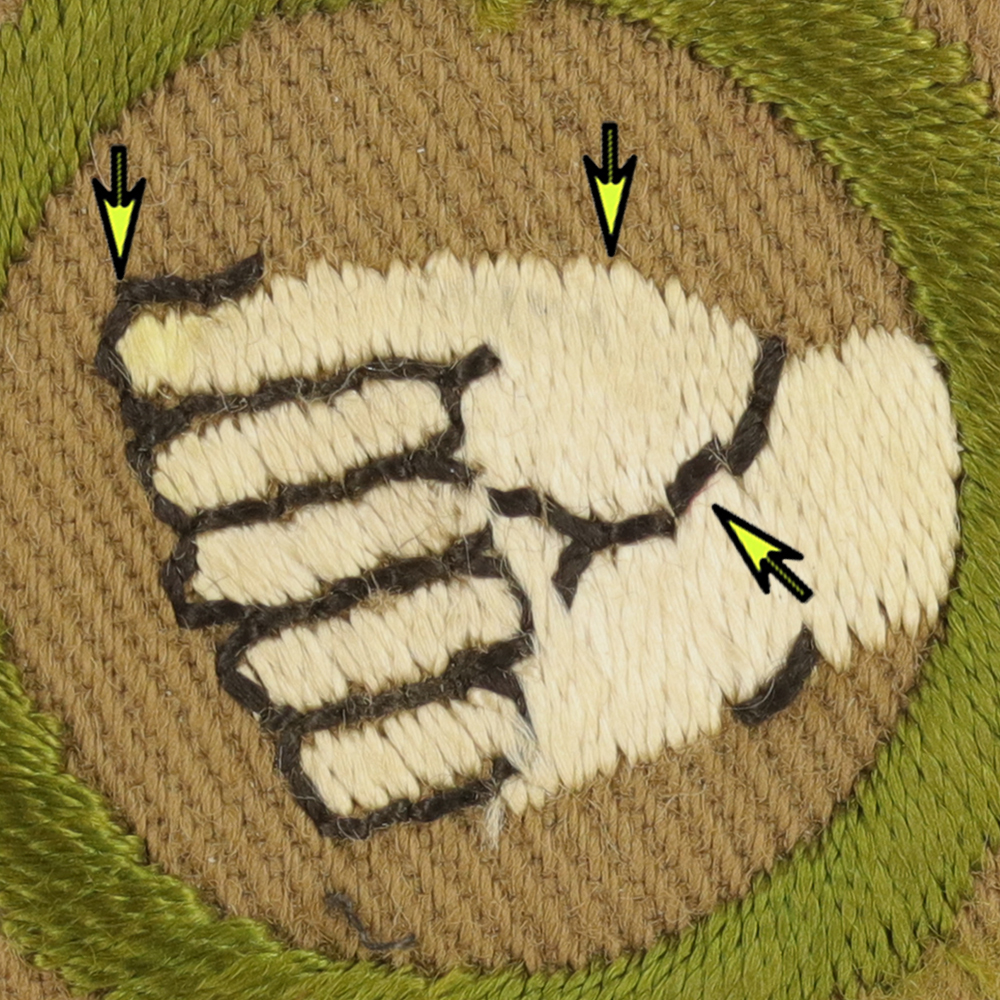
Fig. 2: PhyDev-AH5-Magnified
- Design: Thumb tip and finger knuckles almost even, base of thumb curved, black highlight stitches extend from middle finger tip to wrist
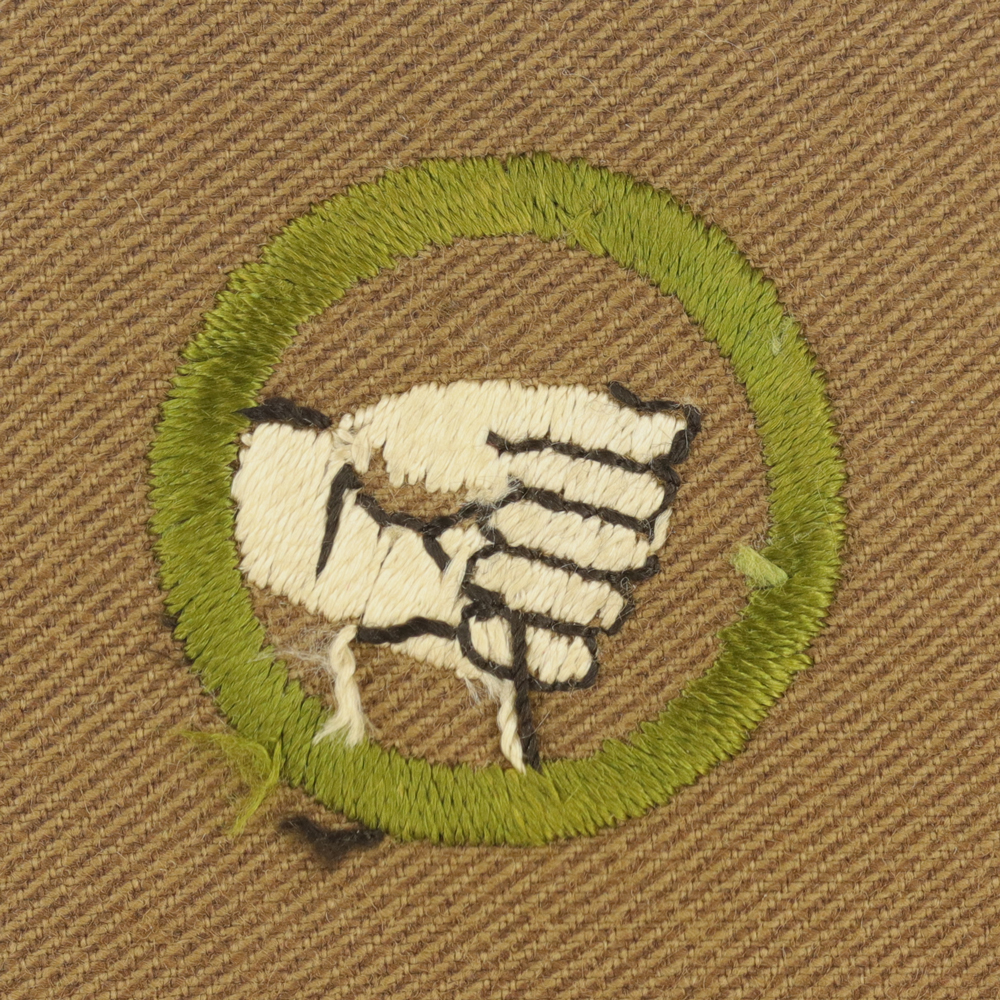
Fig. 3: PhyDev-AH5-Reverse
- Back: Brown imprint
Item Name: Physical Development 1914 - 1921
Item ID: PhyDev-AH5
Collector Rating: 1
Pamphlets Used to Earn this Badge
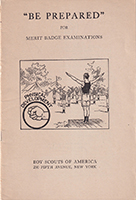
Requirements March 1915 until June 1916
To obtain a merit badge for Physical Development, a scout must:
1. Produce satisfactory evidence of habitual good posture.
2. Have no remediable physical defects uncorrected.
3. Produce satisfactory evidence of daily practice of hygienic habits and a thorough knowledge of a standard book on hygiene.
4. Pass one test in each of the running, jumping, swimming, rope-climbing (or pull-up) events, according to his weight, in the Athletic Schedule (See page 35.)
5. Demonstrate proper form in running high jump, hurdle, and shot-put.
6. Make up a daily drill of ten exercises for scouts, giving proper exercise for whole body; present evidence of having practiced this daily for six months and having taught the same to six or more boys for a period of three months.
7. Demonstrate reasonable efficiency in two outdoor games requiring physical development, and give evidence of having taught at least ten games to a group of boys and know ten more.
Requirements June 1916 until June 1952
1. Produce satisfactory evidence of habitual good posture.
2. Have no remediable physical defects uncorrected.
3. Produce satisfactory evidence of daily practice of hygienic habits and a thorough knowledge of a standard book on hygiene.
4. Pass three of the tests, according to his weight in the Athletic Merit Badge Schedule.
5. Demonstrate proper form in running, high jump, hurdle and shot-put.
6. Make up a daily drill of ten exercises for Scouts, giving proper exercise for whole body; present evidence of having practised this daily for six months and having taught the same to two or more boys for a period of three months.
7. Demonstrate reasonable efficiency in two outdoor games requiring physical development; give evidence of having taught at least ten Scout games to a group of boys, and know ten more.