-
Merit Badges
- Legend to identify Merit Badges
- 1910 British Merit Badges
- Square 1911 - 33
- Wide Crimped 1934 & 35
-
Narrow Tan Crimped 1936 - 42
- Tan Heavyweight Cloth with Silk Embroidery and Printed Back 1936 - 37
- Tan Heavyweight Cloth with Silk Embroidery and Plain Back 1937 - 38
- Tan Lightweight Cloth with Silk Embroidery and Plain Back 1938 - 39
- Tan Lightweight Cloth with Cotton Continuous Loop Embroidery and Plain Back 1939 - 42
- Tan Lightweight Cloth with Cotton Lockstitch Embroidery and Plain Back 1939 - 42
- Blue Background 1942 - 46
- Wartime 1942 - 46
- Khaki Narrow Crimped 1946 - 59
- Green Twill Gauze Back 1960 - 68
- Fully Embroidered Merrowed Edge 1960 - 72
- Unprinted Plastic Back 1972 - 01
- Printed Plastic Back 2002 - Current
-
Merit Badge Paper
- Merit Badge Applications
- Merit Badge Cards
-
Merit Badge Pamphlets
- Type 1 White Cover - Rectangle Drawing On Cover
- Type 2 White Cover 5-375" x 8" Title at Top
- Type 3A Tan Cover - 200 Fifth Avenue
- Type 3B Tan Cover - 2 line address New York City
- Type 3C Tan Cover - 2 line address New York N.Y.
- Type 3D Tan Cover - 1 line address New York N.Y.
- Type 4 Standing Scout Cover
- Type 5A War Cover
- Type 5B Red and White
- Type 6 Photo-Red Cover
- Type 7 Full Photo Cover or Bulls-eye Cover
- Type 8 Full Photo - Green Stripe Cover
- Type 9 Full Photo - Red Stripe Cover
- Type 10A Blue Stripe - Logo above bottom blue stripe - FDL centered
- Type 10B - Blue Stripe in bottom of photo area. FDL to left of text
- Special Covers
- Boy Craft Helps
- Merit Badge Counselor's Guides
-
Youth Position
- Junior Assistant Scoutmaster
- Senior Patrol Leader
- Assistant Senior Patrol Leader
- Patrol Leader
- Assistant Patrol Leader
- Troop Guide
- Scribe
- Quartermaster
- Instructor
- Chaplain Aide
- Den Chief
- Librarian
- Musician
- Webmaster
- Bugler
- Troop Historian
- Troop Representative
- Unit Representative
- Leadership Corps
- Honor Guard
- Leave No Trace Trainer
- Outdoor Ethics Guide
-
Patrol Medallions
- Patrol Medallions Introduction
- Legend to identify Patrol Medallions
- Patrol Shoulder Knot-Ribbons
- Felt Handmade Patrol Medallions
- Square Felt Patrol Medallions
- Round Broadcloth Patrol Medallions
- Red Twill Patrol Medallions
- Multi-Color Cloth Patrol Medallions
- Tan Cloth Patrol Medallions
- Patrol Medallion Back Patches
- Woodbadge Patrol Medallion
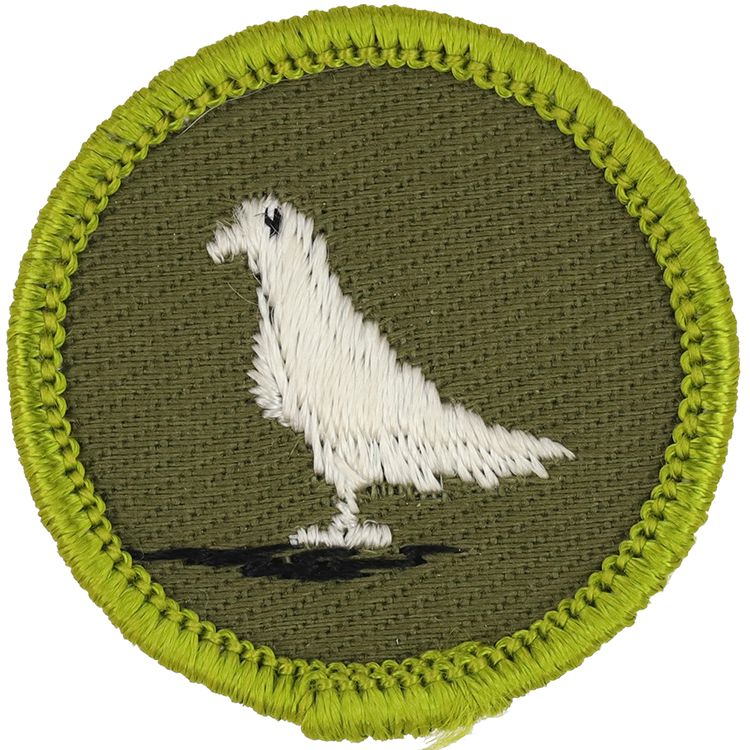
Fig. 1: PigRai-F-Front
- Cloth: Green right twill
- Border: Merrowed
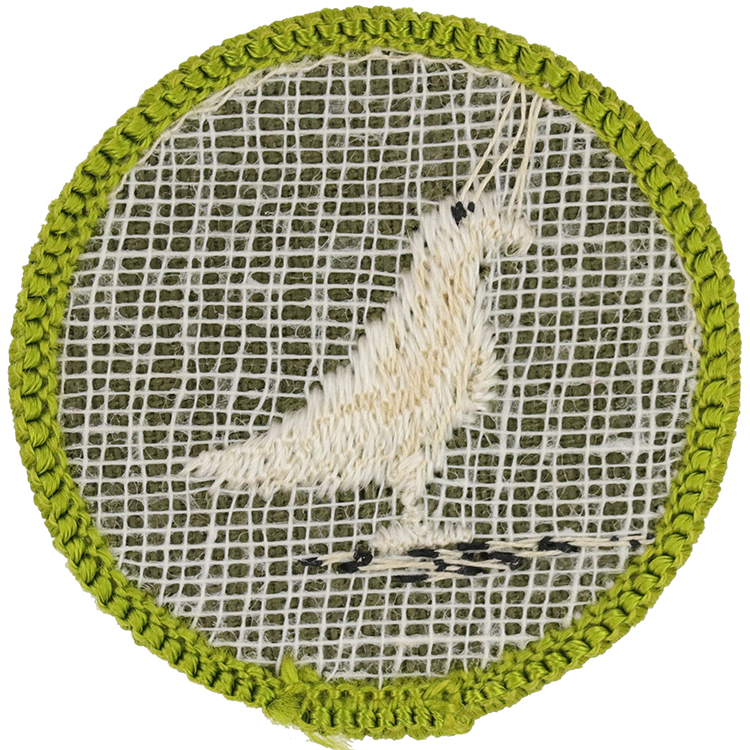
Fig. 2: PigRai-F-Reverse
- Back: Gauze reinforced starched
Item Name: Pigeon Raising 1961 - 1968
Item ID: PigRai-F
Collector Rating: 1
Pamphlets Used to Earn this Badge


Requirements September 1958 until September 1963
1. (a) House and care for at least two pairs of pigeons for three months. (b) Keep an accounting on cost of birds, feed, equipment, etc., and of income received from sale of squabs or birds for this same period. (c) Keep complete production records of eggs laid, squabs hatched, sickness, deaths, etc., for this same period.
2. Submit a photograph or drawing of your loft and flypen.
3. List the four fundamental requirements for successful pigeon raising.
4. If you live in city or town, give its ordinances regulating the keeping of pigeons.
5. Describe two breeds of utility pigeons used for squabbing; two fancy breeds used for exhibiting; and two breeds used for flying (racing or high flying).
6. Do one: (a) Pick, dress, and cook at least one squab raised by you. Visit a squab farm and write a 300-word report on it. (b) Enter at least one pigeon owned by you in a pigeon show. Visit a pigeon show and write a 300-word report on it. (c) Enter at least one pigeon owned by you in a pigeon race. Visit a racing loft, or racing club meeting, and write a 300-word report on it.
This merit badge may be earned as a 4-H'er by completing a club project in that subject or as an FFA member by meeting these requirements through the FFA-supervised farming program.
Requirements December 1966 until June 1972
1. Do the following:
(a) House and care for at least two pairs of pigeons for 3 months.
(b) Keep an accounting on cost of birds, feed, equipment, etc., and of income received from sale of squabs or birds for this same period.
(c) Keep complete production records of eggs laid, squabs hatched, sickness, deaths, etc., for this same period.
2. Submit a photograph or drawing of your loft and flypen.
3. List the four fundamental requirements for successful pigeon raising.
4. If you live in city or town, give its ordinances regulating the keeping of pigeons.
5. Describe two breeds of utility pigeons used for squabbing; two fancy breeds used for exhibiting; and two breeds used for flying (racing or high flying).
6. Do ONE of the following three projects:
(a) Pick, dress, and cook at least one squab raised by you. Visit a squab farm and write a three hundred word report on it.
(b) Enter at least one pigeon owned by you in a pigeon show. Visit a pigeon show and write a three hundred word report on it.
(c) Enter at least one pigeon owned by you in a pigeon race. Visit a racing loft, or racing club meeting, and write a three hundred word report on it.
This merit badge may be earned as a 4-H'er by completing a club project in that subject or as an FFA member by meeting these requirements through the FFA-supervised farming program.