-
Merit Badges
- Legend to identify Merit Badges
- 1910 British Merit Badges
- Square 1911 - 33
- Wide Crimped 1934 & 35
-
Narrow Tan Crimped 1936 - 42
- Tan Heavyweight Cloth with Silk Embroidery and Printed Back 1936 - 37
- Tan Heavyweight Cloth with Silk Embroidery and Plain Back 1937 - 38
- Tan Lightweight Cloth with Silk Embroidery and Plain Back 1938 - 39
- Tan Lightweight Cloth with Cotton Continuous Loop Embroidery and Plain Back 1939 - 42
- Tan Lightweight Cloth with Cotton Lockstitch Embroidery and Plain Back 1939 - 42
- Blue Background 1942 - 46
- Wartime 1942 - 46
- Khaki Narrow Crimped 1946 - 59
- Green Twill Gauze Back 1960 - 68
- Fully Embroidered Merrowed Edge 1960 - 72
- Unprinted Plastic Back 1972 - 01
- Printed Plastic Back 2002 - Current
-
Merit Badge Paper
- Merit Badge Applications
- Merit Badge Cards
-
Merit Badge Pamphlets
- Type 1 White Cover - Rectangle Drawing On Cover
- Type 2 White Cover 5-375" x 8" Title at Top
- Type 3A Tan Cover - 200 Fifth Avenue
- Type 3B Tan Cover - 2 line address New York City
- Type 3C Tan Cover - 2 line address New York N.Y.
- Type 3D Tan Cover - 1 line address New York N.Y.
- Type 4 Standing Scout Cover
- Type 5A War Cover
- Type 5B Red and White
- Type 6 Photo-Red Cover
- Type 7 Full Photo Cover or Bulls-eye Cover
- Type 8 Full Photo - Green Stripe Cover
- Type 9 Full Photo - Red Stripe Cover
- Type 10A Blue Stripe - Logo above bottom blue stripe - FDL centered
- Type 10B - Blue Stripe in bottom of photo area. FDL to left of text
- Special Covers
- Boy Craft Helps
- Merit Badge Counselor's Guides
-
Youth Position
- Junior Assistant Scoutmaster
- Senior Patrol Leader
- Assistant Senior Patrol Leader
- Patrol Leader
- Assistant Patrol Leader
- Troop Guide
- Scribe
- Quartermaster
- Instructor
- Chaplain Aide
- Den Chief
- Librarian
- Musician
- Webmaster
- Bugler
- Troop Historian
- Troop Representative
- Unit Representative
- Leadership Corps
- Honor Guard
- Leave No Trace Trainer
- Outdoor Ethics Guide
-
Patrol Medallions
- Patrol Medallions Introduction
- Legend to identify Patrol Medallions
- Patrol Shoulder Knot-Ribbons
- Felt Handmade Patrol Medallions
- Square Felt Patrol Medallions
- Round Broadcloth Patrol Medallions
- Red Twill Patrol Medallions
- Multi-Color Cloth Patrol Medallions
- Tan Cloth Patrol Medallions
- Patrol Medallion Back Patches
- Woodbadge Patrol Medallion
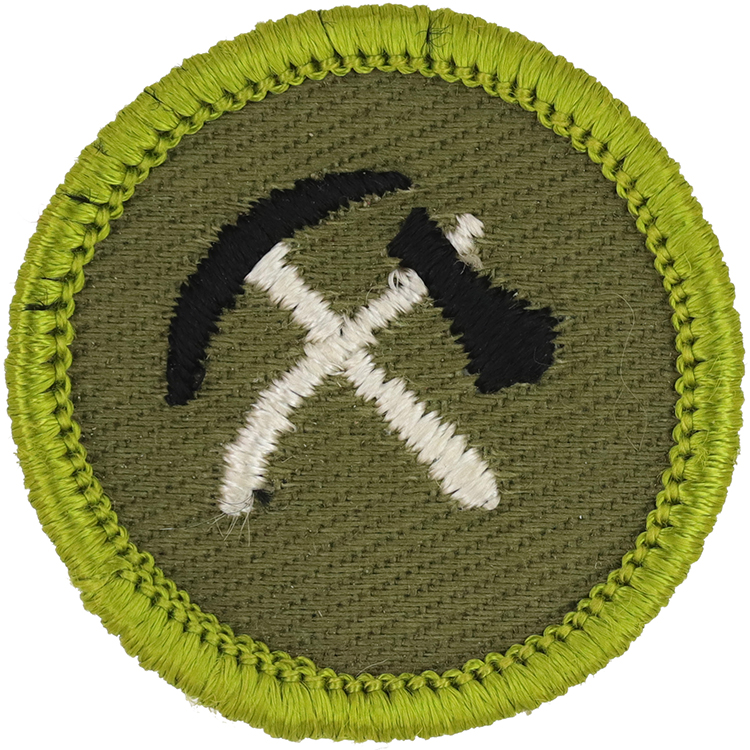
Fig. 1: Pionee-F-Front
- Cloth: Green right twill
- Border: Merrowed
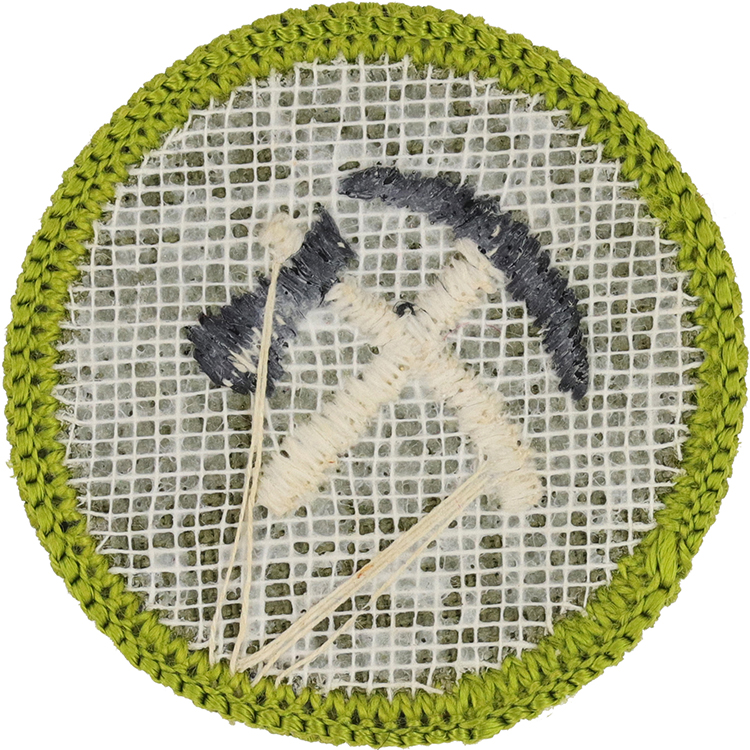
Fig. 2: Pionee-F-Reverse
- Back: Gauze reinforced starched
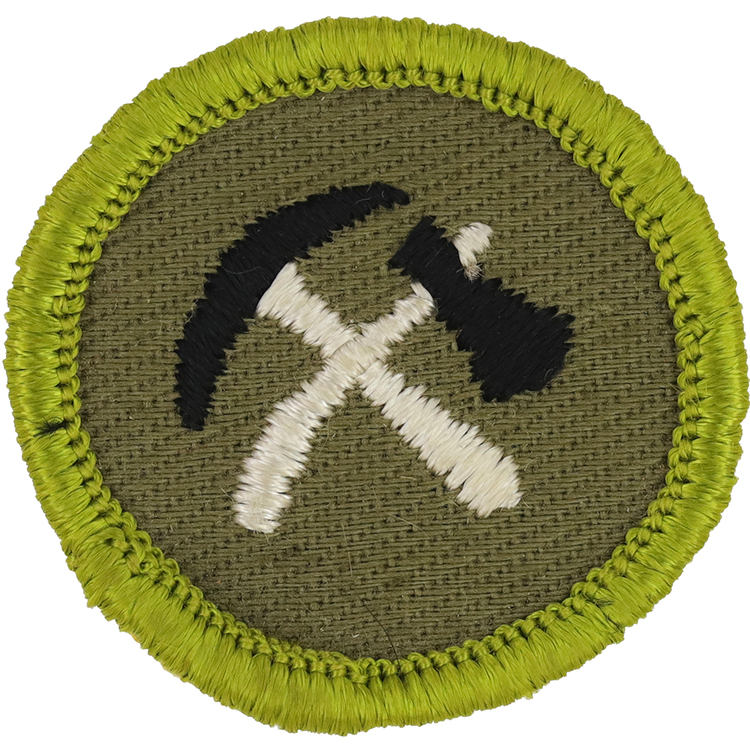
Fig. 3: Pionee-F-mve1-front
- Minor variation: Handle differences
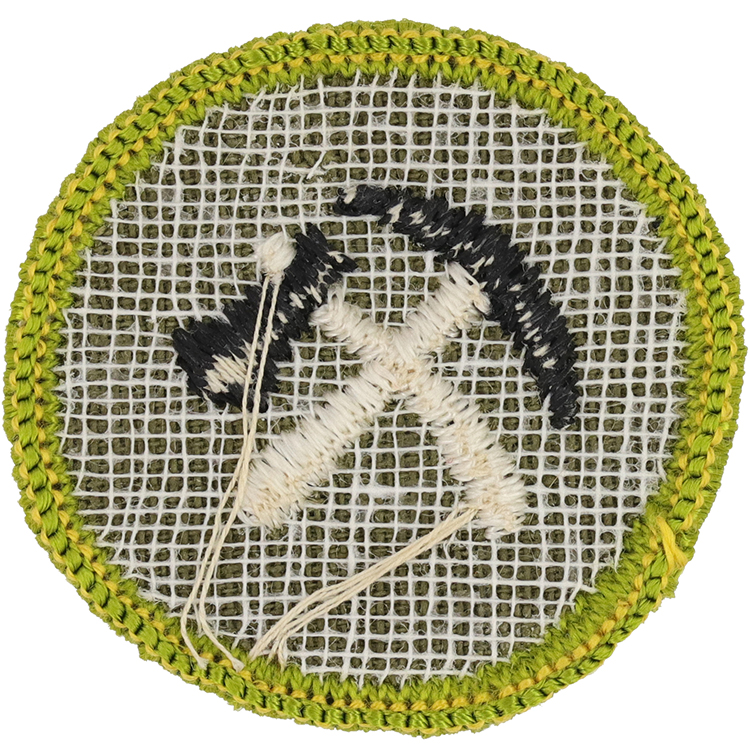
Fig. 4: Pionee-F-mve1-reverse
- Back: Gauze reinforced starched
Item Name: Pioneering 1961 - 1968
Item ID: Pionee-F
Collector Rating: 1
Pamphlets Used to Earn this Badge
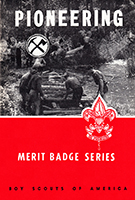
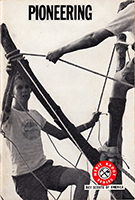
Requirements June 1953 until September 1963
1. Hand coil length of rope. Describe (a) kinds of rope; (b) care of rope; (c) weakening effect of knots.
2. Tie quickly twelve knots and hitches and explain their specific use in pioneering.
3. Make a long, a short, and an eye splice.
4. Lash spars together properly using square, diagonal, and sheer lashings.
5. (a) Build, without the use of nails, spikes, or wire, a bridge or derrick (capable of supporting two hundred pounds in weight) or other practical pioneering project such as signal tower, monkey bridge, gateway. or (b) Build a shack of one kind or another suitable for three occupants. or (c) Using lashings only, make a model bridge at least 18 inches long and explain the principles involved in its construction.
------
” A Second Class Scout must first qualify for First Class Scoutcraft Requirement 3 (see page 112).
3. LIVE IN CAMP
a. CAMP MAKING--Sharpen an axe and use it for cutting light wood into tent pegs. Locate a tent site and pitch a tent, fastening the guy lines with taut-line hitches. Prepare a comfortable ground bed. Make a piece of camp equipment requiring lashings.
b. CAMP HEALTH--Explain methods used in camp for care of food and drinking water, fire protection, and waste disposal.
c. WOOD LORE--Find ten kinds of wild trees or shrubs. Tell what they are and explain their uses.
Requirements December 1966 until June 1972
1. Build a ropemaking machine. Using heavy twine or other light line, make a 6-foot rope 1/4 inch or more in diameter. Whip the ends to prevent fraying.
2. Hand coil a length of rope. Describe:
(a) Kinds of rope.
(b) Care of rope.
(c) Weakening effect of knots.
3. Tie 12 knots and hitches and explain in detail how to use them in pioneering.
4. Make a short splice, end splice, and eye splice.
5. Make and demonstrate one device for moving heavy logs, rocks, etc., using rope and natural materials; OR using rope, build a conveyor cable system for hauling materials over a ravine or up a steep hillside.
6. Following an approved design and using square, diagonal, and shear lashings, build one of the following: log bridge, signal tower, monkey bridge, shelter, or raft.* Dismantle after use and inspection.
* This project may be done in a camp pioneering area to void cutting live trees. Such trees should never be used without permission of the property owners. Assistance of another Scout in handling larger logs or poles is permissible.