-
Merit Badges
- Legend to identify Merit Badges
- 1910 British Merit Badges
- Square 1911 - 33
- Wide Crimped 1934 & 35
-
Narrow Tan Crimped 1936 - 42
- Tan Heavyweight Cloth with Silk Embroidery and Printed Back 1936 - 37
- Tan Heavyweight Cloth with Silk Embroidery and Plain Back 1937 - 38
- Tan Lightweight Cloth with Silk Embroidery and Plain Back 1938 - 39
- Tan Lightweight Cloth with Cotton Continuous Loop Embroidery and Plain Back 1939 - 42
- Tan Lightweight Cloth with Cotton Lockstitch Embroidery and Plain Back 1939 - 42
- Blue Background 1942 - 46
- Wartime 1942 - 46
- Khaki Narrow Crimped 1946 - 59
- Green Twill Gauze Back 1960 - 68
- Fully Embroidered Merrowed Edge 1960 - 72
- Unprinted Plastic Back 1972 - 01
- Printed Plastic Back 2002 - Current
-
Merit Badge Paper
- Merit Badge Applications
- Merit Badge Cards
-
Merit Badge Pamphlets
- Type 1 White Cover - Rectangle Drawing On Cover
- Type 2 White Cover 5-375" x 8" Title at Top
- Type 3A Tan Cover - 200 Fifth Avenue
- Type 3B Tan Cover - 2 line address New York City
- Type 3C Tan Cover - 2 line address New York N.Y.
- Type 3D Tan Cover - 1 line address New York N.Y.
- Type 4 Standing Scout Cover
- Type 5A War Cover
- Type 5B Red and White
- Type 6 Photo-Red Cover
- Type 7 Full Photo Cover or Bulls-eye Cover
- Type 8 Full Photo - Green Stripe Cover
- Type 9 Full Photo - Red Stripe Cover
- Type 10A Blue Stripe - Logo above bottom blue stripe - FDL centered
- Type 10B - Blue Stripe in bottom of photo area. FDL to left of text
- Special Covers
- Boy Craft Helps
- Merit Badge Counselor's Guides
-
Youth Position
- Junior Assistant Scoutmaster
- Senior Patrol Leader
- Assistant Senior Patrol Leader
- Patrol Leader
- Assistant Patrol Leader
- Troop Guide
- Scribe
- Quartermaster
- Instructor
- Chaplain Aide
- Den Chief
- Librarian
- Musician
- Webmaster
- Bugler
- Troop Historian
- Troop Representative
- Unit Representative
- Leadership Corps
- Honor Guard
- Leave No Trace Trainer
- Outdoor Ethics Guide
-
Patrol Medallions
- Patrol Medallions Introduction
- Legend to identify Patrol Medallions
- Patrol Shoulder Knot-Ribbons
- Felt Handmade Patrol Medallions
- Square Felt Patrol Medallions
- Round Broadcloth Patrol Medallions
- Red Twill Patrol Medallions
- Multi-Color Cloth Patrol Medallions
- Tan Cloth Patrol Medallions
- Patrol Medallion Back Patches
- Woodbadge Patrol Medallion
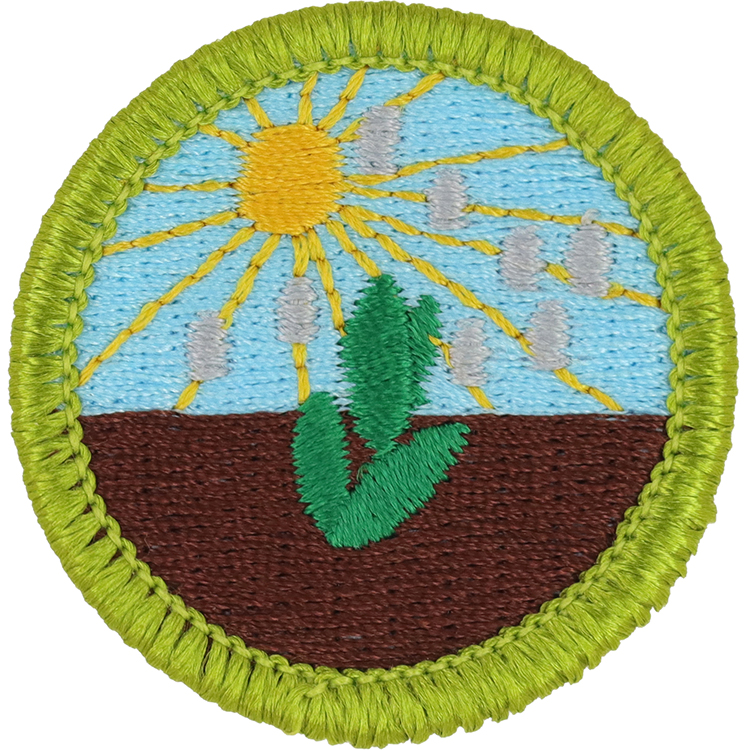
Fig. 1: PlaSci-H5-Front
- Embroidery: Rayon thread
- Border: Merrowed

Fig. 2: PlaSci-H5-Reverse
- Back: Molded plastic
Item Name: Plant Science 1990 - 2002
Item ID: PlaSci-H5
Collector Rating: 1
Pamphlets Used to Earn this Badge
Requirements January 1975 until January 2006
1. Explain the nature and function of the soil. Tell about its texture, structure, need for water, air, organic matter, and the relationship of plants to the soil. Tell how the soil may be improved. Select one soil type from your area. Describe it in relation to the above.
2. Describe how to prepare a seedbed for each of the crops in the options below. Submit a plan for planting an orchard crop. Describe the best type of site for such an orchard.
3. Make and use a germination seed tester to test 50 seeds of four of the following plants: corn, cotton, alfalfa, soybeans, clover, wheat, rice, rye, barley. Determine percent of live seeds.
4. Tell how to propagate plants by seeds, roots, cuttings, tubers, buds, and grafts.
5. Tell about one important insect pest and one important disease that damage each of the following: corn, small grains, cotton, and fruit trees. Collect and name five weeds that damage crops in your locality. Tell how to control these without harming people, wildlife, or useful insects.
6. On a map of the United States indicate the chief regions where the crops listed in the options are produced. Indicate a leading state in production of each crop. Tell how climate and location of these states make them leaders.
7. Tell about three career opportunities in crop production.
8. Complete ONE of the following options:
Corn Option
(a) Grow a plot of corn. Record seed variety or experimental code number.
(b) Have your plot inspected by your counselor. Tell about modern methods of commercial corn farming.
(c) Tell about the contributions corn makes to today's food supply.
Cotton Option
(a) Grow a plot of cotton.
(b) Have your plot inspected by your counselor. Tell about modern methods of commercial cotton farming.
(c) Tell about an insect that causes serious damage. Tell how it affects cotton production. Tell how it is controlled.
(d) Tell how cotton is processed from the field to the finished product.
Forage Crops Option
(a) Collect and mount for display three samples of each: perennial grasses, annual grasses, legumes, and broadleaf weeds. Label each grass and legume, indicating what use is made of it. Label each weed. Tell where each is most likely to be found.
(b) Explain how legumes can be used to enrich the soil. Tell how they may deplete it under certain conditions. Do the same for grasses.
(c) Describe five poisonous plants dangerous to livestock.
(d) Tell the different ways for using forage crops as feed for livestock.
Fruit and Nuts Option
(a) Plant five fruit or nut trees, grapevines, or berry plants.
(b) Take full care of fruit or nut trees, grapevines, or berry plants through one crop season.
(c) Prune a tree, vine, or bush properly. Explain why pruning is necessary.
(d) Demonstrate how a graft is made.
(e) Describe how one fruit, nut, or berry crop is processed for use.
Small Grains Option
(a) Give production figures for the small-grain crops listed in the United States Statistical Report for the latest year available.
(b) Help in harvesting a crop of grain. Tell how to reduce harvesting losses.
(c) Visit a grain elevator, flour mill, cereal plant, feed or seed company. Talk with the operator. Take notes. Describe the processes used.
Oil Crops Option
(a) Grow a plot of soybeans.
(b) Have your plot inspected by your counselor.
(c) Tell about modern methods of soybean growing on a commercial scale.
(d) Tell of the contribution soybeans make to our food supply.