-
Merit Badges
- Legend to identify Merit Badges
- 1910 British Merit Badges
- Square 1911 - 33
- Wide Crimped 1934 & 35
-
Narrow Tan Crimped 1936 - 42
- Tan Heavyweight Cloth with Silk Embroidery and Printed Back 1936 - 37
- Tan Heavyweight Cloth with Silk Embroidery and Plain Back 1937 - 38
- Tan Lightweight Cloth with Silk Embroidery and Plain Back 1938 - 39
- Tan Lightweight Cloth with Cotton Continuous Loop Embroidery and Plain Back 1939 - 42
- Tan Lightweight Cloth with Cotton Lockstitch Embroidery and Plain Back 1939 - 42
- Blue Background 1942 - 46
- Wartime 1942 - 46
- Khaki Narrow Crimped 1946 - 59
- Green Twill Gauze Back 1960 - 68
- Fully Embroidered Merrowed Edge 1960 - 72
- Unprinted Plastic Back 1972 - 01
- Printed Plastic Back 2002 - Current
-
Merit Badge Paper
- Merit Badge Applications
- Merit Badge Cards
-
Merit Badge Pamphlets
- Type 1 White Cover - Rectangle Drawing On Cover
- Type 2 White Cover 5-375" x 8" Title at Top
- Type 3A Tan Cover - 200 Fifth Avenue
- Type 3B Tan Cover - 2 line address New York City
- Type 3C Tan Cover - 2 line address New York N.Y.
- Type 3D Tan Cover - 1 line address New York N.Y.
- Type 4 Standing Scout Cover
- Type 5A War Cover
- Type 5B Red and White
- Type 6 Photo-Red Cover
- Type 7 Full Photo Cover or Bulls-eye Cover
- Type 8 Full Photo - Green Stripe Cover
- Type 9 Full Photo - Red Stripe Cover
- Type 10A Blue Stripe - Logo above bottom blue stripe - FDL centered
- Type 10B - Blue Stripe in bottom of photo area. FDL to left of text
- Special Covers
- Boy Craft Helps
- Merit Badge Counselor's Guides
-
Youth Position
- Junior Assistant Scoutmaster
- Senior Patrol Leader
- Assistant Senior Patrol Leader
- Patrol Leader
- Assistant Patrol Leader
- Troop Guide
- Scribe
- Quartermaster
- Instructor
- Chaplain Aide
- Den Chief
- Librarian
- Musician
- Webmaster
- Bugler
- Troop Historian
- Troop Representative
- Unit Representative
- Leadership Corps
- Honor Guard
- Leave No Trace Trainer
- Outdoor Ethics Guide
-
Patrol Medallions
- Patrol Medallions Introduction
- Legend to identify Patrol Medallions
- Patrol Shoulder Knot-Ribbons
- Felt Handmade Patrol Medallions
- Square Felt Patrol Medallions
- Round Broadcloth Patrol Medallions
- Red Twill Patrol Medallions
- Multi-Color Cloth Patrol Medallions
- Tan Cloth Patrol Medallions
- Patrol Medallion Back Patches
- Woodbadge Patrol Medallion
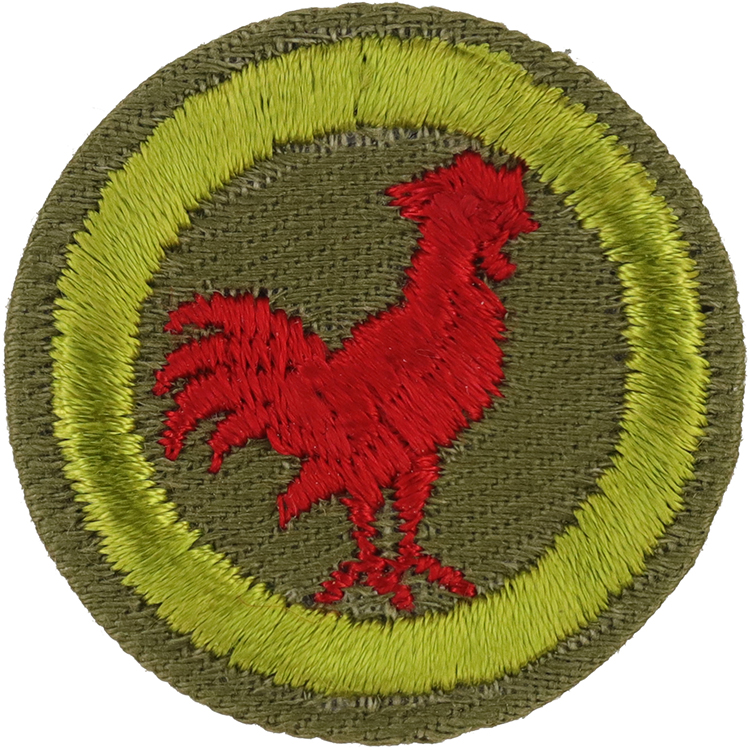
Fig. 1: PouKee-E2-Front
- Cloth: Khaki right twill
- Embroidery: Cotton lock stitch
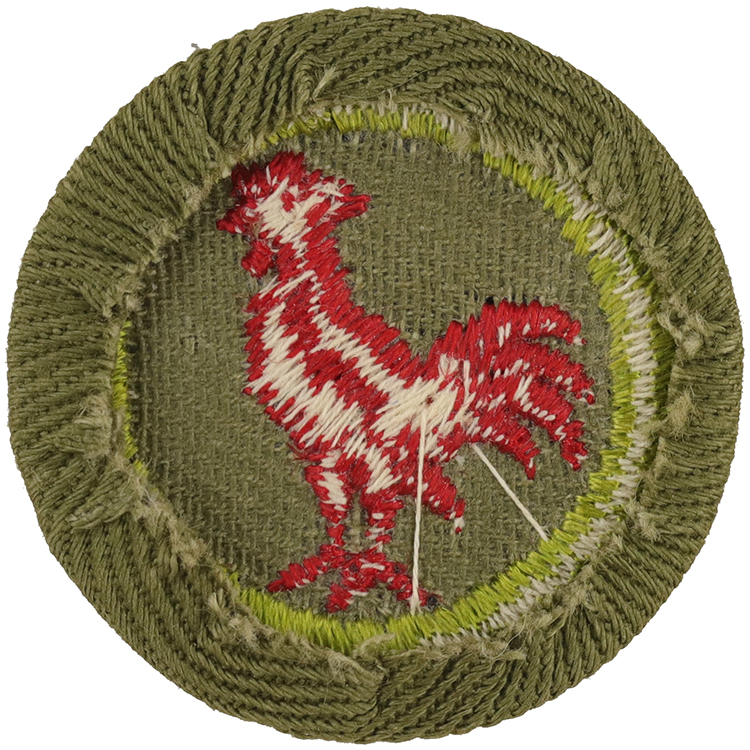
Fig. 2: PouKee-E2-Reverse
- Back: Plain NO imprint with starch
Item Name: Poultry Keeping 1947 - 1960
Item ID: PouKee-E2
Collector Rating: 1
Pamphlets Used to Earn this Badge

Requirements April 1930 until June 1948
1. Have a knowledge of incubators, foster-mothers, sanitary fowl houses, coops and runs.
2. Understand, through experience, rearing, feeding, killing and dressing birds for market.
3. Be able to candle and pack eggs for market; describe the differences, in candling, which distinguish the bad eggs from the good; and tell how eggs are graded.
4. Raise a brood of not less than ten chickens.
5. Report his observations and study of the hen, turkey, duck and goose.
OR
Comply with the 4-H Club or Home Project Requirements in Poultry Management as follows:
1. Own a pen of chickens.
2. Do all the work in its care and management as required in the project by leaders.
3. Keep accurate cost account records.
4. Exhibit poultry as required by state and county leaders in charge.
5. Make complete report at end of season or year as required by leaders in charge.
Requirements June 1948 until June 1952
1. Have a knowledge of incubators, foster-mothers, sanitary fowl houses, coops and runs.
2. Understand, through experience, rearing, feeding, killing and dressing birds for market.
3. Be able to candle and pack eggs for market, describe the differences, in candling, which distinguish the bad eggs from the good; and tell how eggs are graded.
4. Raise a brood of not less than ten chickens.
5. Report his observations and study of the hen, turkey, duck and goose.
OR
Comply with the 4-H Club or Home Project Requirements in Poultry Management.
Requirements June 1952 until January 1957
1. Have a knowledge of incubators, brooders, sanitary fowl houses, coops and runs.
2. Understand, through experience, rearing, feeding, killing and dressing birds for market.
3. Be able to candle and pack eggs for market, describe the differences, in candling, which distinguish the bad eggs from the good; and tell how eggs are graded.
4. Raise a brood of not less than ten fowl.
5. Report his observations and study of the hen, turkey, duck and goose.
OR
Comply with the 4-H Club or Home Project Requirements in Poultry Management.
Requirements January 1957 until June 1972
Complete the requirements in one of the following groups:
Rearing Pullets
1. Raise and take care of twenty or more chicks (straight run or pullet) for five months.
2. Keep records on all management practices (feed consumption, mortality, medications, vaccinations) and present them to your merit badge counselor.
3. Tell how to identify three poultry diseases common in your area and how you prevent your pullets from contracting these diseases.
4. Make one piece of equipment (waterer, feeder, brooder, for example) and put it to good use.
5. Describe the brooding house in which you raised your pullets. Explain how you provided for proper sanitation and ventilation.
Flock Management
1. Manage a flock (your own or a neighbor's) of ten or more pullets or hens for six months. Birds should be at least five months old at the start.
2. Keep daily egg production records and records on feed consumption and mortality. Turn these records in to your merit badge counselor.
3. Tell how to identify three poultry diseases common in your area and how you prevent your birds from contracting these diseases. Explain culling.
4. Make one piece of equipment (feeder, waterer, catching hood, roosts, for example) and put it to good use.
5. Candle, grade, and pack two dozen eggs for market.
Poultry Meat Production
1. Raise twenty or more broilers, fryers, roasters, caponettes, capons, turkeys, or ducks to market age.
2. Keep accurate records of feed consumption, mortality, weight gains, etc., and turn them in to your merit badge counselor.
3. Write a concise report on the management of your birds. Include information on brooding, housing sanitation, feeding, and disease control.
4. Make one piece of equipment (feeder, waterer, catching hook, disposal pit, for example) and put it to good use.
5. Kill and dress two birds for market.
* As a 4-H'er, complete a club project in this subject. Or as an FFA member, meet these or equivalent requirements through the FFA supervised farming program.