-
Merit Badges
- Legend to identify Merit Badges
- 1910 British Merit Badges
- Square 1911 - 33
- Wide Crimped 1934 & 35
-
Narrow Tan Crimped 1936 - 42
- Tan Heavyweight Cloth with Silk Embroidery and Printed Back 1936 - 37
- Tan Heavyweight Cloth with Silk Embroidery and Plain Back 1937 - 38
- Tan Lightweight Cloth with Silk Embroidery and Plain Back 1938 - 39
- Tan Lightweight Cloth with Cotton Continuous Loop Embroidery and Plain Back 1939 - 42
- Tan Lightweight Cloth with Cotton Lockstitch Embroidery and Plain Back 1939 - 42
- Blue Background 1942 - 46
- Wartime 1942 - 46
- Khaki Narrow Crimped 1946 - 59
- Green Twill Gauze Back 1960 - 68
- Fully Embroidered Merrowed Edge 1960 - 72
- Unprinted Plastic Back 1972 - 01
- Printed Plastic Back 2002 - Current
-
Merit Badge Paper
- Merit Badge Applications
- Merit Badge Cards
-
Merit Badge Pamphlets
- Type 1 White Cover - Rectangle Drawing On Cover
- Type 2 White Cover 5-375" x 8" Title at Top
- Type 3A Tan Cover - 200 Fifth Avenue
- Type 3B Tan Cover - 2 line address New York City
- Type 3C Tan Cover - 2 line address New York N.Y.
- Type 3D Tan Cover - 1 line address New York N.Y.
- Type 4 Standing Scout Cover
- Type 5A War Cover
- Type 5B Red and White
- Type 6 Photo-Red Cover
- Type 7 Full Photo Cover or Bulls-eye Cover
- Type 8 Full Photo - Green Stripe Cover
- Type 9 Full Photo - Red Stripe Cover
- Type 10A Blue Stripe - Logo above bottom blue stripe - FDL centered
- Type 10B - Blue Stripe in bottom of photo area. FDL to left of text
- Special Covers
- Boy Craft Helps
- Merit Badge Counselor's Guides
-
Youth Position
- Junior Assistant Scoutmaster
- Senior Patrol Leader
- Assistant Senior Patrol Leader
- Patrol Leader
- Assistant Patrol Leader
- Troop Guide
- Scribe
- Quartermaster
- Instructor
- Chaplain Aide
- Den Chief
- Librarian
- Musician
- Webmaster
- Bugler
- Troop Historian
- Troop Representative
- Unit Representative
- Leadership Corps
- Honor Guard
- Leave No Trace Trainer
- Outdoor Ethics Guide
-
Patrol Medallions
- Patrol Medallions Introduction
- Legend to identify Patrol Medallions
- Patrol Shoulder Knot-Ribbons
- Felt Handmade Patrol Medallions
- Square Felt Patrol Medallions
- Round Broadcloth Patrol Medallions
- Red Twill Patrol Medallions
- Multi-Color Cloth Patrol Medallions
- Tan Cloth Patrol Medallions
- Patrol Medallion Back Patches
- Woodbadge Patrol Medallion

Fig. 1: Progra-L1-Front
- Embroidery: Rayon thread
- Border: Merrowed
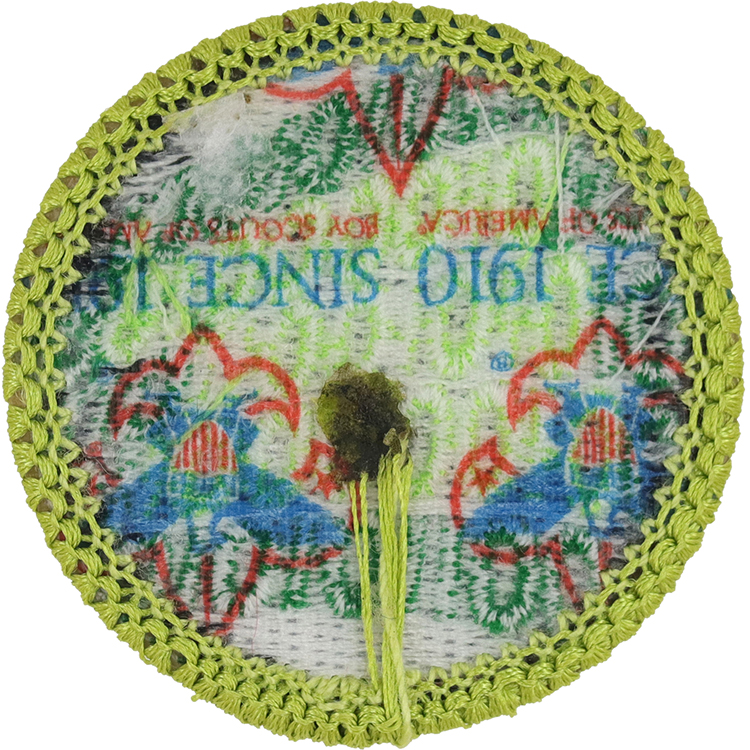
Fig. 2: Progra-L1-Reverse
- Back: Since 1910 imprint with large Tenderfoot image
Item Name: Programming 2014 - Current
Item ID: Progra-L1
Collector Rating: 1
Pamphlets Used to Earn this Badge

Requirements January 2014 until January 2017
1. Do the following:
- Show your counselor your current, up to date cyber chip.
- Discuss first aid and prevention for potential injuries, such as eyestrain and repetive stress injuries that could occur during programming activities.
2. Do the following:
- Give a brief history of programming, including at least three milestones related to the advancement or development of programming.
- Discuss with your counselor the history of programming and the evolution of programming languages.
3. General knowledge. Do the following:
- Create a list of 10 popular programming languages in use today and describe which industry or industries they are primarily used in and why.
- Describe three different programmed devices you rely on every day.
4. ntellectual property. Do the following:
- Explain the four types of intellectual property used to protect computer programsr.
- Describe the difference between licensing and owning software.
- Describe the differences between freeware, open source, and commercial software, and why it is important to respect the terms of use of each.
5. Do the following:
- With your counselor’s approval, choose a sample program. Modify the code or add a function or subroutine to it. Debug and demonstrate the modified program to your counselor.
- With your counselor’s approval, choose a second programming language and a development environment, different from those used in requirement 5a and in a different industry from 5a. Then write, debug, and demonstrate a functioning program to your counselor, using that language and environment.
- With your counselor’s approval, choose a third programming language and development environment, different from those used for requirements 5a and 5b and in a different industry from 5a or 5b. Then write, debug, and demonstrate a functioning program to your counselor, using that language and environment.
- Explain how the programs you wrote the requirements 5a, 5b, and 5c process inputs, how they make decisions based on those inputs, and how they provide outputs based on the decision making.
6. Careers. Find out about three career opportunities in programming. Pick one and find out the education, training, and experience required. Discuss this with your counselor and explain why this career might be of interest to you.
Requirements January 2017 until Current
1. Do the following:
- Show your counselor your current, up to date cyber chip.
- Discuss first aid in prevention for the types of injuries or illnesses that could occur during programming activities, including repetitive stress injuries and eyestrain.
2. Do the following:
- Give a brief history of programming, including at least three milestones related to the advancement or development of programming.
- Describe the evolution of programming methods and how they have improved over time.
3. General knowledge. Do the following:
- Create a list of 10 popular programming languages in use today and describe which industry or industries they are primarily used in and why.
- Describe three different programmed devices you rely on every day.
4. ntellectual property. Do the following:
- Explain how software patents and copyrights protect a programmer.
- Describe the difference between licensing and owning software.
- Describe the differences between freeware, open source, and commercial software, and why it is important to respect the terms of use of each.
5. Do the following:
- With your counselor’s approval, choose a sample program. Then, as a minimum, modify the code or at function or subprogram to it. Debug and demonstrate the modified program to your counselor.
- With your counselor’s approval, choose a second programming language and a development environment, different from those used in requirement 5a and in a different industry from 5a. Then write, debug, and demonstrate a functioning program to your counselor, using that language and environment.
- With your counselor’s approval, choose a third programming language and development environment, different from those used for requirements 5a and 5b and in a different industry from 5a or 5b. Then write, debug, and demonstrate a functioning program to your counselor, using that language and environment.
- Explain how the programs you wrote the requirements 5a, 5b, and 5c process inputs, how they make decisions based on those inputs, and how they provide outputs based on the decision making.
6. Careers. Find out about three career opportunities in programming that require knowledge in programming. Pick one and find out the education, training, and experience required. Discuss this with your counselor and explain why this career might be of interest to you.