-
Merit Badges
- Legend to identify Merit Badges
- 1910 British Merit Badges
- Square 1911 - 33
- Wide Crimped 1934 & 35
-
Narrow Tan Crimped 1936 - 42
- Tan Heavyweight Cloth with Silk Embroidery and Printed Back 1936 - 37
- Tan Heavyweight Cloth with Silk Embroidery and Plain Back 1937 - 38
- Tan Lightweight Cloth with Silk Embroidery and Plain Back 1938 - 39
- Tan Lightweight Cloth with Cotton Continuous Loop Embroidery and Plain Back 1939 - 42
- Tan Lightweight Cloth with Cotton Lockstitch Embroidery and Plain Back 1939 - 42
- Blue Background 1942 - 46
- Wartime 1942 - 46
- Khaki Narrow Crimped 1946 - 59
- Green Twill Gauze Back 1960 - 68
- Fully Embroidered Merrowed Edge 1960 - 72
- Unprinted Plastic Back 1972 - 01
- Printed Plastic Back 2002 - Current
-
Merit Badge Paper
- Merit Badge Applications
- Merit Badge Cards
-
Merit Badge Pamphlets
- Type 1 White Cover - Rectangle Drawing On Cover
- Type 2 White Cover 5-375" x 8" Title at Top
- Type 3A Tan Cover - 200 Fifth Avenue
- Type 3B Tan Cover - 2 line address New York City
- Type 3C Tan Cover - 2 line address New York N.Y.
- Type 3D Tan Cover - 1 line address New York N.Y.
- Type 4 Standing Scout Cover
- Type 5A War Cover
- Type 5B Red and White
- Type 6 Photo-Red Cover
- Type 7 Full Photo Cover or Bulls-eye Cover
- Type 8 Full Photo - Green Stripe Cover
- Type 9 Full Photo - Red Stripe Cover
- Type 10A Blue Stripe - Logo above bottom blue stripe - FDL centered
- Type 10B - Blue Stripe in bottom of photo area. FDL to left of text
- Special Covers
- Boy Craft Helps
- Merit Badge Counselor's Guides
-
Youth Position
- Junior Assistant Scoutmaster
- Senior Patrol Leader
- Assistant Senior Patrol Leader
- Patrol Leader
- Assistant Patrol Leader
- Troop Guide
- Scribe
- Quartermaster
- Instructor
- Chaplain Aide
- Den Chief
- Librarian
- Musician
- Webmaster
- Bugler
- Troop Historian
- Troop Representative
- Unit Representative
- Leadership Corps
- Honor Guard
- Leave No Trace Trainer
- Outdoor Ethics Guide
-
Patrol Medallions
- Patrol Medallions Introduction
- Legend to identify Patrol Medallions
- Patrol Shoulder Knot-Ribbons
- Felt Handmade Patrol Medallions
- Square Felt Patrol Medallions
- Round Broadcloth Patrol Medallions
- Red Twill Patrol Medallions
- Multi-Color Cloth Patrol Medallions
- Tan Cloth Patrol Medallions
- Patrol Medallion Back Patches
- Woodbadge Patrol Medallion
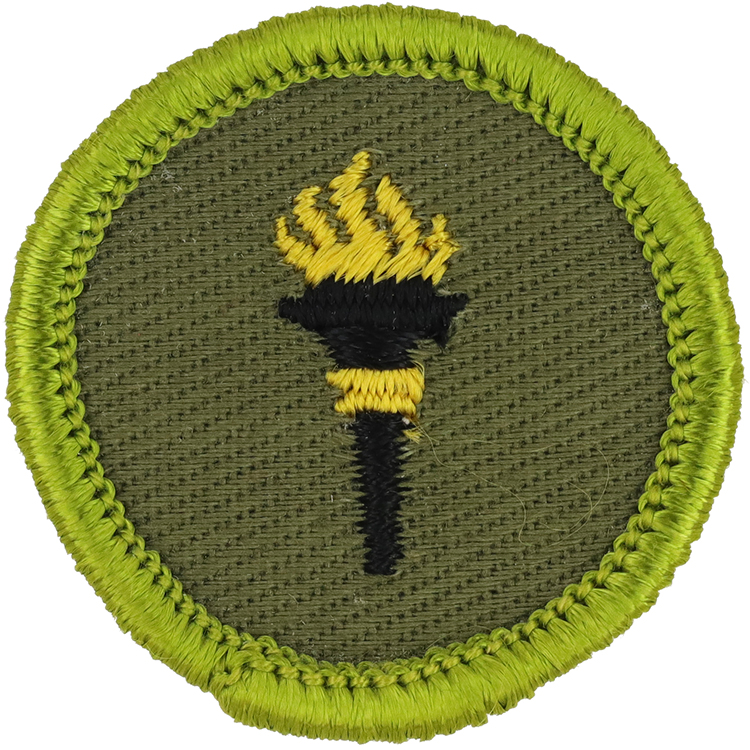
Fig. 1: PubHea-F-Front
- Cloth: Green right twill
- Border: Merrowed
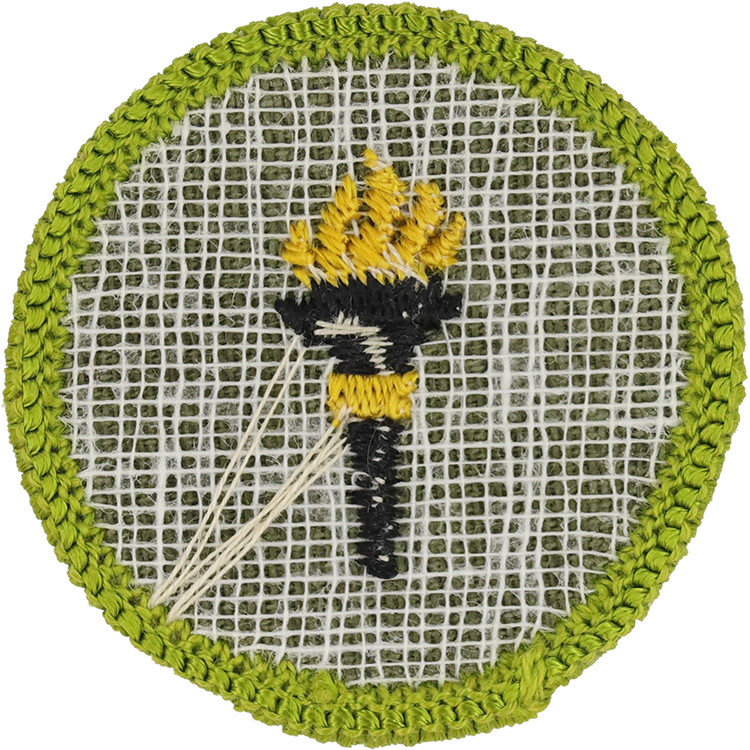
Fig. 2: PubHea-F-Reverse
- Back: Gauze reinforced starched
Item Name: Public Health 1961 - 1968
Item ID: PubHea-F
Collector Rating: 1
Pamphlets Used to Earn this Badge
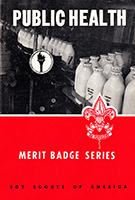

Requirements January 1957 until September 1962
1. Tell how people contract five of the following diseases and what you and the health department can do to prevent their spread: typhoid fever, diphtheria, malaria, hookworm, Rocky Mountain spotted fever, tetanus (lockjaw), rabies, whooping cough, scarlet fever, tuberculosis, smallpox.
2. (a) Name two diseases common to animal and man that can be caught by a person through the drinking of unpasteurized milk. (b) Name two diseases that can be caught by drinking polluted water. (c) Name two diseases that can be spread by rats.
3. Explain how flies may be controlled and their breeding places destroyed.
4. Name three diseases against which an infant should be immunized and two diseases against which boys of Scout and Explorer age should be immunized.
5. Do two of the following: (a) Visit your state, county, or local health department and prepare an outline of its principal functions. (b) Visit your water treatment plant and prepare an outline of the major steps in the water treatment used to protect your community from diseases that may be spread by water. (c) Prepare a simple sketch of a home sewage disposal system and tell how it should be located and constructed to protect against the pollution of nearby wells or springs. (d) Visit a dairy farm and prepare an outline of the measures taken to produce clean milk for pasteurization. (e) Visit a milk pasteurization plant and prepare a brief statement on the pasteurization of milk. (f) Visit your community sewage treatment plant and prepare a brief statement about sewage disposal.
6. Do the following: (a) Filter one full canteen of muddy water, using clean cloth or other materials, and then make the water safe for drinking either by treatment with suitable chemical or by boiling water. (b) Dig and make ready for use either a straddle trench latrine or a "cathole" latrine; then fill in properly. (c) Properly dispose of garbage and rubbish from a camp site. (d) Describe how milk could be pasteurized in your home and make a quart of raw milk safe to drink.
7. Explain two purposes of the "recheck" examination given to Scouts by a medical doctor when they arrive at a council camp.
Requirements September 1962 until January 1969
1. Tell how people contract five of the following diseases and what you and the health department can do to prevent their spread: typhoid fever, diphtheria, malaria, hookworm, Rocky Mountain spotted fever, tetanus (lockjaw), rabies, whooping cough, scarlet fever, tuberculosis, smallpox.
2. (a) Name two diseases common to animal and man that can be caught by a person through the drinking of unpasteurized milk. (b) Name two diseases that can be caught by drinking polluted water. (c) Name two diseases that can be spread by rats.
3. Explain how flies may be controlled and their breeding places destroyed.
4. Name three diseases against which an infant should be immunized and two diseases against which boys of Scout and Explorer age should be immunized.
5. Do two of the following: (a) Visit your state, county, or local health department and prepare an outline of its principal functions. (b) Visit your water treatment plant and prepare an outline of the major steps in the water treatment used to protect your community from diseases that may be spread by water. (c) Prepare a simple sketch of a home sewage disposal system and tell how it should be located and constructed to protect against the pollution of nearby wells or springs. (d) Visit a dairy farm and prepare an outline of the measures taken to produce clean milk for pasteurization. (e) Visit a milk pasteurization plant and prepare a brief statement on the pasteurization of milk. (f) Visit your community sewage treatment plant and prepare a brief statement about sewage disposal.
6. Do the following: (a) Filter one full canteen of muddy water, using clean cloth or other materials, and then make the water safe for drinking either by treatment with suitable chemical or by boiling water. (b) Dig and make ready for use either a straddle trench latrine or a "cathole" latrine; then fill in properly. (c) Properly dispose of garbage and rubbish from a camp site. (d) Describe how milk could be pasteurized in your home and made safe to drink.
7. Explain two purposes of the "recheck" examination given to Scouts by a medical doctor when they arrive at a council camp.