-
Merit Badges
- Legend to identify Merit Badges
- 1910 British Merit Badges
- Square 1911 - 33
- Wide Crimped 1934 & 35
-
Narrow Tan Crimped 1936 - 42
- Tan Heavyweight Cloth with Silk Embroidery and Printed Back 1936 - 37
- Tan Heavyweight Cloth with Silk Embroidery and Plain Back 1937 - 38
- Tan Lightweight Cloth with Silk Embroidery and Plain Back 1938 - 39
- Tan Lightweight Cloth with Cotton Continuous Loop Embroidery and Plain Back 1939 - 42
- Tan Lightweight Cloth with Cotton Lockstitch Embroidery and Plain Back 1939 - 42
- Blue Background 1942 - 46
- Wartime 1942 - 46
- Khaki Narrow Crimped 1946 - 59
- Green Twill Gauze Back 1960 - 68
- Fully Embroidered Merrowed Edge 1960 - 72
- Unprinted Plastic Back 1972 - 01
- Printed Plastic Back 2002 - Current
-
Merit Badge Paper
- Merit Badge Applications
- Merit Badge Cards
-
Merit Badge Pamphlets
- Type 1 White Cover - Rectangle Drawing On Cover
- Type 2 White Cover 5-375" x 8" Title at Top
- Type 3A Tan Cover - 200 Fifth Avenue
- Type 3B Tan Cover - 2 line address New York City
- Type 3C Tan Cover - 2 line address New York N.Y.
- Type 3D Tan Cover - 1 line address New York N.Y.
- Type 4 Standing Scout Cover
- Type 5A War Cover
- Type 5B Red and White
- Type 6 Photo-Red Cover
- Type 7 Full Photo Cover or Bulls-eye Cover
- Type 8 Full Photo - Green Stripe Cover
- Type 9 Full Photo - Red Stripe Cover
- Type 10A Blue Stripe - Logo above bottom blue stripe - FDL centered
- Type 10B - Blue Stripe in bottom of photo area. FDL to left of text
- Special Covers
- Boy Craft Helps
- Merit Badge Counselor's Guides
-
Youth Position
- Junior Assistant Scoutmaster
- Senior Patrol Leader
- Assistant Senior Patrol Leader
- Patrol Leader
- Assistant Patrol Leader
- Troop Guide
- Scribe
- Quartermaster
- Instructor
- Chaplain Aide
- Den Chief
- Librarian
- Musician
- Webmaster
- Bugler
- Troop Historian
- Troop Representative
- Unit Representative
- Leadership Corps
- Honor Guard
- Leave No Trace Trainer
- Outdoor Ethics Guide
-
Patrol Medallions
- Patrol Medallions Introduction
- Legend to identify Patrol Medallions
- Patrol Shoulder Knot-Ribbons
- Felt Handmade Patrol Medallions
- Square Felt Patrol Medallions
- Round Broadcloth Patrol Medallions
- Red Twill Patrol Medallions
- Multi-Color Cloth Patrol Medallions
- Tan Cloth Patrol Medallions
- Patrol Medallion Back Patches
- Woodbadge Patrol Medallion
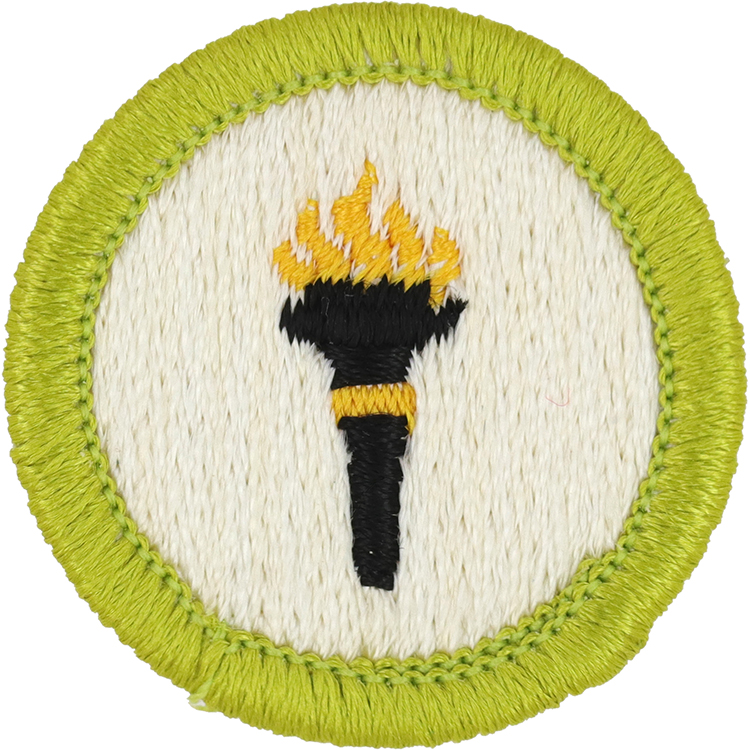
Fig. 1: PubHea-H4-Front
- Embroidery: Cotton thread, dull sheen
- Border: Lt green merrowed
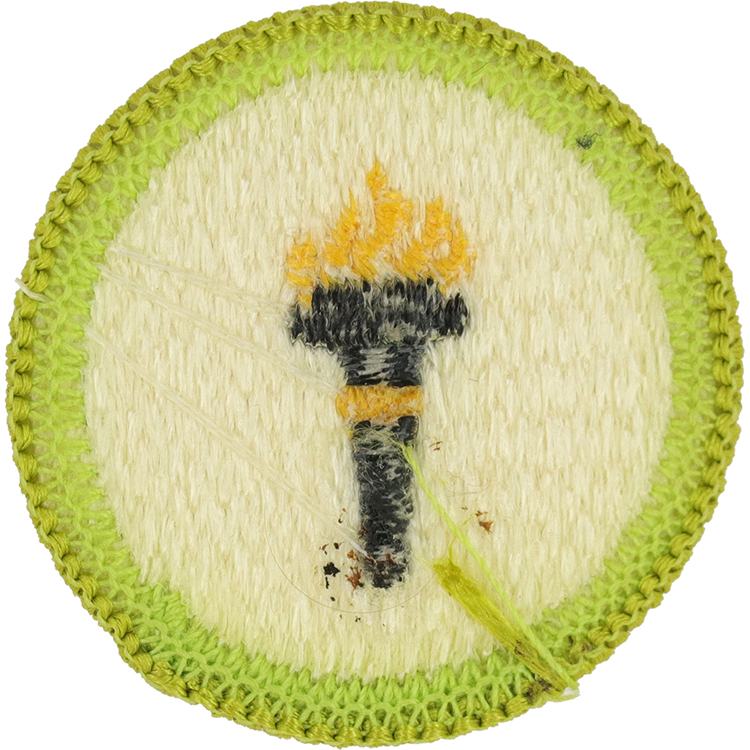
Fig. 2: PubHea-H4-Reverse
- Back: Lt green lock stitch, molded plastic
Item Name: Public Health 1978 - 1990
Item ID: PubHea-H4
Collector Rating: 1
Pamphlets Used to Earn this Badge
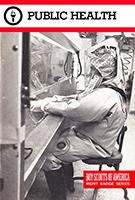
Requirements June 1972 until February 1979
1. Explain the difference between infectious and chronic disease.
2. Explain how people catch the following diseases. Describe how they are spread: typhoid fever, poliomyelitis, hookworm, Rocky Mountain spotted fever, tetanus, rabies, tuberculosis, yellow fever.
3. Do the following:
(a) Explain the meaning of "immunization."
(b) Name three diseases against which a baby should be immunized.
(c) Name two diseases against which you should be immunized.
4. Name two diseases that can be caught from drinking unpasteurized milk.
5. Do the following:
(a) Describe the health aspects of preparing and handling food.
(b) Explain how dishes and utensils should be washed.
6. Show two ways to make water safe to drink.
7. Do the following:
(a) Explain how flies may be controlled. Tell how their breeding places can be destroyed.
(b) Get rid of garbage and rubbish from a camp or home. Tell how this helps control flies.
(c) Prepare a drawing of a home sewage system. Tell how it should be located and built to keep from polluting wells and springs.
8. Do the following:
(a) Describe the health dangers from air and water pollution.
(b) Describe health dangers from cigarette smoking.
9. Explain the reason for the camp arrival medical screening.
10. Visit your city, county, or state health department. Prepare an outline of its various services.
Requirements February 1979 until September 1987
1. Visit your city, county, or state public health agency. Prepare an outline of its various services and:
(a) Explain them briefly to your counselor.
b) Explain how these affect you.
(c) Tell about three professions of the people providing these services.
2. Explain how the following diseases are spread: tetanus, influenza, gonorrhea, hepatitis, trichinosis, syphilis, emphysema, equine encephalitis, salmonellosis, Rocky Mountain spotted fever, mushroom poisoning.
3. Do the following:
(a) Explain the meaning of immunization.
(b) Name five diseases against which a baby should be immunized.
(c) Name two diseases against which you should be immunized.
4. Explain:
(a) How foods can become contaminated.
(b) What conditions allow germs to increase in number in food.
(c) How germs in food can be killed.
(d) How dishes and utensils should be washed in camp and at home.
5. Do the following:
(a) Show two ways of making water safe to drink under camping conditions.
(b) Describe the steps used in making public drinking water safe.
6. Do the following:
(a) Explain how household insects and rodents can be controlled in your home, community, and camp.
(b) Describe a system by which sewage can be safely disposed of from housing in cities, from houses in rural areas, and under primitive camping conditions.
7. Do the following:
(a) Describe the health dangers from air, water, and noise pollution.
(b) Describe health dangers from cigarette smoking.