-
Merit Badges
- Legend to identify Merit Badges
- 1910 British Merit Badges
- Square 1911 - 33
- Wide Crimped 1934 & 35
-
Narrow Tan Crimped 1936 - 42
- Tan Heavyweight Cloth with Silk Embroidery and Printed Back 1936 - 37
- Tan Heavyweight Cloth with Silk Embroidery and Plain Back 1937 - 38
- Tan Lightweight Cloth with Silk Embroidery and Plain Back 1938 - 39
- Tan Lightweight Cloth with Cotton Continuous Loop Embroidery and Plain Back 1939 - 42
- Tan Lightweight Cloth with Cotton Lockstitch Embroidery and Plain Back 1939 - 42
- Blue Background 1942 - 46
- Wartime 1942 - 46
- Khaki Narrow Crimped 1946 - 59
- Green Twill Gauze Back 1960 - 68
- Fully Embroidered Merrowed Edge 1960 - 72
- Unprinted Plastic Back 1972 - 01
- Printed Plastic Back 2002 - Current
-
Merit Badge Paper
- Merit Badge Applications
- Merit Badge Cards
-
Merit Badge Pamphlets
- Type 1 White Cover - Rectangle Drawing On Cover
- Type 2 White Cover 5-375" x 8" Title at Top
- Type 3A Tan Cover - 200 Fifth Avenue
- Type 3B Tan Cover - 2 line address New York City
- Type 3C Tan Cover - 2 line address New York N.Y.
- Type 3D Tan Cover - 1 line address New York N.Y.
- Type 4 Standing Scout Cover
- Type 5A War Cover
- Type 5B Red and White
- Type 6 Photo-Red Cover
- Type 7 Full Photo Cover or Bulls-eye Cover
- Type 8 Full Photo - Green Stripe Cover
- Type 9 Full Photo - Red Stripe Cover
- Type 10A Blue Stripe - Logo above bottom blue stripe - FDL centered
- Type 10B - Blue Stripe in bottom of photo area. FDL to left of text
- Special Covers
- Boy Craft Helps
- Merit Badge Counselor's Guides
-
Youth Position
- Junior Assistant Scoutmaster
- Senior Patrol Leader
- Assistant Senior Patrol Leader
- Patrol Leader
- Assistant Patrol Leader
- Troop Guide
- Scribe
- Quartermaster
- Instructor
- Chaplain Aide
- Den Chief
- Librarian
- Musician
- Webmaster
- Bugler
- Troop Historian
- Troop Representative
- Unit Representative
- Leadership Corps
- Honor Guard
- Leave No Trace Trainer
- Outdoor Ethics Guide
-
Patrol Medallions
- Patrol Medallions Introduction
- Legend to identify Patrol Medallions
- Patrol Shoulder Knot-Ribbons
- Felt Handmade Patrol Medallions
- Square Felt Patrol Medallions
- Round Broadcloth Patrol Medallions
- Red Twill Patrol Medallions
- Multi-Color Cloth Patrol Medallions
- Tan Cloth Patrol Medallions
- Patrol Medallion Back Patches
- Woodbadge Patrol Medallion
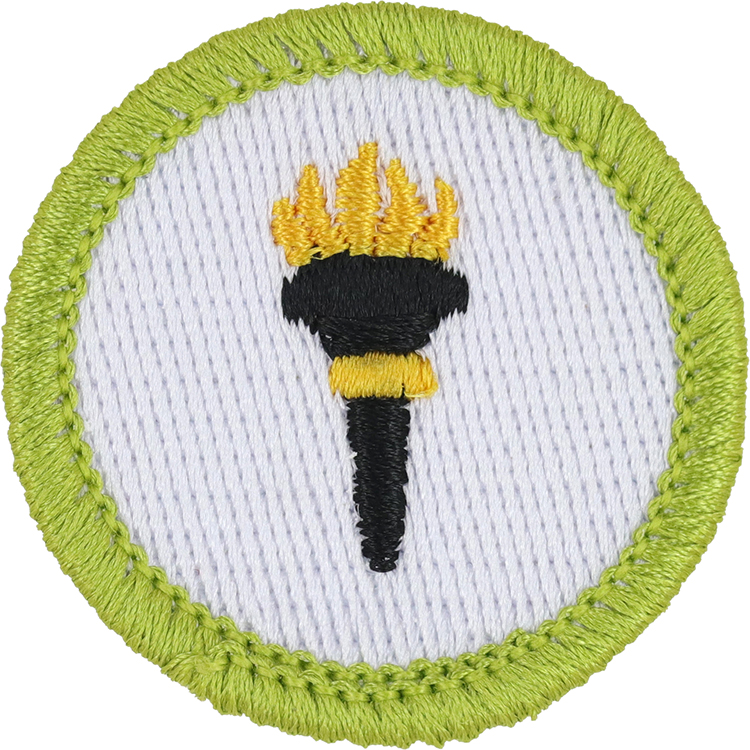
Fig. 1: PubHea-L1-Front
- Embroidery: Rayon thread
- Border: Merrowed
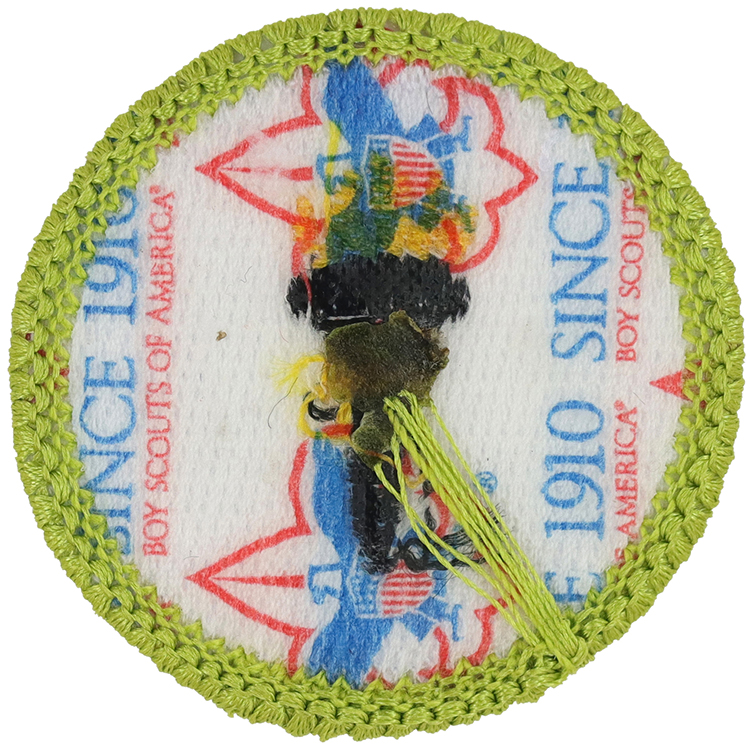
Fig. 2: PubHea-L1-Reverse
- Back: Since 1910 imprint with large Tenderfoot image
Item Name: Public Health 2014 - Current
Item ID: PubHea-L1
Collector Rating: 1
Pamphlets Used to Earn this Badge

Requirements January 2006 until January 2015
1. Explain what public health is. Explain how Escherichia coli (E. coli), tetanus, AIDS, encephalitis, salmonellosis, and Lyme disease are contracted. Then, pick any four of the following diseases and explain how each one is contracted: gonorrhea, West Nile virus, botulism, influenza, syphilis, hepatitis, emphysema, meningitis, herpes, lead poisoning. For all 10 diseases, explain the type or form of the disease (viral, bacterial, environmental, toxin), any possible vectors for transmission, ways to help prevent exposure or the spread of infection, and available treatments.
2. Do the following:
- Explain the meaning of immunization.
- Name five diseases against which a young child should be immunized and two diseases against which everyone should be reimmunized periodically.
- Using the diseases, you chose for requirement 1, discuss the diseases for which there is currently no treatment or immunization.
3. Discuss the importance of safe drinking water in terms of the spread of disease. Then, demonstrate two ways for making water safe to drink that can be used while at camp. In your demonstration, explain how dishes and utensils should be washed, dried, and kept sanitary at home and in camp.
4. Explain what a vector is and how insects and rodents can be controlled in your home, in your community, and at camp. Tell why this is important. In your discussion, explain which vectors can be easily controlled by individuals and which ones require long-term, collective action.
5. With your parent’s and counselor’s approval, do ONE of the following:
- Visit a municipal wastewater treatment facility OR a solid-waste management operation in your community. Describe how the facility safely treats and disposes of sewage or solid waste. Describe how sewage and solid waste should be disposed of under wilderness camping conditions.
- Arrange to meet with the food service manager of a food service facility (such as a restaurant or school cafeteria) and visit this establishment. Observe food preparation, handling, and storage, and learn how the facility keeps foods from becoming contaminated. Find out what conditions allow microorganisms to multiply in food and how conditions can be controlled to help prevent the growth and dissemination of microorganisms. Learn how microorganisms in food can be killed. Discuss what you learned with your counselor.
6. Do the following:
- Describe the health dangers from air, water, and noise pollution.
- Describe health dangers from tobacco use and alcohol and drug use.
7. With your parent’s and counselor’s approval, visit your city, county, or state public health agency. Discuss how the agency addresses the concerns raised in 1 through 6 and how the services provided by this agency affect your family. Then do the following:
- Compare the four leading causes of mortality (death) in your community for any of the past five years with the four leading causes of morbidity (incidence of disease) in your community. Explain how the public health agency you visited is trying to reduce the mortality and morbidity rates of these leading causes of illness and death.
- Explain the role of the health agency you visited related to the outbreak of diseases.
- Discuss the kinds of public assistance the agency is able to provide in case of disasters such as floods, storms, tornadoes, earthquakes, and other acts of destruction. Your discussion can include the cleanup necessary after a disaster occurs.
8. Pick a profession in the public health sector that interests you. Find out the education, training, and experience required to work in this profession. Discuss what you learn with your counselor.
Requirements January 2015 until Current
1. Explain what public health is. Explain how Escherichia coli (E. coli), tetanus, AIDS, encephalitis, salmonellosis, and Lyme disease are contracted. Then, pick any four of the following diseases and explain how each one is contracted and possibly prevented: gonorrhea, West Nile virus, botulism, influenza, syphilis, hepatitis, emphysema, meningitis, herpes, lead poisoning. For all 10 diseases, explain the type or form of the disease (viral, bacterial, environmental, toxin), any possible vectors for transmission, ways to help prevent exposure or the spread of infection, and available treatments.
2. Do the following:
- Explain the meaning of immunization.
- Name five diseases against which a young child should be immunized and two diseases against which everyone should be reimmunized periodically.
- Using the diseases, you chose for requirement 1, discuss the diseases for which there is currently no treatment or immunization. If treatment or immunizations are available for the diseases you chose, discuss others on the list.
3. Discuss the importance of safe drinking water in terms of the spread of disease. Then, demonstrate two ways for making water safe to drink that can be used while at camp. In your demonstration, explain how dishes and utensils should be washed, dried, and kept sanitary at home and in camp.
4. Explain what a vector is and how insects and rodents can be controlled in your home, in your community, and at camp. Tell why this is important. In your discussion, explain which vectors can be easily controlled by individuals and which ones require long-term, collective action.
5. With your parent’s and counselor’s approval, do ONE of the following:
- Visit a municipal wastewater treatment facility OR a solid-waste management operation in your community. Describe how the facility safely treats and disposes of sewage or solid waste. Describe how sewage and solid waste should be disposed of under wilderness camping conditions OR visit the mosquito abatement district facility in your community. Tell how your community attempts to control the mosquito population and why.
- Arrange to meet with the food service manager of a food service facility (such as a restaurant or school cafeteria) and visit this establishment. Observe food preparation, handling, and storage, and learn how the facility keeps foods from becoming contaminated. Find out what conditions allow microorganisms to multiply in food and how conditions can be controlled to help prevent the growth and dissemination of microorganisms. Learn how microorganisms in food can be killed. Discuss what you learned with your counselor.
6. Do the following:
- Describe the health dangers from air, water, and noise pollution.
- Describe health dangers from tobacco use and alcohol and drug use.
7. With your parent’s and counselor’s approval, visit your city, county, or state public health agency. Discuss how the agency addresses the concerns raised in 1 through 6 and how the services provided by this agency affect your family. Then do the following:
- Compare the four leading causes of mortality (death) in your community for any of the past five years with the four leading causes of disease in your community. Explain how the public health agency you visited is trying to reduce the mortality and morbidity rates of these leading causes of illness and death.
- Explain the role of the health agency you visited related to the outbreak of diseases.
- Discuss the kinds of public assistance the agency is able to provide in case of disasters such as floods, storms, tornadoes, earthquakes, and other acts of destruction. Your discussion can include the cleanup necessary after a disaster occurs.
8. Pick a profession in the public health sector that interests you. Find out the education, training, and experience required to work in this profession. Discuss what you learn with your counselor.