-
Merit Badges
- Legend to identify Merit Badges
- 1910 British Merit Badges
- Square 1911 - 33
- Wide Crimped 1934 & 35
-
Narrow Tan Crimped 1936 - 42
- Tan Heavyweight Cloth with Silk Embroidery and Printed Back 1936 - 37
- Tan Heavyweight Cloth with Silk Embroidery and Plain Back 1937 - 38
- Tan Lightweight Cloth with Silk Embroidery and Plain Back 1938 - 39
- Tan Lightweight Cloth with Cotton Continuous Loop Embroidery and Plain Back 1939 - 42
- Tan Lightweight Cloth with Cotton Lockstitch Embroidery and Plain Back 1939 - 42
- Blue Background 1942 - 46
- Wartime 1942 - 46
- Khaki Narrow Crimped 1946 - 59
- Green Twill Gauze Back 1960 - 68
- Fully Embroidered Merrowed Edge 1960 - 72
- Unprinted Plastic Back 1972 - 01
- Printed Plastic Back 2002 - Current
-
Merit Badge Paper
- Merit Badge Applications
- Merit Badge Cards
-
Merit Badge Pamphlets
- Type 1 White Cover - Rectangle Drawing On Cover
- Type 2 White Cover 5-375" x 8" Title at Top
- Type 3A Tan Cover - 200 Fifth Avenue
- Type 3B Tan Cover - 2 line address New York City
- Type 3C Tan Cover - 2 line address New York N.Y.
- Type 3D Tan Cover - 1 line address New York N.Y.
- Type 4 Standing Scout Cover
- Type 5A War Cover
- Type 5B Red and White
- Type 6 Photo-Red Cover
- Type 7 Full Photo Cover or Bulls-eye Cover
- Type 8 Full Photo - Green Stripe Cover
- Type 9 Full Photo - Red Stripe Cover
- Type 10A Blue Stripe - Logo above bottom blue stripe - FDL centered
- Type 10B - Blue Stripe in bottom of photo area. FDL to left of text
- Special Covers
- Boy Craft Helps
- Merit Badge Counselor's Guides
-
Youth Position
- Junior Assistant Scoutmaster
- Senior Patrol Leader
- Assistant Senior Patrol Leader
- Patrol Leader
- Assistant Patrol Leader
- Troop Guide
- Scribe
- Quartermaster
- Instructor
- Chaplain Aide
- Den Chief
- Librarian
- Musician
- Webmaster
- Bugler
- Troop Historian
- Troop Representative
- Unit Representative
- Leadership Corps
- Honor Guard
- Leave No Trace Trainer
- Outdoor Ethics Guide
-
Patrol Medallions
- Patrol Medallions Introduction
- Legend to identify Patrol Medallions
- Patrol Shoulder Knot-Ribbons
- Felt Handmade Patrol Medallions
- Square Felt Patrol Medallions
- Round Broadcloth Patrol Medallions
- Red Twill Patrol Medallions
- Multi-Color Cloth Patrol Medallions
- Tan Cloth Patrol Medallions
- Patrol Medallion Back Patches
- Woodbadge Patrol Medallion
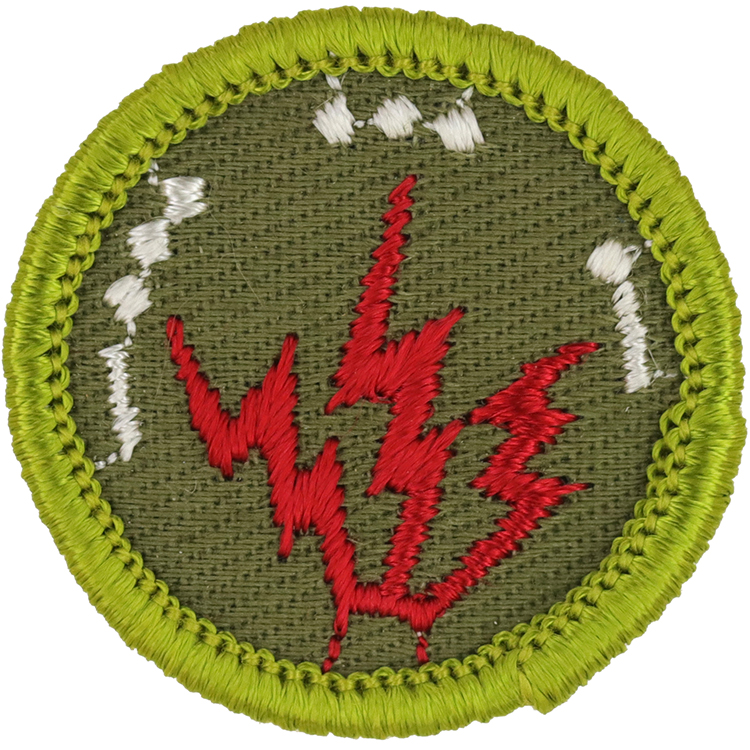
Fig. 1: Radio-F-Front
- Cloth: Green right twill
- Border: Merrowed
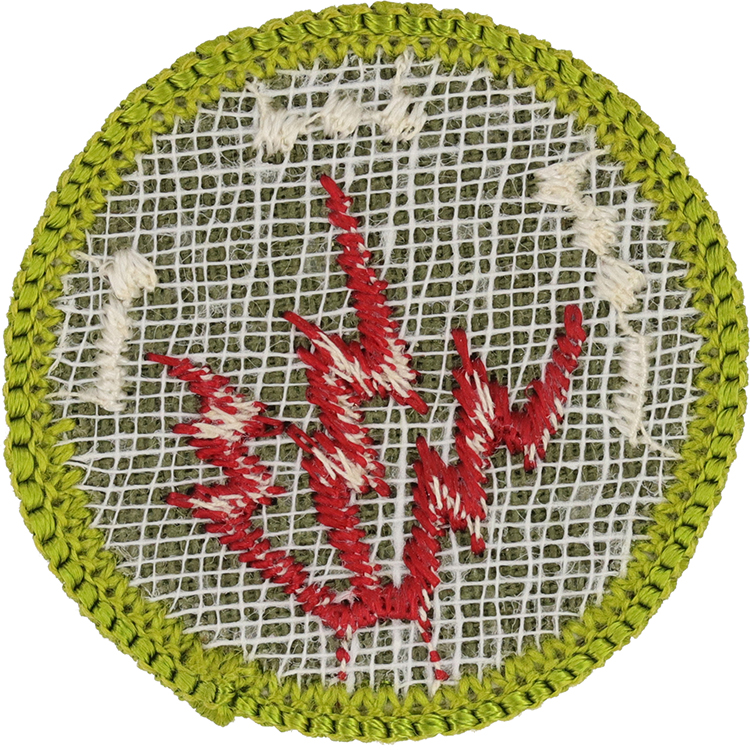
Fig. 2: Radio-F-Reverse
- Back: Gauze reinforced starched
Item Name: Radio 1961 - 1968
Item ID: Radio-F
Collector Rating: 1
Pamphlets Used to Earn this Badge

Requirements January 1960 until September 1962
1. Draw a basic wiring diagram of a one-tube receiving set. Use correct symbols and show all essential parts. Describe purpose of each part.
2. Build a one-tube or one-transistor short-wave receiver and demonstrate its operation by receiving at least five different stations.
3. Explain how to install a receiving antenna and how to ground equipment properly for protection against lightning.
4. Receive and send correctly a straight text of not less than five words (or twenty-five letters) per minute. Text will be assigned by merit badge counselor.
5. Name five of the most frequently used "Q" signals and explain the meaning of each.
6. Tell five basic requirements for a federal license to operate a transmitting station.
-------
NOTE: The holding of a general class amateur operator's license will exempt the Scout from examination on all requirements above, except 1 and 2. Such license must be in force at the time the Radio badge is awarded.
Requirements September 1962 until June 1972
1. Learn the safety precautions necessary in the building, repairing, and testing of radio equipment, and in the erection of transmitting and receiving antennas.
2. Do the following:
(a) Demonstrate correct soldering techniques suitable for the wiring of radio equipment.
(b) Show how to avoid heat damage to transistors and other small parts during soldering.
(c) Explain why rosin-core solder is used rather than acid-core solder in the building of equipment.
3. Do the following:
(a) Draw 10 schematic symbols commonly used in diagrams of radio receivers, radio transmitters, or audio-frequency equipment.
(b) Explain in general terms what each of the parts represented by the schematic symbols does.
4. Using the knowledge gained from the first three questions, build from individually purchased parts or from a kit at least one piece of radio equipment using a vacuum tube, transistor, or diode (including selenium, germanium, or silicon rectifiers). Demonstrate the equipment for the counselor to show that it works correctly and to show that the wiring is safe, correctly soldered, and reasonably neat. (Acceptable equipment includes a portable radio, shortwave receiver, amateur transmitter, hi-fi amplifier, a.c.-d.c. multimeter, vacuum-tube voltmeter, FM tuner, shortwave converter, tube or transistor code-practice set, and similar apparatus. Because they are usually too simple, crystal radios, buzzer-type code sets, and continuity testers would not be considered acceptable.)
5. Demonstrate your ability to send and receive Morse code by ear for at least 1 minute at a rate of at least five words (25 letters) per minute without any errors. (Holders of unexpired amateur licenses of any class, issued by the Federal Communications Commission, are exempt from this requirement.)
6. Do the following:
(a) Name and explain five of the common "Q" signals and five common abbreviations used by radio operators.
(b) Explain how amateur radio operators prepare to handle emergency messages during floods, hurricanes, forest fires, blizzards, or similar disasters.
7. Investigate job opportunities in radio. Discuss these with your counselor. Tell what job, if any, would interest you and what training is advisable in preparing for it.