-
Merit Badges
- Legend to identify Merit Badges
- 1910 British Merit Badges
- Square 1911 - 33
- Wide Crimped 1934 & 35
-
Narrow Tan Crimped 1936 - 42
- Tan Heavyweight Cloth with Silk Embroidery and Printed Back 1936 - 37
- Tan Heavyweight Cloth with Silk Embroidery and Plain Back 1937 - 38
- Tan Lightweight Cloth with Silk Embroidery and Plain Back 1938 - 39
- Tan Lightweight Cloth with Cotton Continuous Loop Embroidery and Plain Back 1939 - 42
- Tan Lightweight Cloth with Cotton Lockstitch Embroidery and Plain Back 1939 - 42
- Blue Background 1942 - 46
- Wartime 1942 - 46
- Khaki Narrow Crimped 1946 - 59
- Green Twill Gauze Back 1960 - 68
- Fully Embroidered Merrowed Edge 1960 - 72
- Unprinted Plastic Back 1972 - 01
- Printed Plastic Back 2002 - Current
-
Merit Badge Paper
- Merit Badge Applications
- Merit Badge Cards
-
Merit Badge Pamphlets
- Type 1 White Cover - Rectangle Drawing On Cover
- Type 2 White Cover 5-375" x 8" Title at Top
- Type 3A Tan Cover - 200 Fifth Avenue
- Type 3B Tan Cover - 2 line address New York City
- Type 3C Tan Cover - 2 line address New York N.Y.
- Type 3D Tan Cover - 1 line address New York N.Y.
- Type 4 Standing Scout Cover
- Type 5A War Cover
- Type 5B Red and White
- Type 6 Photo-Red Cover
- Type 7 Full Photo Cover or Bulls-eye Cover
- Type 8 Full Photo - Green Stripe Cover
- Type 9 Full Photo - Red Stripe Cover
- Type 10A Blue Stripe - Logo above bottom blue stripe - FDL centered
- Type 10B - Blue Stripe in bottom of photo area. FDL to left of text
- Special Covers
- Boy Craft Helps
- Merit Badge Counselor's Guides
-
Youth Position
- Junior Assistant Scoutmaster
- Senior Patrol Leader
- Assistant Senior Patrol Leader
- Patrol Leader
- Assistant Patrol Leader
- Troop Guide
- Scribe
- Quartermaster
- Instructor
- Chaplain Aide
- Den Chief
- Librarian
- Musician
- Webmaster
- Bugler
- Troop Historian
- Troop Representative
- Unit Representative
- Leadership Corps
- Honor Guard
- Leave No Trace Trainer
- Outdoor Ethics Guide
-
Patrol Medallions
- Patrol Medallions Introduction
- Legend to identify Patrol Medallions
- Patrol Shoulder Knot-Ribbons
- Felt Handmade Patrol Medallions
- Square Felt Patrol Medallions
- Round Broadcloth Patrol Medallions
- Red Twill Patrol Medallions
- Multi-Color Cloth Patrol Medallions
- Tan Cloth Patrol Medallions
- Patrol Medallion Back Patches
- Woodbadge Patrol Medallion
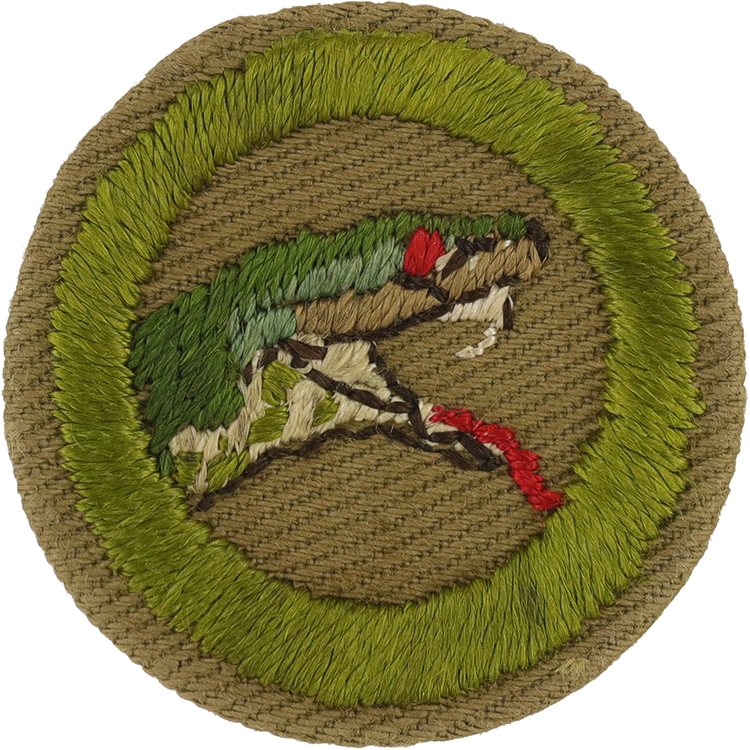
Fig. 1: RepStu-C1a-Front
- Cloth: Heavyweight tan right twill
- Embroidery: Continuous loop silk
- Eye: Red
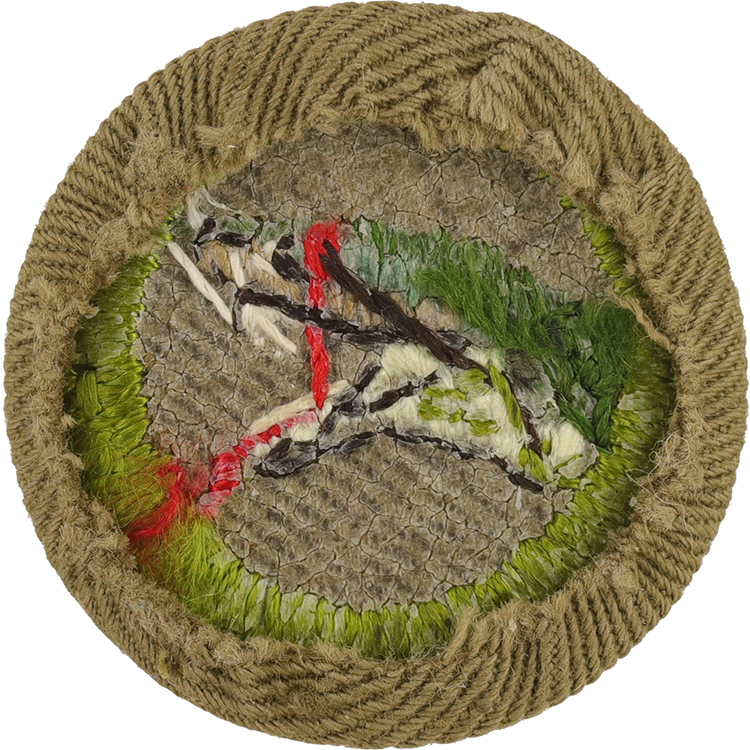
Fig. 2: RepStu-C1a-Reverse
- Back: Black imprint with starch
Item Name: Reptile Study 1936 - 1937
Item ID: RepStu-C1a
Collector Rating: 1
Pamphlets Used to Earn this Badge
Requirements July 1933 until December 1943
1. Know what representative species of reptile (snakes, lizards, turtles, crocodiles) are found in his own state or locality. Be able to identify all these species.
2. Know distribution and typical life history of the crocodilians inhabiting the United States.
3. Be able to distinguish the poisonous reptiles of the United States.
(a) The one kind of poisonous lizard.
(b) Four kinds of poisonous snake, by shape, size, markings, heads, tails or by teeth (fangs).
(c) The location and operation of the fangs of the four kinds of snake.
(d) General distribution of the poisonous forms.
(e) Whether these poisonous snakes are aggressive or defensive, and how far they can strike.
4. Know eight harmless snakes, four of which feed on destructive rodents, and know the food of each. Know how they capture and eat their food, know something of the usefulness of the snake to man. Know how young snakes are produced--from eggs or living young; how and why a snake sheds its skin; why snakes are partly blind prior to shedding; the function of the snake tongue.
5. Know some of the important differences between the groups (snakes, lizards, turtles, crocodiles) as to (a) eyes, (b) ears, (c) teeth, (d) heart, (e) lungs, (f) limbs, (g) tails, (h) scales (shell).
6. (a) Know the typical life history of lizards; how young are produced--from eggs or living young. Recognize and describe five kinds, preferably common to his own region. Know the common food of lizard and their usefulness to man in thus controlling pests. Know how and why a lizard will drop its tail and how it regrows.
7. Know the relative position of reptiles in the animal kingdom. Explain why, where and when reptiles hibernate, and the duration of the hibernation period.
8. Know what first aid treatment should be given in case of poison snake bite and the reasons for the same.