-
Merit Badges
- Legend to identify Merit Badges
- 1910 British Merit Badges
- Square 1911 - 33
- Wide Crimped 1934 & 35
-
Narrow Tan Crimped 1936 - 42
- Tan Heavyweight Cloth with Silk Embroidery and Printed Back 1936 - 37
- Tan Heavyweight Cloth with Silk Embroidery and Plain Back 1937 - 38
- Tan Lightweight Cloth with Silk Embroidery and Plain Back 1938 - 39
- Tan Lightweight Cloth with Cotton Continuous Loop Embroidery and Plain Back 1939 - 42
- Tan Lightweight Cloth with Cotton Lockstitch Embroidery and Plain Back 1939 - 42
- Blue Background 1942 - 46
- Wartime 1942 - 46
- Khaki Narrow Crimped 1946 - 59
- Green Twill Gauze Back 1960 - 68
- Fully Embroidered Merrowed Edge 1960 - 72
- Unprinted Plastic Back 1972 - 01
- Printed Plastic Back 2002 - Current
-
Merit Badge Paper
- Merit Badge Applications
- Merit Badge Cards
-
Merit Badge Pamphlets
- Type 1 White Cover - Rectangle Drawing On Cover
- Type 2 White Cover 5-375" x 8" Title at Top
- Type 3A Tan Cover - 200 Fifth Avenue
- Type 3B Tan Cover - 2 line address New York City
- Type 3C Tan Cover - 2 line address New York N.Y.
- Type 3D Tan Cover - 1 line address New York N.Y.
- Type 4 Standing Scout Cover
- Type 5A War Cover
- Type 5B Red and White
- Type 6 Photo-Red Cover
- Type 7 Full Photo Cover or Bulls-eye Cover
- Type 8 Full Photo - Green Stripe Cover
- Type 9 Full Photo - Red Stripe Cover
- Type 10A Blue Stripe - Logo above bottom blue stripe - FDL centered
- Type 10B - Blue Stripe in bottom of photo area. FDL to left of text
- Special Covers
- Boy Craft Helps
- Merit Badge Counselor's Guides
-
Youth Position
- Junior Assistant Scoutmaster
- Senior Patrol Leader
- Assistant Senior Patrol Leader
- Patrol Leader
- Assistant Patrol Leader
- Troop Guide
- Scribe
- Quartermaster
- Instructor
- Chaplain Aide
- Den Chief
- Librarian
- Musician
- Webmaster
- Bugler
- Troop Historian
- Troop Representative
- Unit Representative
- Leadership Corps
- Honor Guard
- Leave No Trace Trainer
- Outdoor Ethics Guide
-
Patrol Medallions
- Patrol Medallions Introduction
- Legend to identify Patrol Medallions
- Patrol Shoulder Knot-Ribbons
- Felt Handmade Patrol Medallions
- Square Felt Patrol Medallions
- Round Broadcloth Patrol Medallions
- Red Twill Patrol Medallions
- Multi-Color Cloth Patrol Medallions
- Tan Cloth Patrol Medallions
- Patrol Medallion Back Patches
- Woodbadge Patrol Medallion
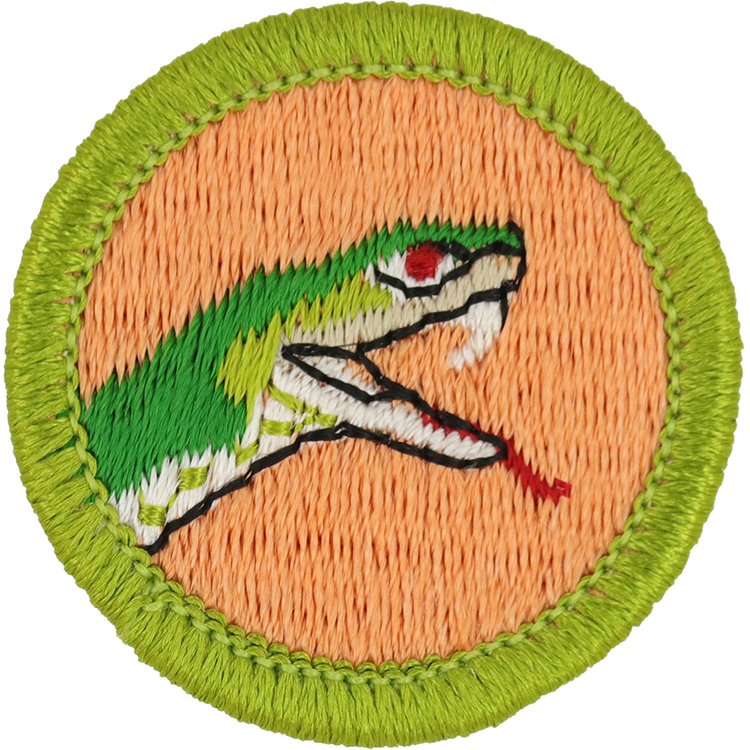
Fig. 1: RepStu-H4-Front
- Embroidery: Cotton thread, dull sheen
- Border: Lt green merrowed
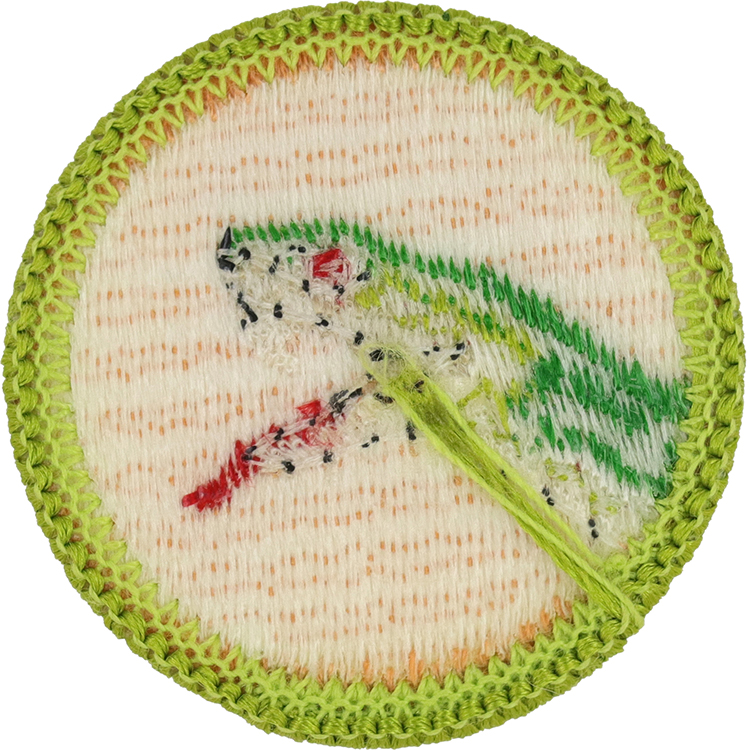
Fig. 2: RepStu-H4-Reverse
- Back: Lt green lock stitch, molded plastic
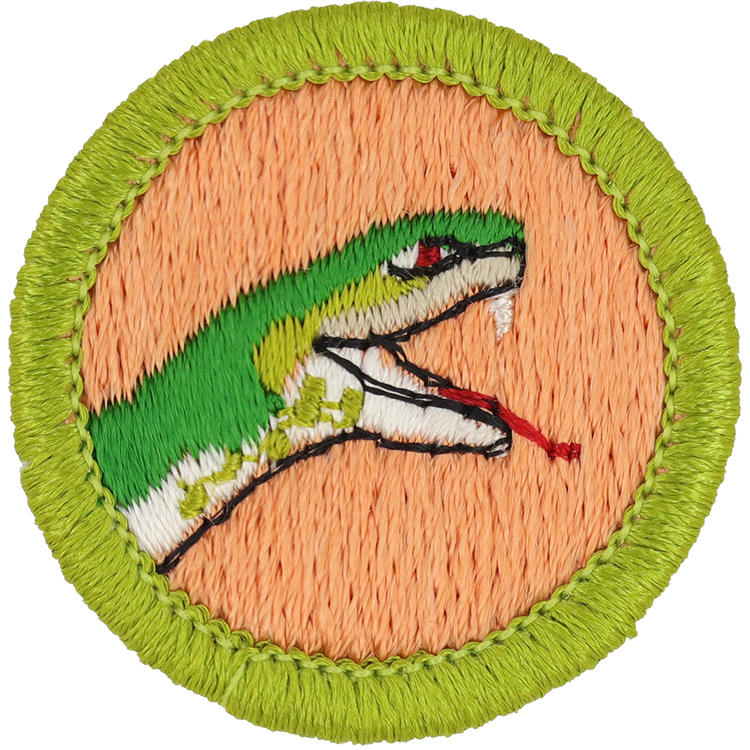
Fig. 3: RepStu-H4-mve1-front
- Minor variation: Eye and fang differences
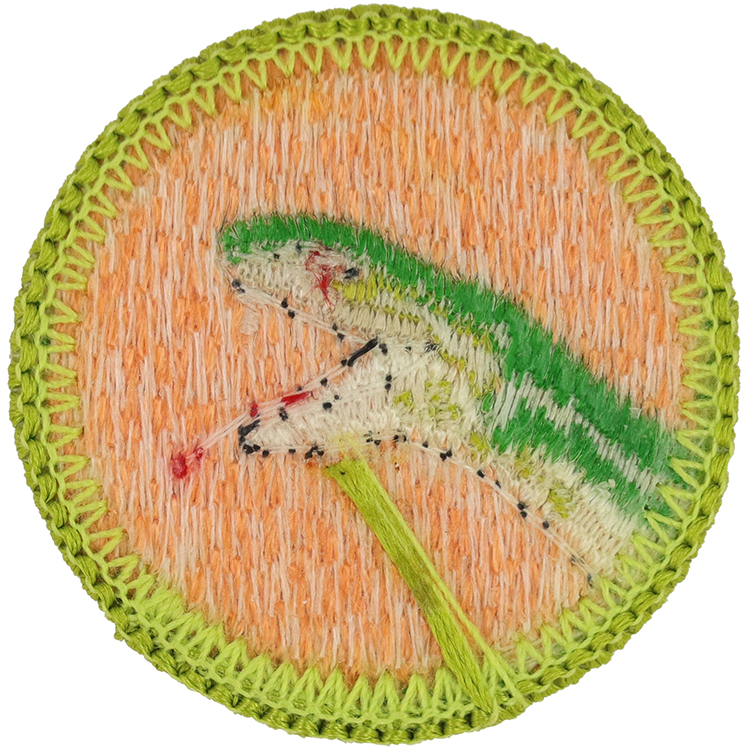
Fig. 4: RepStu-H4-mve1-reverse
- Minor variation: Lt green lock stitch, molded plastic
Item Name: Reptile Study 1978 - 1990
Item ID: RepStu-H4
Collector Rating: 1
Pamphlets Used to Earn this Badge
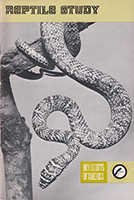
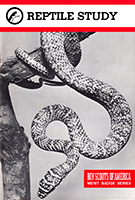
Requirements July 1976 and September 1993
1. Know approximately the number of species and general distribution of reptiles and amphibians in the United States.
2. Make sketches from your own observations, showing markings and color patterns of seven reptiles and three amphibians found in the United States. Record the habits and habitats of each of these species.
3. Describe the main differences between (a) alligators and crocodiles, (b) toads and frogs, (c) salamanders and lizards, and (d) snakes and lizards.
4. List 10 reptiles or amphibians useful to man. Tell how they take in food. List food habits of each species. If there are laws in your state for their protection, tell why each is protected.
5. Describe how reptiles and amphibians reproduce themselves.
6. From observation, describe how snakes move forward. Describe the functions of the muscles, ribs, and belly plates.
7. Describe in detail six poisonous snakes and the one poisonous lizard found in the United States. Describe their habits. Demonstrate first aid treatment for snakebite.
8. Maintain one or more reptiles or amphibians for at least a month. Record the food accepted, methods employed in eating, changes in coloration, shedding of skins, and general habits; OR keep the eggs of a reptile from the time of laying until hatching; OR keep the eggs of an amphibian from the time of laying until the transformation of the tadpoles or (salamander) larvae.
9. Do ONE of the following:
(a) Identify at night three kinds of toads or frogs by their voices. Imitate the song of each for your counselor. Stalk each with a flashlight and discover how each sings and from where.
(b) Take a recognizable photograph of a live turtle, snake, and amphibian.
(c) Give a brief talk to a small group on the subject of reptiles and amphibians. Use three living specimens or 20 pictures you have collected.
10. Give 10 superstitions about reptiles and amphibians and a correct explanation in each case.
Note: The Scout must use nonpoisonous reptiles only in fulfilling requirements 8 and 9. Some reptiles are protected by federal law. Others may be protected by state law. Before collecting, be sure you know which are on both lists. Be sure that you do not collect protected species. All specimens should be returned to the wild after the requirements have been met.