-
Merit Badges
- Legend to identify Merit Badges
- 1910 British Merit Badges
- Square 1911 - 33
- Wide Crimped 1934 & 35
-
Narrow Tan Crimped 1936 - 42
- Tan Heavyweight Cloth with Silk Embroidery and Printed Back 1936 - 37
- Tan Heavyweight Cloth with Silk Embroidery and Plain Back 1937 - 38
- Tan Lightweight Cloth with Silk Embroidery and Plain Back 1938 - 39
- Tan Lightweight Cloth with Cotton Continuous Loop Embroidery and Plain Back 1939 - 42
- Tan Lightweight Cloth with Cotton Lockstitch Embroidery and Plain Back 1939 - 42
- Blue Background 1942 - 46
- Wartime 1942 - 46
- Khaki Narrow Crimped 1946 - 59
- Green Twill Gauze Back 1960 - 68
- Fully Embroidered Merrowed Edge 1960 - 72
- Unprinted Plastic Back 1972 - 01
- Printed Plastic Back 2002 - Current
-
Merit Badge Paper
- Merit Badge Applications
- Merit Badge Cards
-
Merit Badge Pamphlets
- Type 1 White Cover - Rectangle Drawing On Cover
- Type 2 White Cover 5-375" x 8" Title at Top
- Type 3A Tan Cover - 200 Fifth Avenue
- Type 3B Tan Cover - 2 line address New York City
- Type 3C Tan Cover - 2 line address New York N.Y.
- Type 3D Tan Cover - 1 line address New York N.Y.
- Type 4 Standing Scout Cover
- Type 5A War Cover
- Type 5B Red and White
- Type 6 Photo-Red Cover
- Type 7 Full Photo Cover or Bulls-eye Cover
- Type 8 Full Photo - Green Stripe Cover
- Type 9 Full Photo - Red Stripe Cover
- Type 10A Blue Stripe - Logo above bottom blue stripe - FDL centered
- Type 10B - Blue Stripe in bottom of photo area. FDL to left of text
- Special Covers
- Boy Craft Helps
- Merit Badge Counselor's Guides
-
Youth Position
- Junior Assistant Scoutmaster
- Senior Patrol Leader
- Assistant Senior Patrol Leader
- Patrol Leader
- Assistant Patrol Leader
- Troop Guide
- Scribe
- Quartermaster
- Instructor
- Chaplain Aide
- Den Chief
- Librarian
- Musician
- Webmaster
- Bugler
- Troop Historian
- Troop Representative
- Unit Representative
- Leadership Corps
- Honor Guard
- Leave No Trace Trainer
- Outdoor Ethics Guide
-
Patrol Medallions
- Patrol Medallions Introduction
- Legend to identify Patrol Medallions
- Patrol Shoulder Knot-Ribbons
- Felt Handmade Patrol Medallions
- Square Felt Patrol Medallions
- Round Broadcloth Patrol Medallions
- Red Twill Patrol Medallions
- Multi-Color Cloth Patrol Medallions
- Tan Cloth Patrol Medallions
- Patrol Medallion Back Patches
- Woodbadge Patrol Medallion

Fig. 1: RifSho-H1-Front
- Embroidery: Cotton thread
- Border: Merrowed
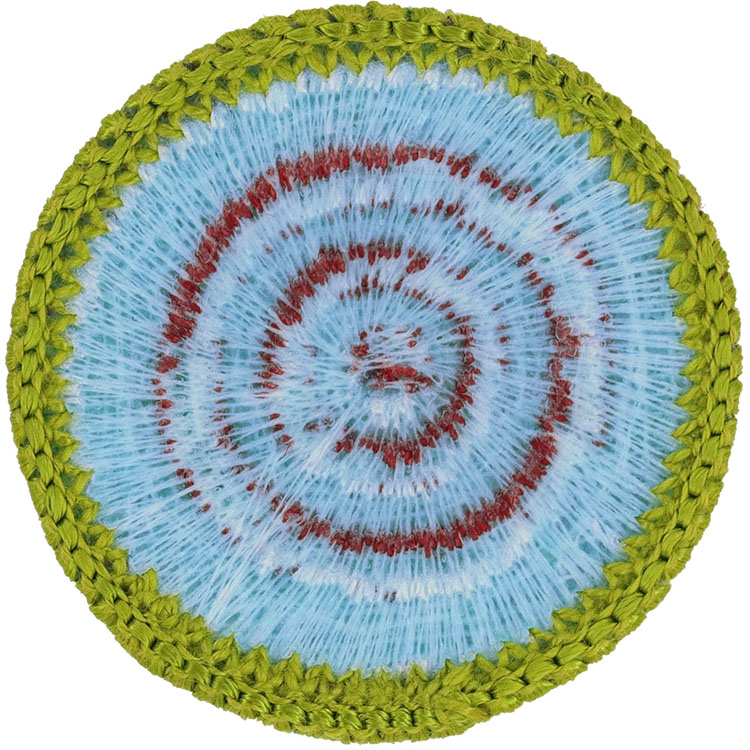
Fig. 2: RifSho-H1-Reverse
- Back: Blue plastic with waffle pattern
Item Name: Rifle and Shotgun Shooting 1972 - 1975
Item ID: RifSho-H1
Collector Rating: 1
Pamphlets Used to Earn this Badge
Requirements June 1972 until January 1975
1. Do the following:
(a) Explain the meaning of each point in the Shooter's Safety Code. Agree to live up to it.
(b) Write 200 words on "My Responsibility as a Shooter."
(c) Explain the main points of the laws for owning and using guns in your town.
(d) Explain how guns are related to wildlife conservation.
(e) Explain the main points of the hunting laws in your state. Tell the kinds of game which may be hunted. Give any special laws on the use of guns.
(F) Explain how a good sportsman acts when handling guns.
2. Do the following:
(a) Describe two main differences between the rifle and the shotgun. Explain how these differences affect their use in the field.
(b) Draw and explain in proper sight alignment and a proper sight picture with the rifle and the shotgun. Explain how these differences affect their use in the field.
(c) Explain the principles of good rifle shooting positions. SHow three positions. Explain and show the differences between a good rifle shooting position and a good shotgun shooting position.
(d) Explain and show the right use of the trigger in rifle shooting. Explain and show the right use of the trigger in shotgun shooting.
(e) Explain and show shotgun swing. Explain why "follow-through is so important.
3. Do the following:
(a) Explain the general principles of safe handling of guns and ammunition.
(b) Explain the safety precautions for guns having fixed or detachable magazines. Tell the special precautions for tubular magazines.
(c) Show how to check for safety at least THREE of the following. Explain how to check the others. (1) Rifle or shotgun--a) semiautomatic action; b) pump action; c) break-open or hinge action; d) bolt action; e) lever action. (2) Handguns--a) semiautomatic; b) revolver. (3) Muzzle loader of any kind. (4) Gas, pneumatic, or air gun.
(d) Show the following: (1) Safe carrying of a gun when alone or with other hunters. (2) Proper relationship of hunters when loading and unloading guns. (3) Safe handling of a gun when taking it out of and putting it in a car. (4) Safe gun handling when crossing a fence.
(e) Explain what is meant by "safe zone of fire."
(f) Explain the principles of safe storage of guns and ammunition at home.
(g) Explain what you would do if a friend visiting your home asked to see your target rifle.
(h) Explain the care needed to keep a gun in good and safe working condition.
4. Meet the standards shown in either "Option A--Rifle Shooting" or "Option B--Shotgun Shooting."
OPTION A--RIFLE SHOOTING
(a) Score required. Make a total score of at least 380 points out of a possible 600 on a total of 12 targets. Include the following: (1) Four targets from the prone position, each scoring at least 35 points out of a possible 50; (2) Four targets from the kneeling position, each scoring at least 25 points out of a possible 50; (3) Four targets from the standing position, each scoring at least 20 points out of a possible 50.
Note: You will have to make more than the minimum score on some targets to make the required total of 380 points.
(b) Specifications. Qualification may be fired on any one of the following courses of fire: (1) The 50-Foot Course--fired with the .22-caliber rim-fire rifle using the .22 cartridge. Use 50-foot A1, A2, A4, A5, A16, or A17 targets. (2) The 25-Foot Course--shot with any air gun or gas gun having a rifled barrel. Use 25-foot A18 or A19 targets. (3) The 15-Foot Course--shot with any smoothbore air or gas gun using BB's. Use 15-foot A45 or A46 targets.
Range distance: Measured from firing line to face of target.
Number of shots: Five shots per target.
Sights: Any not using glass.
Targets: Official BSA, NRA, or those issued by the director of Civilian Marksmanship.
Sling: The sling may be used only with the arm and hand supporting the barrel.
OPTION B--SHOTGUN SHOOTING
(a) Score required. Break at least 13 clay birds out of a possible 25 in each of five separate 25-bird events.
(b) Specifications. (1) The .22 Caliber Shotgun Course--fired with .22-caliber smoothbore gun, using .22 rim-fire shot cartridges. Targets must be of the Mo-Skeet-O type, about 2 inches across. Targets may be thrown from a hand or foot trap. (2) The Large Caliber Shotgun Course--fired with a standard shotgun of .410 gauge or larger. Targets shall be of the standard type, about 4½ inches across. Targets may be thrown from a hand or a foot trap. Standard skeet or trap courses may be used.
Requirements January 1975 until December 1977
1. Do the following:
(a) Explain the meaning of each point in the Shooter's Safety Code. Agree to live up to it.
(b) Write 200 words on "My Responsibility as a Shooter."
(c) Explain the main points of the laws for owning and using guns in your town.
(d) Explain how guns are related to wildlife conservation.
(e) Explain the main points of the hunting laws in your state. Tell the kinds of game which may be hunted. Give any special laws on the use of guns.
(f) Explain how a good sportsman acts when handling guns.
2. Do the following:
(a) Describe two main differences between the rifle and the shotgun. Explain how these differences affect their use in the field.
(b) Draw and explain proper sight alignment and a proper sight picture with the rifle and the shotgun. Explain how these differences affect their use in the field.
(c) Explain the principles of good rifle shooting positions. Show three positions. Explain and show the differences between a good rifle shooting position and a good shotgun shooting position.
(d) Explain and show the right use of the trigger in rifle shooting. Explain and show the right use of the trigger in shotgun shooting.
(e) Explain and show shotgun swing. Explain why "follow-through" is so important.
3. Do the following:
(a) Explain the general principles of safe handling of guns and ammunition.
(b) Explain the safety precautions for guns having fixed or detachable magazines. Tell the special precautions for tubular magazines.
(c) Show how to check for safety the following: (1) Rifle or shotgun--a) semiautomatic action; b) pump action; c) break-open or hinge action; d) bolt action; e) lever action. (2) Muzzle-loader of any kind. (3) Gas, pneumatic, or air gun.
(d) Show the following: (1) Safe carrying of a gun when alone or with other hunters. (2) Proper relationship of hunters when loading and unloading guns. (3) Safe handling of a gun when taking it out of and putting it in a car. (4) Safe gun handling when crossing a fence.
(e) Explain what is meant by "safe zone of fire."
(f) Explain the principles of safe storage of guns and ammunition at home.
(g) Explain what you would do if a friend visiting your home asked to see your target rifle.
(h) Explain the care needed to keep a gun in good and safe working condition.
4. Meet the standards shown in either "Option A--Rifle Shooting" or "Option B--Shotgun Shooting."
Option A--Rifle Shooting
(a) Score required. Make a total score of at least 380 points out of a possible 600 on a total of 12 targets. Include the following: (1) Four targets from the prone position, each scoring at least 35 points out of a possible 50; (2) Four targets from the kneeling position, each scoring at least 25 points out of a possible 50; (3) Four targets from the standing position, each scoring at least 20 points out of a possible 50.
Note: You will have to make more than the minimum score on some targets to make the required total of 380 points.
(b) Specifications. Qualification may be fired on any one of the following courses of fire: (1) The 50-Foot Course--fired with the .22-caliber rim-fire rifle using the .22 cartridge. Use 50-foot A1, A2, A4, A5, A16, or A17 targets. (2) The 25-Foot Course--shot with any air gun or gas gun having a rifled barrel. Use 25-foot A18 or A19 targets. (3) The 15-Foot Course--shot with any smoothbore air or gas gun using BB's. Use 15-foot A45 or A46 targets.
Range distance: Measured from firing line to face of target.
Number of shots: Five shots per target.
Sights: Any not using glass.
Targets: Official BSA, NRA, or those issued by the director of Civilian Marksmanship.
Sling: The sling may be used only with the arm and hand supporting the barrel.
Option B--Shotgun Shooting
(a) Score required. Break at least 13 clay birds out of a possible 25 in each of five separate 25-bird events.
(b) Specifications. (1) The .22 Caliber Shotgun Course--fired with .22-caliber smoothbore gun using .22 rim-fire shot cartridges. Targets must be of the Mo-Skeet-O type, about 2 inches across. Targets may be thrown from a hand or foot trap. (2) The Large Caliber Shotgun Course--fired with a standard shotgun of .410 gauge or larger. Targets shall be of the standard type, about 4½ inches across. Targets may be thrown from a hand or a foot trap. Standard skeet or trap courses may be used.