-
Merit Badges
- Legend to identify Merit Badges
- 1910 British Merit Badges
- Square 1911 - 33
- Wide Crimped 1934 & 35
-
Narrow Tan Crimped 1936 - 42
- Tan Heavyweight Cloth with Silk Embroidery and Printed Back 1936 - 37
- Tan Heavyweight Cloth with Silk Embroidery and Plain Back 1937 - 38
- Tan Lightweight Cloth with Silk Embroidery and Plain Back 1938 - 39
- Tan Lightweight Cloth with Cotton Continuous Loop Embroidery and Plain Back 1939 - 42
- Tan Lightweight Cloth with Cotton Lockstitch Embroidery and Plain Back 1939 - 42
- Blue Background 1942 - 46
- Wartime 1942 - 46
- Khaki Narrow Crimped 1946 - 59
- Green Twill Gauze Back 1960 - 68
- Fully Embroidered Merrowed Edge 1960 - 72
- Unprinted Plastic Back 1972 - 01
- Printed Plastic Back 2002 - Current
-
Merit Badge Paper
- Merit Badge Applications
- Merit Badge Cards
-
Merit Badge Pamphlets
- Type 1 White Cover - Rectangle Drawing On Cover
- Type 2 White Cover 5-375" x 8" Title at Top
- Type 3A Tan Cover - 200 Fifth Avenue
- Type 3B Tan Cover - 2 line address New York City
- Type 3C Tan Cover - 2 line address New York N.Y.
- Type 3D Tan Cover - 1 line address New York N.Y.
- Type 4 Standing Scout Cover
- Type 5A War Cover
- Type 5B Red and White
- Type 6 Photo-Red Cover
- Type 7 Full Photo Cover or Bulls-eye Cover
- Type 8 Full Photo - Green Stripe Cover
- Type 9 Full Photo - Red Stripe Cover
- Type 10A Blue Stripe - Logo above bottom blue stripe - FDL centered
- Type 10B - Blue Stripe in bottom of photo area. FDL to left of text
- Special Covers
- Boy Craft Helps
- Merit Badge Counselor's Guides
-
Youth Position
- Junior Assistant Scoutmaster
- Senior Patrol Leader
- Assistant Senior Patrol Leader
- Patrol Leader
- Assistant Patrol Leader
- Troop Guide
- Scribe
- Quartermaster
- Instructor
- Chaplain Aide
- Den Chief
- Librarian
- Musician
- Webmaster
- Bugler
- Troop Historian
- Troop Representative
- Unit Representative
- Leadership Corps
- Honor Guard
- Leave No Trace Trainer
- Outdoor Ethics Guide
-
Patrol Medallions
- Patrol Medallions Introduction
- Legend to identify Patrol Medallions
- Patrol Shoulder Knot-Ribbons
- Felt Handmade Patrol Medallions
- Square Felt Patrol Medallions
- Round Broadcloth Patrol Medallions
- Red Twill Patrol Medallions
- Multi-Color Cloth Patrol Medallions
- Tan Cloth Patrol Medallions
- Patrol Medallion Back Patches
- Woodbadge Patrol Medallion
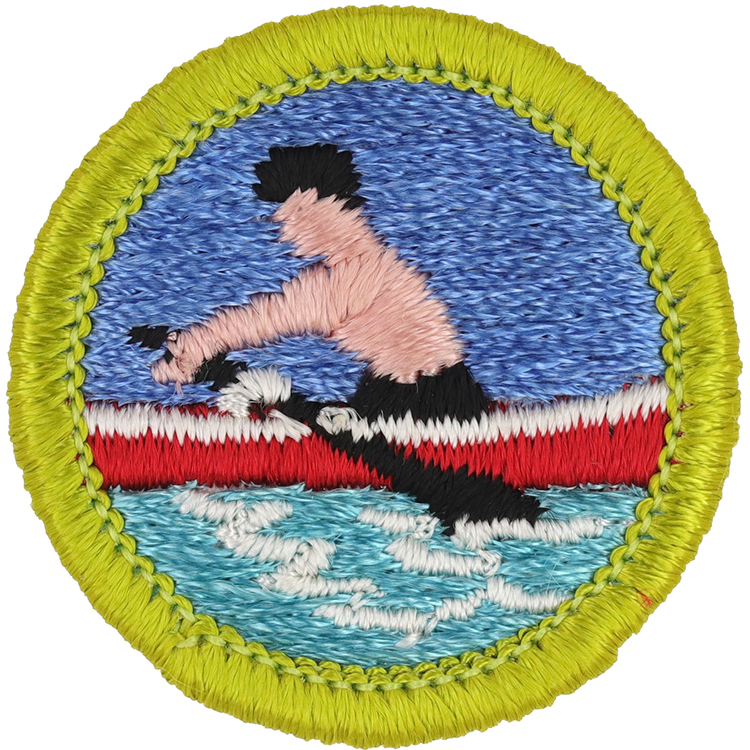
Fig. 1: Rowing-H4-Front
- Embroidery: Cotton thread, dull sheen
- Border: Lt green merrowed
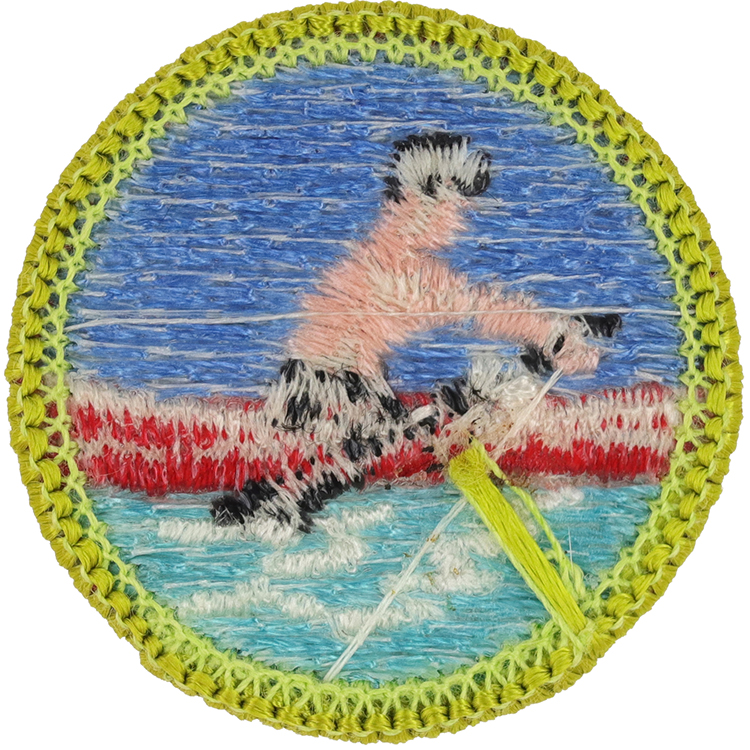
Fig. 2: Rowing-H4-Reverse
- Back: Lt green lock stitch, molded plastic

Fig. 3: Rowing-H4-mve1-front
- Minor variation: Yellow border
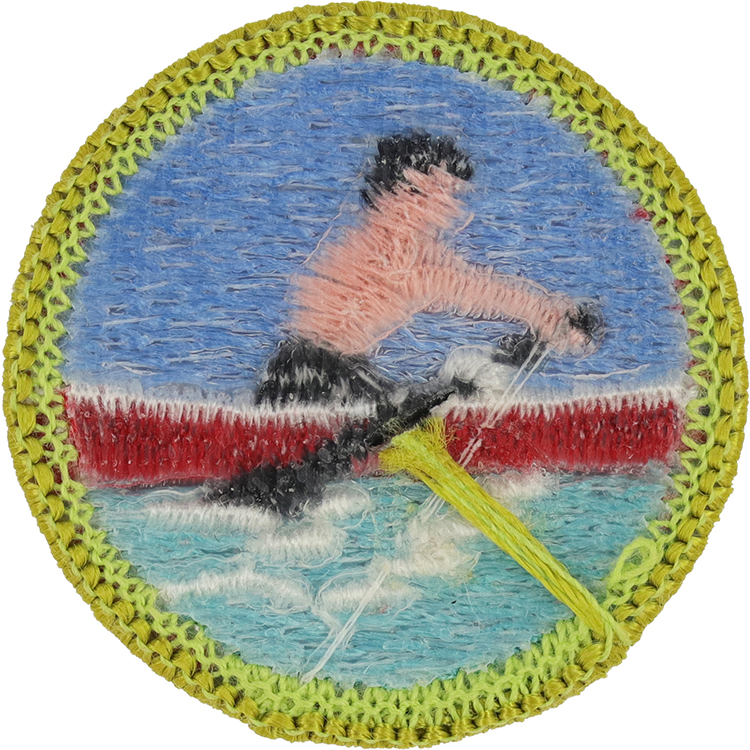
Fig. 4: Rowing-H4-mve1-reverse
- Minor variation: Lt green lock stitch, molded plastic
Item Name: Rowing 1978 - 1990
Item ID: Rowing-H4
Collector Rating: 1
Pamphlets Used to Earn this Badge
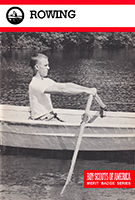
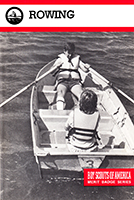
Requirements June 1972 until August 1982
1. Before doing other requirements, swim 100 yards as follows: 75 yards with any strokes. Then 25 yards on your back using an easy resting stroke. Then rest by floating as still as you can for 1 minute.
2. Do the following correctly:
(a) Launch and land a rowboat from and to shore.
(b) Bring a rowboat alongside a dock. Help a passenger into it. Row 50 feet, stop, pivot, and come back to the dock. Help the passenger from the boat.
(c) Tie a rowboat to a dock using: (1) A clove hitch. (2) Round turn and two half hitches. (3) A bowline. (4) A hitching tie or mooring hitch.
3. Do the following with another person in the stern:
(a) Row in a straight line for a quarter mile. Stop, make a pivot turn, and return to the starting point. If a quarter-mile straight course is not available, shorter courses may be used. Row back and forth in a straight line until a quarter mile has been covered.
(b) Backwater in a straight line 200 yards. Make a turn under way still backing water. Return to the starting point.
(c) Change places with your passenger. Show sculling in good form for 25 yards. Turn under way, and return to starting point.
4. Alone, or with one other person who is a swimmer, tip over a rowboat. Turn it right side up, get in, and paddle 10 yards with your hands or an oar. Tell why you should stay with a swamped boat.
5. Alone in a rowboat push off from shore or dock. Row 25 yards to a swimmer. Turn the boat so that the swimmer may hold onto the stern. Tow him to shore.
6. Show and explain the proper use of anchors for rowboats.
7. Describe the following:
(a) Dory, dory skiff, dinghy, punt, pram.
(b) Four common boatbuilding materials. Give some good and bad points of each.
(c) Two of the following rowlocks: Tholepin, box rowlock, ring rowlock, open top rowlock. Tell why pin-type rowlocks are not recommended.
8. Explain the advantages of feathering oars while rowing.
Answer the following questions:
(a) How would you handle a rowboat if caught in a storm?
(b) How would you figure the number of pounds that might be carried under normal conditions in any given boat under oars?
(c) How would you properly fit out a rowboat, maintain and care for it during the boating season? How would you prepare and store it for winter season?
Requirements August 1982 until September 1985
1. Before doing other requirements, successfully complete the BSA swimmer test. Jump feet first into water over your head in depth, swim 75 yards or 75 meters in a strong manner using one or more of the following strokes: side stroke, breast stroke, trudgen, or crawl; then swim 25 yards or 25 meters using an easy, resting backstroke. The 100 yards or 100 meters must be swum continuously and include at least one sharp turn. After completing the swim, rest by floating as motionless as possible.
2. Do the following correctly:
(a) Launch and land a rowboat from and to shore.
(b) Bring a rowboat alongside a dock. Help a passenger into it. Row 50 feet, stop, pivot, and come back to the dock. Help the passenger from the boat.
(c) Tie a rowboat to a dock using: (1) A clove hitch. (2) Round turn and two half hitches. (3) A bowline. (4) A hitching tie or mooring hitch.
3. Do the following with another person in the stern:
(a) Row in a straight line for a quarter mile. Stop, make a pivot turn, and return to the starting point. If a quarter-mile straight course is not available, shorter courses may be used. Row back and forth in a straight line until a quarter mile has been covered.
(b) Backwater in a straight line 200 yards. Make a turn under way still backing water. Return to the starting point.
(c) Change places with your passenger. Show sculling in good form for 25 yards. Turn under way, and return to starting point.
4. *Alone, or with one other person who is a swimmer, tip over a rowboat. Turn it right side up, get in, and paddle 10 yards with your hands or an oar. Tell why you should stay with a swamped boat.
5. Alone in a rowboat push off from shore or dock. Row 25 yards to a swimmer. Turn the boat so that the swimmer may hold onto the stern. Tow him to shore.
6. Show and explain the proper use of anchors for rowboats.
7. Describe the following:
(a) Dory, dory skiff, dinghy, punt, pram.
(b) Four common boatbuilding materials. Give some good and bad points of each.
(c) Two of the following rowlocks: Tholepin, box rowlock, ring rowlock, open top rowlock. Tell why pin-type rowlocks are not recommended.
8. Explain the advantages of feathering oars while rowing.
Answer the following questions:
(a) How would you handle a rowboat if caught in a storm?
(b) How would you figure the number of pounds that might be carried under normal conditions in any given boat under oars?
(c) How would you properly fit out a rowboat, maintain and care for it during the boating season? How would you prepare and store it for the winter season?
* This requirement can be met in shallow water.
Requirements September 1985 until September 1995 .
1. Before doing other requirements, successfully complete the BSA swimmer test. Jump feet first into water over your head in depth, swim 75 yards or 75 meters in a strong manner using one or more of the following strokes: side stroke, breast stroke, trudgen, or crawl; then swim 25 yards or 25 meters using an easy, resting backstroke. The 100 yards or 100 meters must be swum continuously and include at least one sharp turn. After completing the swim, rest by floating as motionless as possible.
2. Review and discuss Safety Afloat and demonstrate the proper fit and use of personal flotation devices (PFDs).
3. Do the following correctly in either a fixed seat or sliding seat rowboat:
(a) Launch and land from and to shore.
(b) Row in a straight line for a quarter mile. Stop, make a pivot turn, and return to the starting point.
(c) Backwater in a straight line for 50 yards. Make a turn underway still backing water. Return to the starting point.
(d) Properly moor or rack your craft. Demonstrate your ability to tie the following mooring knots: clove hitch, round turn and two half hitches, bowline, and hitching tie or mooring hitch.
4. In a fixed seat rowboat, do the following:
(a) Come alongside a dock and help a passenger into the boat. Row 50 feet, stop, pivot, and come back to the dock. Help the passenger from the boat.
(b) Show sculling in good form over the stern for 25 yards. Turn underway, and return to starting point.
5. *Alone, or with one other person who is a swimmer, tip over a rowboat. Turn it right side up, get in, and row or paddle 25 yards with hands or oars. Tell why you should stay with a swamped boat.
6. Alone in a rowboat push off from shore or dock. Row 25 yards to a swimmer. While giving instructions to the swimmer, turn the boat so that the swimmer may hold onto the stern. Tow him to shore.
7. Show and explain the proper use of anchors for rowboats.
8. Describe the following:
(a) Types of craft used in commercial, competitive, and recreational rowing.
(b) Four common boatbuilding materials. Give some good and bad points of each.
(c) Types of oarlocks used in commercial, competitive, and recreational rowing.
9. Discuss the following:
(a) The advantage of feathering oars while rowing.
(b) How to handle a rowboat in a storm.
(c) How to properly fit out and maintain a boat in season. How to prepare and store a boat for winter.
(d) How to calculate the weight a boat may carry under normal conditions.
(e) The differences between fixed seat and sliding seat rowing.
(f) The different meaning of the term "sculling" in fixed and sliding seat rowing.
(g) The health benefits from rowing for exercise.
* This requirement can be met in shallow water.