-
Merit Badges
- Legend to identify Merit Badges
- 1910 British Merit Badges
- Square 1911 - 33
- Wide Crimped 1934 & 35
-
Narrow Tan Crimped 1936 - 42
- Tan Heavyweight Cloth with Silk Embroidery and Printed Back 1936 - 37
- Tan Heavyweight Cloth with Silk Embroidery and Plain Back 1937 - 38
- Tan Lightweight Cloth with Silk Embroidery and Plain Back 1938 - 39
- Tan Lightweight Cloth with Cotton Continuous Loop Embroidery and Plain Back 1939 - 42
- Tan Lightweight Cloth with Cotton Lockstitch Embroidery and Plain Back 1939 - 42
- Blue Background 1942 - 46
- Wartime 1942 - 46
- Khaki Narrow Crimped 1946 - 59
- Green Twill Gauze Back 1960 - 68
- Fully Embroidered Merrowed Edge 1960 - 72
- Unprinted Plastic Back 1972 - 01
- Printed Plastic Back 2002 - Current
-
Merit Badge Paper
- Merit Badge Applications
- Merit Badge Cards
-
Merit Badge Pamphlets
- Type 1 White Cover - Rectangle Drawing On Cover
- Type 2 White Cover 5-375" x 8" Title at Top
- Type 3A Tan Cover - 200 Fifth Avenue
- Type 3B Tan Cover - 2 line address New York City
- Type 3C Tan Cover - 2 line address New York N.Y.
- Type 3D Tan Cover - 1 line address New York N.Y.
- Type 4 Standing Scout Cover
- Type 5A War Cover
- Type 5B Red and White
- Type 6 Photo-Red Cover
- Type 7 Full Photo Cover or Bulls-eye Cover
- Type 8 Full Photo - Green Stripe Cover
- Type 9 Full Photo - Red Stripe Cover
- Type 10A Blue Stripe - Logo above bottom blue stripe - FDL centered
- Type 10B - Blue Stripe in bottom of photo area. FDL to left of text
- Special Covers
- Boy Craft Helps
- Merit Badge Counselor's Guides
-
Youth Position
- Junior Assistant Scoutmaster
- Senior Patrol Leader
- Assistant Senior Patrol Leader
- Patrol Leader
- Assistant Patrol Leader
- Troop Guide
- Scribe
- Quartermaster
- Instructor
- Chaplain Aide
- Den Chief
- Librarian
- Musician
- Webmaster
- Bugler
- Troop Historian
- Troop Representative
- Unit Representative
- Leadership Corps
- Honor Guard
- Leave No Trace Trainer
- Outdoor Ethics Guide
-
Patrol Medallions
- Patrol Medallions Introduction
- Legend to identify Patrol Medallions
- Patrol Shoulder Knot-Ribbons
- Felt Handmade Patrol Medallions
- Square Felt Patrol Medallions
- Round Broadcloth Patrol Medallions
- Red Twill Patrol Medallions
- Multi-Color Cloth Patrol Medallions
- Tan Cloth Patrol Medallions
- Patrol Medallion Back Patches
- Woodbadge Patrol Medallion
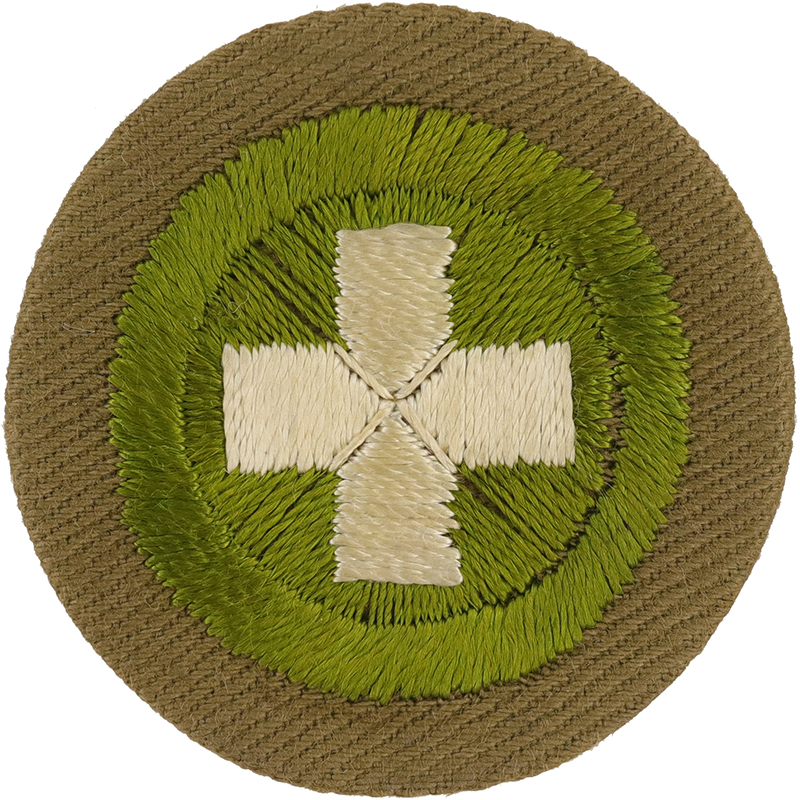
Fig. 1: Safety-B2-Front
- Cloth: Heavyweight tan right twill
- Embroidery: Continuous loop silk
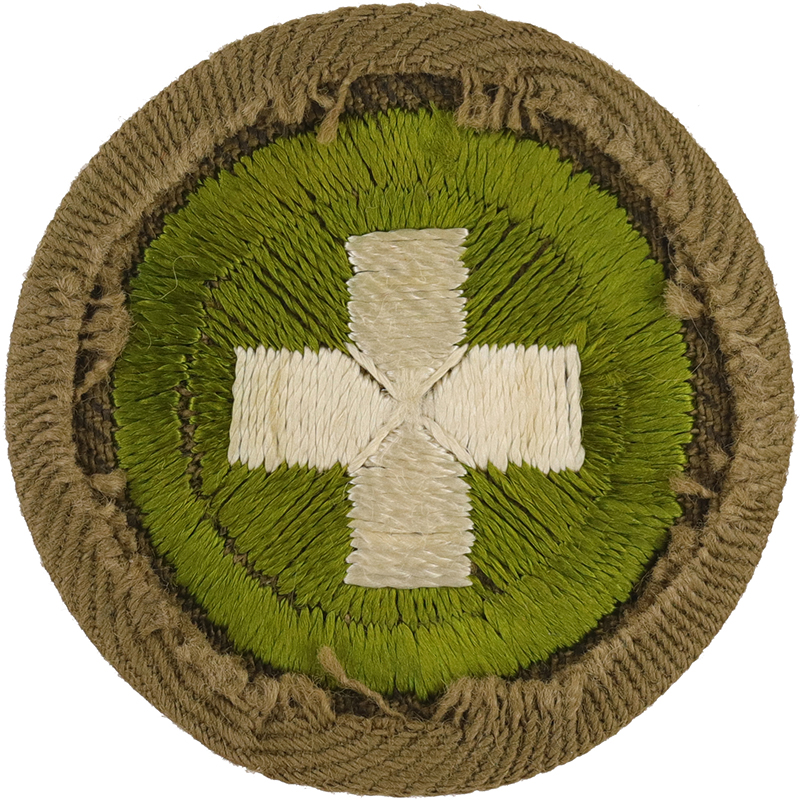
Fig. 2: Safety-B2-Reverse
- Back: Black imprint
Item Name: Safety 1934 - 1935
Item ID: Safety-B2
Collector Rating: 1
Pamphlets Used to Earn this Badge
Requirements November 1932 until June 1952
1. Submit evidence of having satisfactorily done one of the following:
(a) Made a safety inspection of his home and premises, listed conditions which might prove dangerous, and taken practical measures to remedy at least two such conditions; or
(b) Actively shared in the safety work in school over a period of at least ten weeks and at all times done his best by example and attitude to interest his schoolmates in safety activities; or
(c) Built cabinet for the safe and proper storage of medicines and poisons; or kitchen cabinet for storage of lye, "lysol", ammonia, etc.; or suitable play pen for the baby, screening, if desired, for outdoor use; or gate guarding stairs for children; or safety rail for cellar stairs with painted white stripes on lowest step; or built and filled sandbox for slipper walks; or recommended a needed safety device for home or Troop and when approved by Counselor, made such device.
2. Demonstrate how he would make himself visible while walking on the road at night; explain on which side of the road he should walk, day or night, and why.
3. Demonstrate with a modern gun:
(a) The direction in which he should point the muzzle when picking it up and tell why;*
(b) Other safety precautions which should always be taken to avoid accident when handling a gun or passing it to another person, and tell why.*
4. Demonstrate, with a full size axe, the correct way to carry it safely;
(b) Demonstrate how to handle, carry, and store safely different kinds of farm tools such as scythe, sickle and pitch fork, or sharp edged tools about the home or shop.
5. Demonstrate (a) with another boy what action he would take, and tell why, in the following situation: Some children have been playing with fire; the clothing of one becomes ignited;
(b) With two other boys, method he would use, (1) with a 20-foot rope, and (2) with a board, to rescue a fourth boy who had broken through the ice;
(c) How he would save himself if he had broken through the ice, and there were no help in sight.
6. Submit and comment on newspaper account which he has gathered within a period of the past six months describing at least three different kinds of accidents due to any of the following causes: (a) Stealing rides on automobiles or street cars; (b) Hitch hiking; (c) Crossing street or highway; (d) Reckless driving; (e) Failure to observe a traffic law.
7. Explain, in discussion with his Counselor, or dramatize with members of his Patrol, what he considers the main safety hazards involved in modern transportation, industry, recreation, and in the home, indicating general ways in which they should be met, including also ways for dealing with such specific problems as:
(a) Escaping gas; (b) wire dangling from electric line; (c) safe storage and use of gasoline; (d) running engine in closed garage; (e) three ways of turning in fire alarm, citing best local method and giving exact location of nearest fire alarm to his home or place of employment; (f) appearance of blasting caps, their use, and precautions against untimely explosion.
* Note--This Requirement must be waives when it involves conflict with local or state law relating to ownership and use of firearms. In all other cases evidence must be produced that all practice and the test have been conducted under a range officer whose appointment has been approved by the Local or National Council. (This Requirement does not necessitate Scout's supplying gun).