-
Merit Badges
- Legend to identify Merit Badges
- 1910 British Merit Badges
- Square 1911 - 33
- Wide Crimped 1934 & 35
-
Narrow Tan Crimped 1936 - 42
- Tan Heavyweight Cloth with Silk Embroidery and Printed Back 1936 - 37
- Tan Heavyweight Cloth with Silk Embroidery and Plain Back 1937 - 38
- Tan Lightweight Cloth with Silk Embroidery and Plain Back 1938 - 39
- Tan Lightweight Cloth with Cotton Continuous Loop Embroidery and Plain Back 1939 - 42
- Tan Lightweight Cloth with Cotton Lockstitch Embroidery and Plain Back 1939 - 42
- Blue Background 1942 - 46
- Wartime 1942 - 46
- Khaki Narrow Crimped 1946 - 59
- Green Twill Gauze Back 1960 - 68
- Fully Embroidered Merrowed Edge 1960 - 72
- Unprinted Plastic Back 1972 - 01
- Printed Plastic Back 2002 - Current
-
Merit Badge Paper
- Merit Badge Applications
- Merit Badge Cards
-
Merit Badge Pamphlets
- Type 1 White Cover - Rectangle Drawing On Cover
- Type 2 White Cover 5-375" x 8" Title at Top
- Type 3A Tan Cover - 200 Fifth Avenue
- Type 3B Tan Cover - 2 line address New York City
- Type 3C Tan Cover - 2 line address New York N.Y.
- Type 3D Tan Cover - 1 line address New York N.Y.
- Type 4 Standing Scout Cover
- Type 5A War Cover
- Type 5B Red and White
- Type 6 Photo-Red Cover
- Type 7 Full Photo Cover or Bulls-eye Cover
- Type 8 Full Photo - Green Stripe Cover
- Type 9 Full Photo - Red Stripe Cover
- Type 10A Blue Stripe - Logo above bottom blue stripe - FDL centered
- Type 10B - Blue Stripe in bottom of photo area. FDL to left of text
- Special Covers
- Boy Craft Helps
- Merit Badge Counselor's Guides
-
Youth Position
- Junior Assistant Scoutmaster
- Senior Patrol Leader
- Assistant Senior Patrol Leader
- Patrol Leader
- Assistant Patrol Leader
- Troop Guide
- Scribe
- Quartermaster
- Instructor
- Chaplain Aide
- Den Chief
- Librarian
- Musician
- Webmaster
- Bugler
- Troop Historian
- Troop Representative
- Unit Representative
- Leadership Corps
- Honor Guard
- Leave No Trace Trainer
- Outdoor Ethics Guide
-
Patrol Medallions
- Patrol Medallions Introduction
- Legend to identify Patrol Medallions
- Patrol Shoulder Knot-Ribbons
- Felt Handmade Patrol Medallions
- Square Felt Patrol Medallions
- Round Broadcloth Patrol Medallions
- Red Twill Patrol Medallions
- Multi-Color Cloth Patrol Medallions
- Tan Cloth Patrol Medallions
- Patrol Medallion Back Patches
- Woodbadge Patrol Medallion
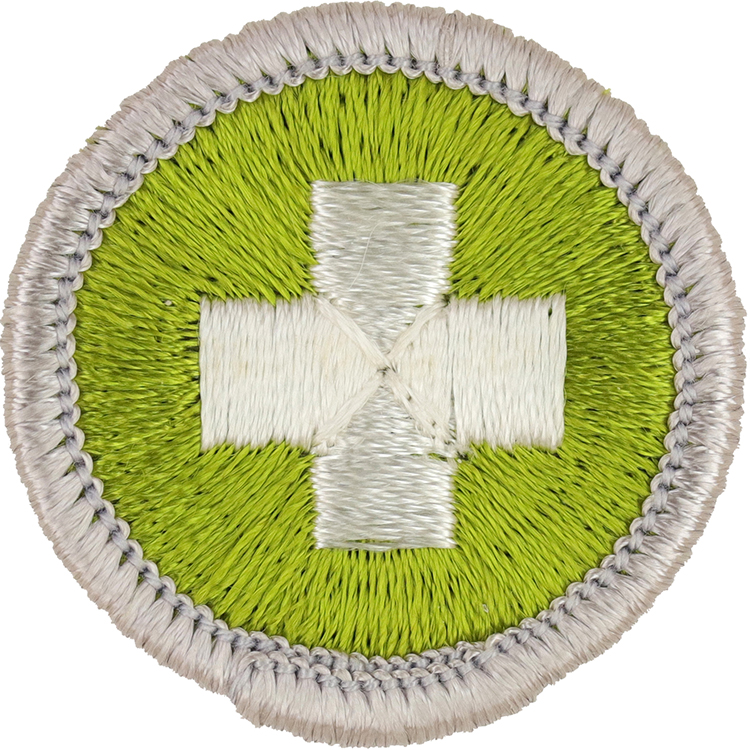
Fig. 1: Safety-G2-Front
- Embroidery: Cotton thread
- Border: Merrowed
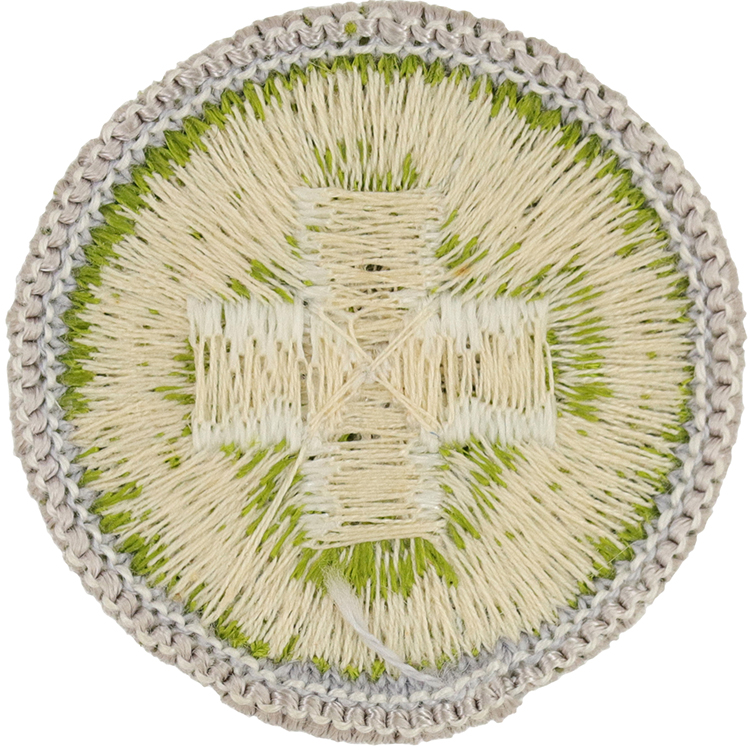
Fig. 2: Safety-G2-Reverse
- Back: Starched cloth
Item Name: Safety 1969 - 1972
Item ID: Safety-G2
Collector Rating: 1
Pamphlets Used to Earn this Badge


Requirements December 1966 until June 1972
1. Write a report of not less than 150 words on ONE of the following three topics or come prepared with notes to discuss them with your merit badge counselor:
(a) Accident figures in the United States for 1 year. Include number of deaths and injuries in the four principal accident classes (work, motor vehicle, home, public) and costs of accidents. Explain how a serious accident to you or your parents can change your life.
(b) Unsafe actions and accidents. Explain how at least five unsafe actions can cause death or injury.
(c) Safety and daily living. Explain how safety information acquired in Scouting can help you in daily living. Also tell how safety helps you enjoy adventures.
2. Watch drivers and pedestrians at or near an intersection for a total of 3 hours (can be done ½ hour, 1 hour, etc., at a time). List the unsafe practices you see and explain what would have been the safe practice in each case.
3. Demonstrate or list five important safety practices for each of the following: walking, bicycle riding, automobile driving in town, automobile driving in the country.
4. Do ONE of the following three projects:
(a) Assist in an organized safety campaign.
(b) Visit and report on a local traffic court.
(c) Add approved reflective Slow Moving Vehicle emblem to farm equipment likely to move on the highway.
5. Using a safety checklist, complete a safety inspection of your home and premises. Explain what hazards have been corrected and how.
6. Describe safety practices in the home that help prevent falls, burns and scalds, and poisonings.
7. Explain to your counselor safety precautions related to the following: dogs or other pets, firearms, hiking and camping, hand tools, electric wires, blasting caps, outdoor fires, swimming, excavations, winter sports or summer sports (except swimming).
8. List safety precautions that should be followed in two work areas where boys of Scout age might be employed, either in after-school or vacation jobs.
9. Do ONE of the following three projects:
(a) Report on a safety project in which you participated at school, at church, or in the community.
(b) Get permission and accompany a building or fire inspector on a safety inspection tour of a public building. Make a report of the tour.
(c) Get permission and accompany a safety director, safety engineer, or safety inspector of an industrial plant on a safety inspection tour of his plant. Make a report of the tour.
10. Discuss with your counselor how you can contribute to the safety of yourself, your family, and your community.