-
Merit Badges
- Legend to identify Merit Badges
- 1910 British Merit Badges
- Square 1911 - 33
- Wide Crimped 1934 & 35
-
Narrow Tan Crimped 1936 - 42
- Tan Heavyweight Cloth with Silk Embroidery and Printed Back 1936 - 37
- Tan Heavyweight Cloth with Silk Embroidery and Plain Back 1937 - 38
- Tan Lightweight Cloth with Silk Embroidery and Plain Back 1938 - 39
- Tan Lightweight Cloth with Cotton Continuous Loop Embroidery and Plain Back 1939 - 42
- Tan Lightweight Cloth with Cotton Lockstitch Embroidery and Plain Back 1939 - 42
- Blue Background 1942 - 46
- Wartime 1942 - 46
- Khaki Narrow Crimped 1946 - 59
- Green Twill Gauze Back 1960 - 68
- Fully Embroidered Merrowed Edge 1960 - 72
- Unprinted Plastic Back 1972 - 01
- Printed Plastic Back 2002 - Current
-
Merit Badge Paper
- Merit Badge Applications
- Merit Badge Cards
-
Merit Badge Pamphlets
- Type 1 White Cover - Rectangle Drawing On Cover
- Type 2 White Cover 5-375" x 8" Title at Top
- Type 3A Tan Cover - 200 Fifth Avenue
- Type 3B Tan Cover - 2 line address New York City
- Type 3C Tan Cover - 2 line address New York N.Y.
- Type 3D Tan Cover - 1 line address New York N.Y.
- Type 4 Standing Scout Cover
- Type 5A War Cover
- Type 5B Red and White
- Type 6 Photo-Red Cover
- Type 7 Full Photo Cover or Bulls-eye Cover
- Type 8 Full Photo - Green Stripe Cover
- Type 9 Full Photo - Red Stripe Cover
- Type 10A Blue Stripe - Logo above bottom blue stripe - FDL centered
- Type 10B - Blue Stripe in bottom of photo area. FDL to left of text
- Special Covers
- Boy Craft Helps
- Merit Badge Counselor's Guides
-
Youth Position
- Junior Assistant Scoutmaster
- Senior Patrol Leader
- Assistant Senior Patrol Leader
- Patrol Leader
- Assistant Patrol Leader
- Troop Guide
- Scribe
- Quartermaster
- Instructor
- Chaplain Aide
- Den Chief
- Librarian
- Musician
- Webmaster
- Bugler
- Troop Historian
- Troop Representative
- Unit Representative
- Leadership Corps
- Honor Guard
- Leave No Trace Trainer
- Outdoor Ethics Guide
-
Patrol Medallions
- Patrol Medallions Introduction
- Legend to identify Patrol Medallions
- Patrol Shoulder Knot-Ribbons
- Felt Handmade Patrol Medallions
- Square Felt Patrol Medallions
- Round Broadcloth Patrol Medallions
- Red Twill Patrol Medallions
- Multi-Color Cloth Patrol Medallions
- Tan Cloth Patrol Medallions
- Patrol Medallion Back Patches
- Woodbadge Patrol Medallion
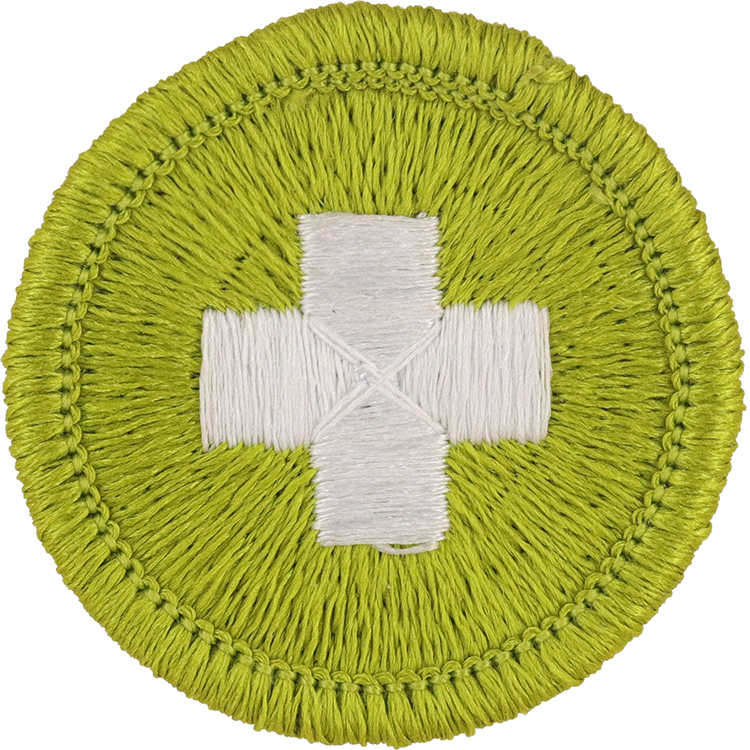
Fig. 1: Safety-J2-Front
- Embroidery: Rayon thread
- Border: Merrowed

Fig. 2: Safety-J2-Reverse
- Back: Smooth clear NO Scout Stuff imprint Bisphenol A (BPA) free plastic
Item Name: Safety 2009 - 2010
Item ID: Safety-J2
Collector Rating: 1
Pamphlets Used to Earn this Badge
Requirements January 2007 until January 2010
1. Prepare a notebook to include:
(a) Newspaper and other stories, facts, and statistics showing common types and causes of injuries in the home and in the workplace, and how these injuries could be prevented.
(b) Newspaper and other stories, facts, and statistics showing common kinds of crimes and ways to avoid being a crime victim.
(c) Facts you have obtained concerning the frequency of accidents and of crimes in your local area.
(d) A paragraph or more, written by you, explaining how a serious fire, accident, or crime could change your family life.
(e) A list of safe practices and safety devices currently used by your family, such as safety practices used while driving or working and safety devices that prevent injuries or help in an emergency.
2. Do the following:
(a) Using a safety checklist approved by your counselor, make an inspection of your home. Explain the hazards found and how they can be corrected.
(b) Review or develop your family's plan of escape in case of fire in your home.
3. Do the following:
(a) Discuss with your counselor how you contribute to the safety of yourself, your family, and your community.
(b) Show your family members how to protect themselves and your home from accidents, fire, theft, robbery, and assault.
(c) Discuss with your counselor the tips for online safety. Explain the steps individuals can take to help prevent identity theft.
(d) Discuss with your counselor the three R’s of youth Prevention and how to recognize child abuse.
4. Show your family the exits you would use from different public buildings (such as a theater, municipal building, library, supermarket, shopping center, or your place of worship) in the event of an emergency. Teach your family what to do in the event that they need to take shelter in or evacuate a public place.
5. Make an accident prevention plan for five family activities outside the home (at your place of worship, at a theater, on a picnic, at the beach, and while traveling for example). Each plan should include an analysis of possible hazards, proposed action to correct hazards, and reasons for the correction you propose in each plan.
6. Plan and complete a safety project approved by your counselor for your home, school, place of worship, place of employment, or community. Include in your plan an explanation of the U.S. Department of Homeland Security’s Advisory System and appropriate actions to take for each threat level.
7. Learn about three career opportunities in the field of safety. Pick one career and find out the education, training, and experience required for this profession. Discuss this choice with your counselor, and explain why this profession might interest you.