-
Merit Badges
- Legend to identify Merit Badges
- 1910 British Merit Badges
- Square 1911 - 33
- Wide Crimped 1934 & 35
-
Narrow Tan Crimped 1936 - 42
- Tan Heavyweight Cloth with Silk Embroidery and Printed Back 1936 - 37
- Tan Heavyweight Cloth with Silk Embroidery and Plain Back 1937 - 38
- Tan Lightweight Cloth with Silk Embroidery and Plain Back 1938 - 39
- Tan Lightweight Cloth with Cotton Continuous Loop Embroidery and Plain Back 1939 - 42
- Tan Lightweight Cloth with Cotton Lockstitch Embroidery and Plain Back 1939 - 42
- Blue Background 1942 - 46
- Wartime 1942 - 46
- Khaki Narrow Crimped 1946 - 59
- Green Twill Gauze Back 1960 - 68
- Fully Embroidered Merrowed Edge 1960 - 72
- Unprinted Plastic Back 1972 - 01
- Printed Plastic Back 2002 - Current
-
Merit Badge Paper
- Merit Badge Applications
- Merit Badge Cards
-
Merit Badge Pamphlets
- Type 1 White Cover - Rectangle Drawing On Cover
- Type 2 White Cover 5-375" x 8" Title at Top
- Type 3A Tan Cover - 200 Fifth Avenue
- Type 3B Tan Cover - 2 line address New York City
- Type 3C Tan Cover - 2 line address New York N.Y.
- Type 3D Tan Cover - 1 line address New York N.Y.
- Type 4 Standing Scout Cover
- Type 5A War Cover
- Type 5B Red and White
- Type 6 Photo-Red Cover
- Type 7 Full Photo Cover or Bulls-eye Cover
- Type 8 Full Photo - Green Stripe Cover
- Type 9 Full Photo - Red Stripe Cover
- Type 10A Blue Stripe - Logo above bottom blue stripe - FDL centered
- Type 10B - Blue Stripe in bottom of photo area. FDL to left of text
- Special Covers
- Boy Craft Helps
- Merit Badge Counselor's Guides
-
Youth Position
- Junior Assistant Scoutmaster
- Senior Patrol Leader
- Assistant Senior Patrol Leader
- Patrol Leader
- Assistant Patrol Leader
- Troop Guide
- Scribe
- Quartermaster
- Instructor
- Chaplain Aide
- Den Chief
- Librarian
- Musician
- Webmaster
- Bugler
- Troop Historian
- Troop Representative
- Unit Representative
- Leadership Corps
- Honor Guard
- Leave No Trace Trainer
- Outdoor Ethics Guide
-
Patrol Medallions
- Patrol Medallions Introduction
- Legend to identify Patrol Medallions
- Patrol Shoulder Knot-Ribbons
- Felt Handmade Patrol Medallions
- Square Felt Patrol Medallions
- Round Broadcloth Patrol Medallions
- Red Twill Patrol Medallions
- Multi-Color Cloth Patrol Medallions
- Tan Cloth Patrol Medallions
- Patrol Medallion Back Patches
- Woodbadge Patrol Medallion
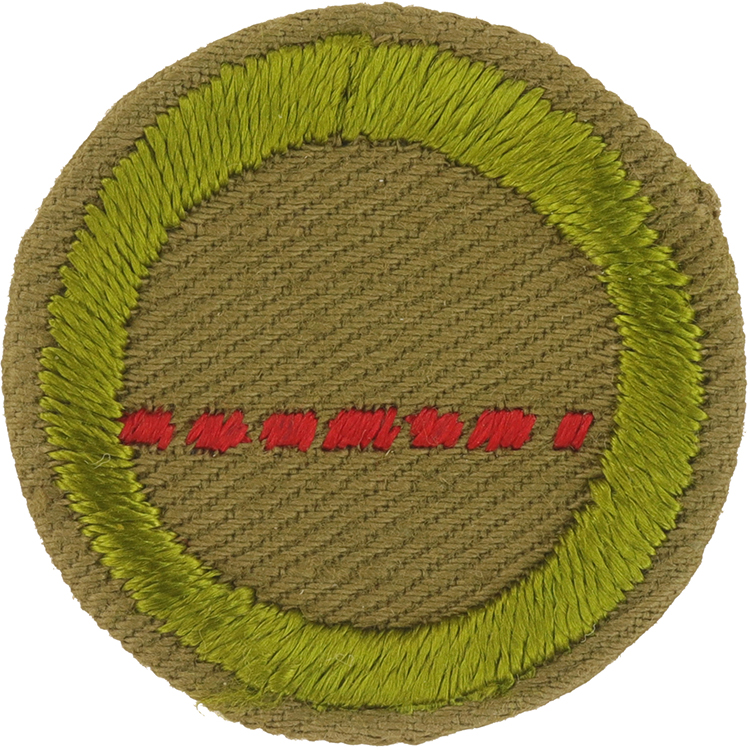
Fig. 1: Salesm-C2-Front
- Cloth: Heavyweight tan right twill
- Embroidery: Continuous loop silk
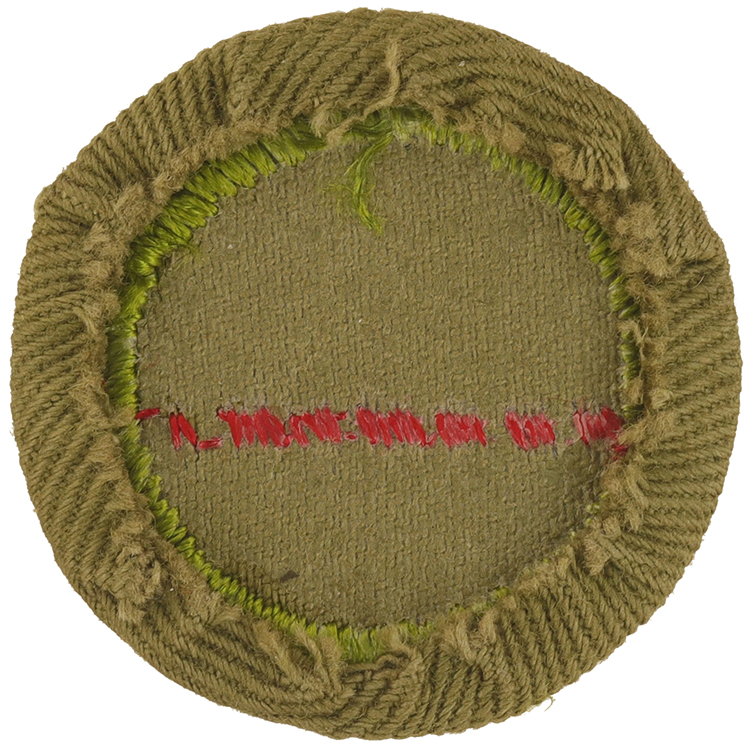
Fig. 2: Salesm-C2-Reverse
- Back: Plain NO imprint with starch
Item Name: Salesmanship 1937 - 1938
Item ID: Salesm-C2
Collector Rating: 1
Pamphlets Used to Earn this Badge
Requirements March 1927 until June 1948
1. Analyze an article of merchandise from each of five retail stores, and make a report of what happens to each article of merchandise investigated from time it leaves the manufacturer until it reaches the consumer.
2. Explain the value of a salesman between manufacturer and jobber, between jobber and retailer; or between manufacturer and retailer.
3. Sell a definite quantity of merchandise total sales value of which is in excess of $10.00 and give his actual selling experience, telling the methods he used to influence people to buy his merchandise, and how he overcame "selling resistance."
4. Indicate the place or importance of selling in business.
5. Explain how ideas are formed and how a salesman can lead a customer to decide to buy.
6. Sell at a profit something he has made or grown. Keep the necessary records to enable him to fix the right selling price and tell how much profit he has made.
7. Obtain and hold for three months, a selling job for the hours after school, Saturday afternoons, or vacation. Describe what is necessary to sell the things he handles.
8. In uniform, visit a business concern and learn how their product is sold. Describe the selling process. Take with him an outline of at least ten questions prepared in advance.
9. Name five fundamental requirements of successful salesmanship.
10. Go to some successful practical salesman in his community and find out what he thinks of selling as a life work. Write out in 500 words or more his conclusions of what the salesman tells him of salesmanship as a life work.
11. (a) Explain what he understands to be the meaning of the statement that "Every man is a salesman. He must sell himself, his time, his ideas, his service."
(b) Explain why TRUTHFULNESS about an article is one of the outstanding requirements of all good selling.
(c) Explain what it is that every salesman sells to his employer.
(d) Explain how courtesy to prospective customers aids selling.
(Be prepared to give examples)