-
Merit Badges
- Legend to identify Merit Badges
- 1910 British Merit Badges
- Square 1911 - 33
- Wide Crimped 1934 & 35
-
Narrow Tan Crimped 1936 - 42
- Tan Heavyweight Cloth with Silk Embroidery and Printed Back 1936 - 37
- Tan Heavyweight Cloth with Silk Embroidery and Plain Back 1937 - 38
- Tan Lightweight Cloth with Silk Embroidery and Plain Back 1938 - 39
- Tan Lightweight Cloth with Cotton Continuous Loop Embroidery and Plain Back 1939 - 42
- Tan Lightweight Cloth with Cotton Lockstitch Embroidery and Plain Back 1939 - 42
- Blue Background 1942 - 46
- Wartime 1942 - 46
- Khaki Narrow Crimped 1946 - 59
- Green Twill Gauze Back 1960 - 68
- Fully Embroidered Merrowed Edge 1960 - 72
- Unprinted Plastic Back 1972 - 01
- Printed Plastic Back 2002 - Current
-
Merit Badge Paper
- Merit Badge Applications
- Merit Badge Cards
-
Merit Badge Pamphlets
- Type 1 White Cover - Rectangle Drawing On Cover
- Type 2 White Cover 5-375" x 8" Title at Top
- Type 3A Tan Cover - 200 Fifth Avenue
- Type 3B Tan Cover - 2 line address New York City
- Type 3C Tan Cover - 2 line address New York N.Y.
- Type 3D Tan Cover - 1 line address New York N.Y.
- Type 4 Standing Scout Cover
- Type 5A War Cover
- Type 5B Red and White
- Type 6 Photo-Red Cover
- Type 7 Full Photo Cover or Bulls-eye Cover
- Type 8 Full Photo - Green Stripe Cover
- Type 9 Full Photo - Red Stripe Cover
- Type 10A Blue Stripe - Logo above bottom blue stripe - FDL centered
- Type 10B - Blue Stripe in bottom of photo area. FDL to left of text
- Special Covers
- Boy Craft Helps
- Merit Badge Counselor's Guides
-
Youth Position
- Junior Assistant Scoutmaster
- Senior Patrol Leader
- Assistant Senior Patrol Leader
- Patrol Leader
- Assistant Patrol Leader
- Troop Guide
- Scribe
- Quartermaster
- Instructor
- Chaplain Aide
- Den Chief
- Librarian
- Musician
- Webmaster
- Bugler
- Troop Historian
- Troop Representative
- Unit Representative
- Leadership Corps
- Honor Guard
- Leave No Trace Trainer
- Outdoor Ethics Guide
-
Patrol Medallions
- Patrol Medallions Introduction
- Legend to identify Patrol Medallions
- Patrol Shoulder Knot-Ribbons
- Felt Handmade Patrol Medallions
- Square Felt Patrol Medallions
- Round Broadcloth Patrol Medallions
- Red Twill Patrol Medallions
- Multi-Color Cloth Patrol Medallions
- Tan Cloth Patrol Medallions
- Patrol Medallion Back Patches
- Woodbadge Patrol Medallion
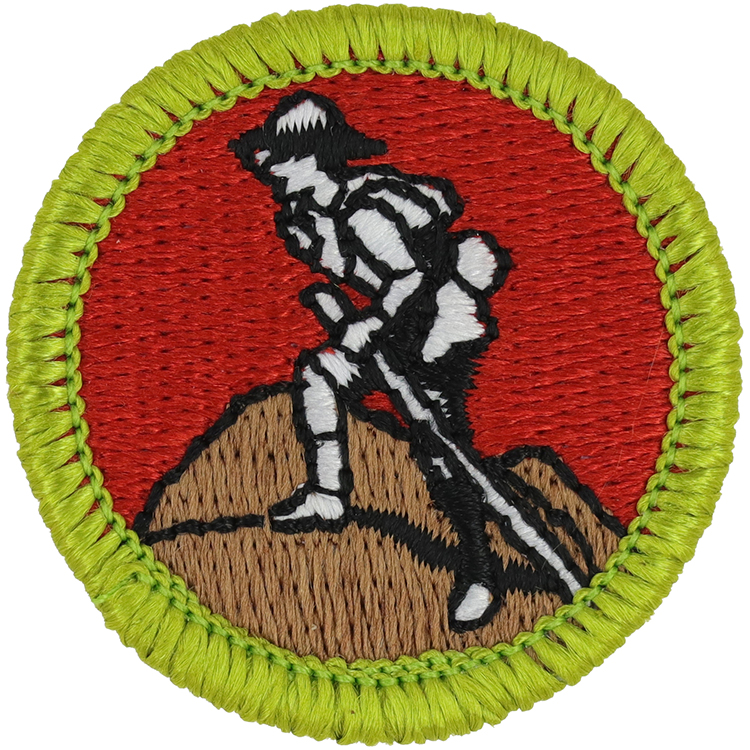
Fig. 1: ScoHer-K-Front
- Embroidery: Rayon thread
- Design: With PFD
- Border: /strong> Merrowed
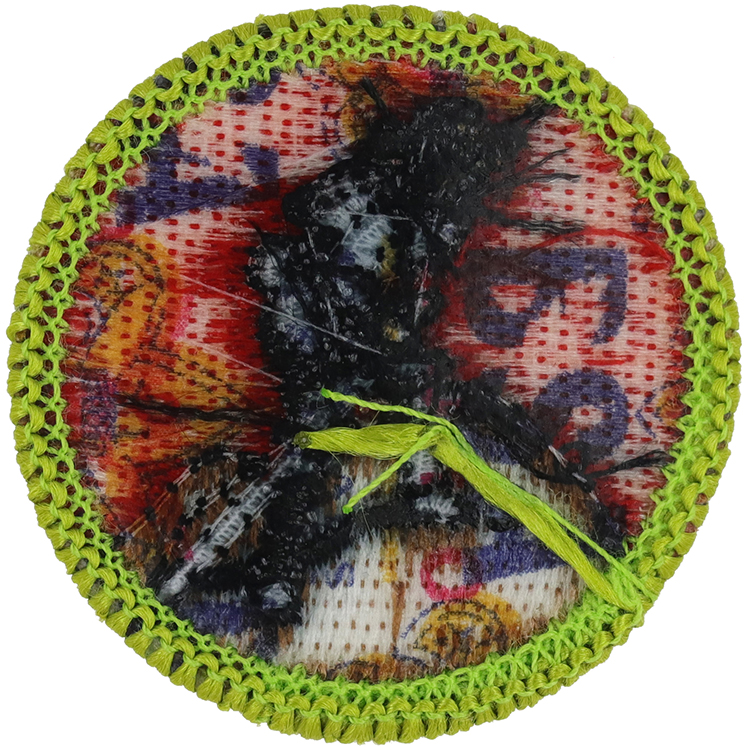
Fig. 2: ScoHer-K-Reverse
- Back: 100th Anniversary imprint
Item Name: Scouting Heritage 2012 - 2013
Item ID: ScoHer-K
Collector Rating: 1
Pamphlets Used to Earn this Badge

Requirements January 2011 until January 2012
1. Discuss with your counselor the life and times of Lord Baden-Powell of Gilwell. Explain why he felt a program like Scouting would be good for the young men of his day. Include in your discussion how Scouting was introduced in the United States, and the origins of Boy Scouting and Cub Scouting under Baden-Powell.
2. Do the following:
(a) Give a short biographical sketch of any TWO of the following, and tell of their roles in how Scouting developed and grew in the United States prior to 1940.
(1) Daniel Carter Beard
(2) William D. Boyce
(3) Waite Phillips
(4) Ernest Thompson Seton
(5) James E. West
(b) Discuss the significance to Scouting of any TWO of the following:
(1) Brownsea Island
(2) The First World Scout Jamboree
(3) Boy Scout Handbook
(4) Boy’s Life magazine
3. Discuss with your counselor how Scouting’s programs have developed over time and been adapted to fit different age groups and interest (Cub Scouting, Boy Scouting, Exploring, Venturing)
4. Do ONE of the following:
(a) Attend either a BSA national jamboree, OR world Scout jamboree, OR a national BSA high-adventure base. While there, keep a journal documenting your day-to-day experiences. Upon your return, report to your counselor what you did, saw, and learned. You may include photos, brochures, and other documentation in your report.
(b) Write or visit the National Scouting Museum in Irving, Texas.* Obtain information about this facility, Give a short report on what you think the role of this museum is in the Scouting program.
5. Learn about the history of your unit in Scouting in your area. Interview at least two people (one from the past and one from the present) associated with your troop. These individuals could be adult unit leaders, Scouts, troop committee members, or representatives of your troop’s chartered organization. Find out when your unit was originally chartered. Create a report of your findings on the history of your troop, and present it to your patrol or troop or at a court of honor, and then add it to the troop’s library. This presentation could be in the form of an oral/written report, an exhibit, a scrapbook, or a computer presentation such as a slide show.
6. Make a collection of some of your personal patches and other Scouting memorabilia. With their permission, you may include items borrowed from a family members or friends who have been in Scouting in the past, or you may include photographs of these items. Show this collection to your counselor, and share what you have learned about items in the collection. (There is no requirement regarding how large or small this collection must be.)
7. Reproduce the equipment for an old-time Scouting game such as those played at Brownsea Island. You may find one on your own (with your counselor’s approval), or pick one from the Scouting Heritage merit badge pamphlet. Teach and play the game with other Scouts.
8. Interview at least three people (different from those interviewed for requirement 5) over the age of 50 who were Scouts. Find out about their Scouting experiences. Ask about the impact that Scouting has had on their lives. Share what you learned with your counselor.
*If you visited the BSA’s national traveling tour, Adventure Base 100, in 2000, you may use that experience to fulfill requirement 4b.
Requirements January 2012 until January 2014
1. Discuss with your counselor the life and times of Lord Baden-Powell of Gilwell. Explain why he felt a program like Scouting would be good for the young men of his day. Include in your discussion how Scouting was introduced in the United States, and the origins of Boy Scouting and Cub Scouting under Baden-Powell.
2. Do the following:
(a) Give a short biographical summary of any TWO of the following, and tell of their roles in how Scouting developed and grew in the United States prior to 1940.
(1) Daniel Carter Beard
(2) William D. Boyce
(3) Waite Phillips
(4) Ernest Thompson Seton
(5) James E. West
(b) Discuss the significance to Scouting of any TWO of the following:
(1) Brownsea Island
(2) The First World Scout Jamboree
(3) Boy Scout Handbook
(4) Boys’ Life magazine
3. Discuss with your counselor how Scouting’s programs have developed over time and been adapted to fit different age groups and interest (Cub Scouting, Boy Scouting, Exploring, Venturing)
4. Do ONE of the following:
(a) Attend either a BSA national jamboree, OR world Scout jamboree, OR a national BSA high-adventure base. While there, keep a journal documenting your day-to-day experiences. Upon your return, report to your counselor what you did, saw, and learned. You may include photos, brochures, and other documentation in your report.
(b) Write or visit the National Scouting Museum in Irving, Texas.* Obtain information about this facility, Give a short report on what you think the role of this museum is in the Scouting program.
5. Learn about the history of your unit in Scouting in your area. Interview at least two people (one from the past and one from the present) associated with your troop. These individuals could be adult unit leaders, Scouts, troop committee members, or representatives of your troop’s chartered organization. Find out when your unit was originally chartered. Create a report of your findings on the history of your troop, and present it to your patrol or troop or at a court of honor, and then add it to the troop’s library. This presentation could be in the form of an oral/written report, an exhibit, a scrapbook, or a computer presentation such as a slide show.
6. Make a collection of some of your personal patches and other Scouting memorabilia. With their permission, you may include items borrowed from a family members or friends who have been in Scouting in the past, or you may include photographs of these items. Show this collection to your counselor, and share what you have learned about items in the collection. (There is no requirement regarding how large or small this collection must be.)
7. Reproduce the equipment for an old-time Scouting game such as those played at Brownsea Island. You may find one on your own (with your counselor’s approval), or pick one from the Scouting Heritage merit badge pamphlet. Teach and play the game with other Scouts.
8. Interview at least three people (different from those interviewed for requirement 5) over the age of 40 who were Scouts. Find out about their Scouting experiences. Ask about the impact that Scouting has had on their lives. Share what you learned with your counselor.
*If you visited the BSA’s national traveling tour, Adventure Base 100, in 2000, you may use that experience to fulfill requirement 4b.