-
Merit Badges
- Legend to identify Merit Badges
- 1910 British Merit Badges
- Square 1911 - 33
- Wide Crimped 1934 & 35
-
Narrow Tan Crimped 1936 - 42
- Tan Heavyweight Cloth with Silk Embroidery and Printed Back 1936 - 37
- Tan Heavyweight Cloth with Silk Embroidery and Plain Back 1937 - 38
- Tan Lightweight Cloth with Silk Embroidery and Plain Back 1938 - 39
- Tan Lightweight Cloth with Cotton Continuous Loop Embroidery and Plain Back 1939 - 42
- Tan Lightweight Cloth with Cotton Lockstitch Embroidery and Plain Back 1939 - 42
- Blue Background 1942 - 46
- Wartime 1942 - 46
- Khaki Narrow Crimped 1946 - 59
- Green Twill Gauze Back 1960 - 68
- Fully Embroidered Merrowed Edge 1960 - 72
- Unprinted Plastic Back 1972 - 01
- Printed Plastic Back 2002 - Current
-
Merit Badge Paper
- Merit Badge Applications
- Merit Badge Cards
-
Merit Badge Pamphlets
- Type 1 White Cover - Rectangle Drawing On Cover
- Type 2 White Cover 5-375" x 8" Title at Top
- Type 3A Tan Cover - 200 Fifth Avenue
- Type 3B Tan Cover - 2 line address New York City
- Type 3C Tan Cover - 2 line address New York N.Y.
- Type 3D Tan Cover - 1 line address New York N.Y.
- Type 4 Standing Scout Cover
- Type 5A War Cover
- Type 5B Red and White
- Type 6 Photo-Red Cover
- Type 7 Full Photo Cover or Bulls-eye Cover
- Type 8 Full Photo - Green Stripe Cover
- Type 9 Full Photo - Red Stripe Cover
- Type 10A Blue Stripe - Logo above bottom blue stripe - FDL centered
- Type 10B - Blue Stripe in bottom of photo area. FDL to left of text
- Special Covers
- Boy Craft Helps
- Merit Badge Counselor's Guides
-
Youth Position
- Junior Assistant Scoutmaster
- Senior Patrol Leader
- Assistant Senior Patrol Leader
- Patrol Leader
- Assistant Patrol Leader
- Troop Guide
- Scribe
- Quartermaster
- Instructor
- Chaplain Aide
- Den Chief
- Librarian
- Musician
- Webmaster
- Bugler
- Troop Historian
- Troop Representative
- Unit Representative
- Leadership Corps
- Honor Guard
- Leave No Trace Trainer
- Outdoor Ethics Guide
-
Patrol Medallions
- Patrol Medallions Introduction
- Legend to identify Patrol Medallions
- Patrol Shoulder Knot-Ribbons
- Felt Handmade Patrol Medallions
- Square Felt Patrol Medallions
- Round Broadcloth Patrol Medallions
- Red Twill Patrol Medallions
- Multi-Color Cloth Patrol Medallions
- Tan Cloth Patrol Medallions
- Patrol Medallion Back Patches
- Woodbadge Patrol Medallion
Fig. 1: "Media Not Available"
- Cloth: Heavyweight tan right twill
- Embroidery: Silk continuous
- Border: Clockwise, round & dense
Fig. 2: "Media Not Available"
- Design: Straight stock end bulb on right side only, thin red anchor, chain connected top ring, rounded anchor tip
Fig. 3: "Media Not Available"
- Back: Black imprint
Item Name: Seamanship 1913 - 1921
Item ID: Seaman-AH6
Collector Rating: 1
Pamphlets Used to Earn this Badge
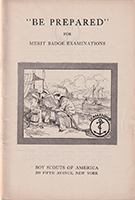
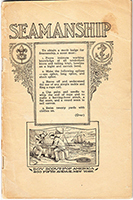
Requirements August 1911 until October 1914
I. Be able to tie rapidly six different knots.
2. Splice ropes.
3. Use a palm and needle.
4. Fling a rope coil.
5. Be able to row, pole, scull, and steer a boat; also bring a boat properly alongside and make fast.
6. Know how to box the compass, read a chart, and show use of parallel rules and dividers.
7. Be able to state direction by the stars and sun.
8. Swim fifty yards with shoes and clothes on.
9. Understand the general working of steam and hydraulic winches, and have a knowledge of weather wisdom and of tides.
Requirements October 1914 until December 1916
I. Tie rapidly sixteen different knots.
2. Show proficiency in making a short splice, a long splice, and in covering an eye splice.
3. Use a palm and needle.
4. Fling a rope coil.
5. Row, pole, scull, and steer a boat; also bring a boat properly alongside and make fast.
6. Box the compass; read a chart; and show use of parallel rules, dividers, and lead line.
7. State direction by the stars and sun.
8. Swim fifty yards with shoes and clothes on.
9. Understand the general working of steam and hydraulic winches, and have a knowledge of weather wisdom and of tides.
Requirements December 1916 until May 1926
I. Prove intimate working knowledge of all tenderfoot knots and rolling hitch, bowline on a bight and carrick bend.
2. Make the following splices -eye splice, long splice, and short splice.
3. Reeve off and understand the use of any simple tackle and fling a rope coil.
4. Use palm and needle to whip the end of rope and to make a herring-bone stitch, a flat seam, and a round seam in sail canvas.
5. Swim twenty yards with clothes and shoes on.
6. Handle a rowboat with a pair of oars; also act as coxswain, giving orders for getting under way and making landings properly. Scull a boat with one oar.
7. Have a working knowledge of:
(a) the lead line and patent log;
(b) anchors and use of ground tackle;
(c) weather wisdom and tides;
(d) charts and pilotage.
8. Box the compass by quarter-points and point out direction by the stars and sun.
9. Know the lights used on sail and power vessels and be familiar with the elementary rules of the road.
10. Handle a boat under sail on all points of sailing, getting under way, making landing at dock or alongside another vessel and reefing.