-
Merit Badges
- Legend to identify Merit Badges
- 1910 British Merit Badges
- Square 1911 - 33
- Wide Crimped 1934 & 35
-
Narrow Tan Crimped 1936 - 42
- Tan Heavyweight Cloth with Silk Embroidery and Printed Back 1936 - 37
- Tan Heavyweight Cloth with Silk Embroidery and Plain Back 1937 - 38
- Tan Lightweight Cloth with Silk Embroidery and Plain Back 1938 - 39
- Tan Lightweight Cloth with Cotton Continuous Loop Embroidery and Plain Back 1939 - 42
- Tan Lightweight Cloth with Cotton Lockstitch Embroidery and Plain Back 1939 - 42
- Blue Background 1942 - 46
- Wartime 1942 - 46
- Khaki Narrow Crimped 1946 - 59
- Green Twill Gauze Back 1960 - 68
- Fully Embroidered Merrowed Edge 1960 - 72
- Unprinted Plastic Back 1972 - 01
- Printed Plastic Back 2002 - Current
-
Merit Badge Paper
- Merit Badge Applications
- Merit Badge Cards
-
Merit Badge Pamphlets
- Type 1 White Cover - Rectangle Drawing On Cover
- Type 2 White Cover 5-375" x 8" Title at Top
- Type 3A Tan Cover - 200 Fifth Avenue
- Type 3B Tan Cover - 2 line address New York City
- Type 3C Tan Cover - 2 line address New York N.Y.
- Type 3D Tan Cover - 1 line address New York N.Y.
- Type 4 Standing Scout Cover
- Type 5A War Cover
- Type 5B Red and White
- Type 6 Photo-Red Cover
- Type 7 Full Photo Cover or Bulls-eye Cover
- Type 8 Full Photo - Green Stripe Cover
- Type 9 Full Photo - Red Stripe Cover
- Type 10A Blue Stripe - Logo above bottom blue stripe - FDL centered
- Type 10B - Blue Stripe in bottom of photo area. FDL to left of text
- Special Covers
- Boy Craft Helps
- Merit Badge Counselor's Guides
-
Youth Position
- Junior Assistant Scoutmaster
- Senior Patrol Leader
- Assistant Senior Patrol Leader
- Patrol Leader
- Assistant Patrol Leader
- Troop Guide
- Scribe
- Quartermaster
- Instructor
- Chaplain Aide
- Den Chief
- Librarian
- Musician
- Webmaster
- Bugler
- Troop Historian
- Troop Representative
- Unit Representative
- Leadership Corps
- Honor Guard
- Leave No Trace Trainer
- Outdoor Ethics Guide
-
Patrol Medallions
- Patrol Medallions Introduction
- Legend to identify Patrol Medallions
- Patrol Shoulder Knot-Ribbons
- Felt Handmade Patrol Medallions
- Square Felt Patrol Medallions
- Round Broadcloth Patrol Medallions
- Red Twill Patrol Medallions
- Multi-Color Cloth Patrol Medallions
- Tan Cloth Patrol Medallions
- Patrol Medallion Back Patches
- Woodbadge Patrol Medallion
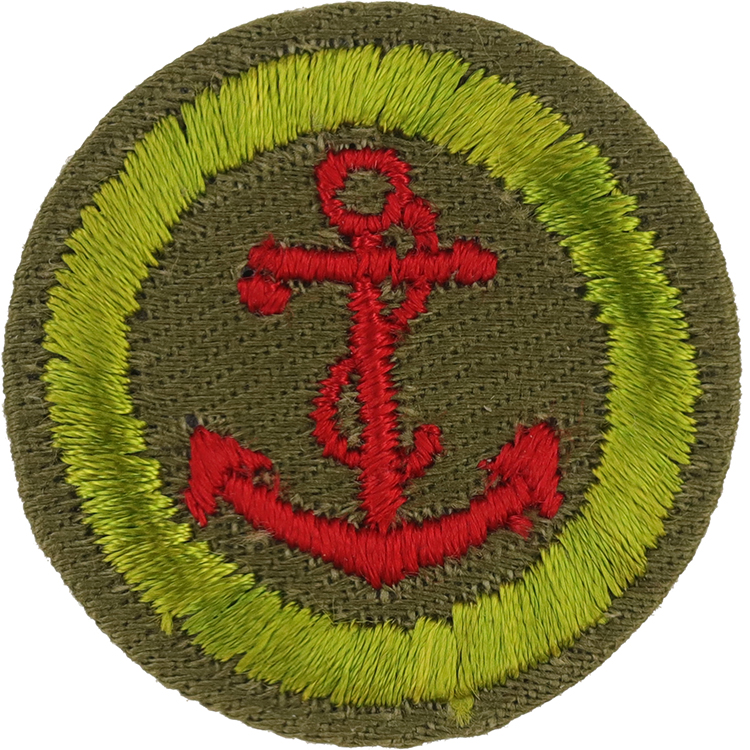
Fig. 1: Seaman-E2-Front
- Cloth: Khaki right twill
- Embroidery: Cotton lock stitch
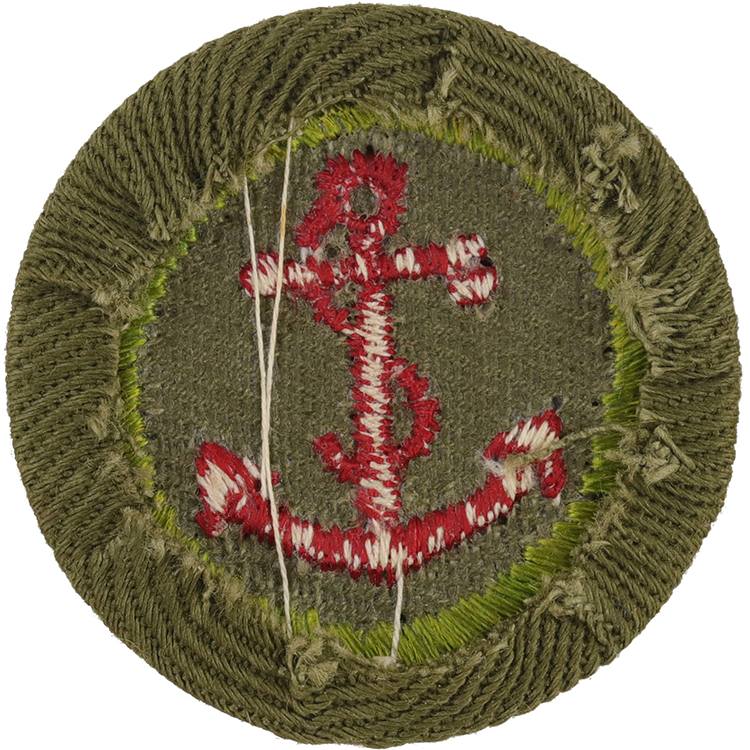
Fig. 2: Seaman-E2-Reverse
- Back: Plain NO imprint with starch
Item Name: Seamanship 1947 - 1960
Item ID: Seaman-E2
Collector Rating: 1
Pamphlets Used to Earn this Badge

Requirements December 1940 until September 1963
1. Using at least one inch (circumference) rope, demonstrate correct (a) whipping of rope, (b) coiling, and (c) flinging. Describe the characteristics of three different types of rope commonly used by seamen.
2. Using at least one inch (circumference) rope, make: (a) at least three kinds of knots used by seamen; (b) two bends; (c) two kinds of hitches; (d) a short splice; (e) and an eye splice. (Explain practical uses in seamanship of each type of know, bend, hitch and splice demonstrated.)
3. Demonstrate on sail cloth use of palm and needle in making: (a) a herring-bone stitch and (b) both flat and round seams.
4. Demonstrate: (a) making a line fast to a cleat, ringbolt, and pile, correctly; (b) a simple whip; (c) a single block tackle; (d) a double block tackle. Describe and explain uses of: (a) a snatch block; (b) a becket.
5. Describe: (a) at least two kinds of anchors and (b) the uses and outstanding features of a lead line.
6. Box the compass to 32 points. Explain: (a) The quarter point and degree systems; (b) compass deviation; (c) compass variation. Know the importance of the North Star to seamen.
7. Have a working knowledge of: (a) weather and tides; (b) coast and geodetic survey charts. Understand buoyage system as used on coastwise harbors, rivers, and bays.
8. Know what lights and other equipment are required by law for: (a) a power-driven pleasure boat of Class 2; (b) a power-driven motor boat under 26 feet; (c) sailing vessels.
9. Understand proper flying of the ensign, jack, and two other flags commonly used on commercial or pleasure craft.
10. Name the working sails of a schooner from bow to stern. Know the name of the line used for: (a) Hoisting a sail or a flag; (b) for trimming a sail to make it set properly. Explain the following terms: starboard tack; port tack; running free; reaching; abaft; abeam.
11. Know: (a) what the danger sector is when two vessels are approaching; (b) what signals are used when a vessel is passing: (1) to left; (2) to right; (3) a sailing vessel lying at anchor in fog; (4) a power-driven vessel; (c) two types of distress signals commonly used at sea other than radio.
12. (a) Fully dressed (in shoes, trousers and jumper or coat),, jump overboard in deep water, undress and, accompanied by a boat, swim 100 yards under supervision of Counselor. (b) Demonstrate proper use of life belt and life buoy.
13. Handle correctly some type of boat or canoe, under sail on all points of sailing, getting under way, reefing, docking, and anchoring.
14. Handle a rowboat (a) with a pair of oars; (b) with a single oar (sculling).
15. (a) Launch and land a rowboat or canoe properly from and to shore. (b) Bring rowboat or canoe alongside pier, properly assist a passenger into boat, row fifty feet, pivot, come back to pier and assist passenger safely and properly from boat. (c) Make rowboat or canoe fast to pier properly, using clove hitch, two half-hitches, and bowline.