-
Merit Badges
- Legend to identify Merit Badges
- 1910 British Merit Badges
- Square 1911 - 33
- Wide Crimped 1934 & 35
-
Narrow Tan Crimped 1936 - 42
- Tan Heavyweight Cloth with Silk Embroidery and Printed Back 1936 - 37
- Tan Heavyweight Cloth with Silk Embroidery and Plain Back 1937 - 38
- Tan Lightweight Cloth with Silk Embroidery and Plain Back 1938 - 39
- Tan Lightweight Cloth with Cotton Continuous Loop Embroidery and Plain Back 1939 - 42
- Tan Lightweight Cloth with Cotton Lockstitch Embroidery and Plain Back 1939 - 42
- Blue Background 1942 - 46
- Wartime 1942 - 46
- Khaki Narrow Crimped 1946 - 59
- Green Twill Gauze Back 1960 - 68
- Fully Embroidered Merrowed Edge 1960 - 72
- Unprinted Plastic Back 1972 - 01
- Printed Plastic Back 2002 - Current
-
Merit Badge Paper
- Merit Badge Applications
- Merit Badge Cards
-
Merit Badge Pamphlets
- Type 1 White Cover - Rectangle Drawing On Cover
- Type 2 White Cover 5-375" x 8" Title at Top
- Type 3A Tan Cover - 200 Fifth Avenue
- Type 3B Tan Cover - 2 line address New York City
- Type 3C Tan Cover - 2 line address New York N.Y.
- Type 3D Tan Cover - 1 line address New York N.Y.
- Type 4 Standing Scout Cover
- Type 5A War Cover
- Type 5B Red and White
- Type 6 Photo-Red Cover
- Type 7 Full Photo Cover or Bulls-eye Cover
- Type 8 Full Photo - Green Stripe Cover
- Type 9 Full Photo - Red Stripe Cover
- Type 10A Blue Stripe - Logo above bottom blue stripe - FDL centered
- Type 10B - Blue Stripe in bottom of photo area. FDL to left of text
- Special Covers
- Boy Craft Helps
- Merit Badge Counselor's Guides
-
Youth Position
- Junior Assistant Scoutmaster
- Senior Patrol Leader
- Assistant Senior Patrol Leader
- Patrol Leader
- Assistant Patrol Leader
- Troop Guide
- Scribe
- Quartermaster
- Instructor
- Chaplain Aide
- Den Chief
- Librarian
- Musician
- Webmaster
- Bugler
- Troop Historian
- Troop Representative
- Unit Representative
- Leadership Corps
- Honor Guard
- Leave No Trace Trainer
- Outdoor Ethics Guide
-
Patrol Medallions
- Patrol Medallions Introduction
- Legend to identify Patrol Medallions
- Patrol Shoulder Knot-Ribbons
- Felt Handmade Patrol Medallions
- Square Felt Patrol Medallions
- Round Broadcloth Patrol Medallions
- Red Twill Patrol Medallions
- Multi-Color Cloth Patrol Medallions
- Tan Cloth Patrol Medallions
- Patrol Medallion Back Patches
- Woodbadge Patrol Medallion
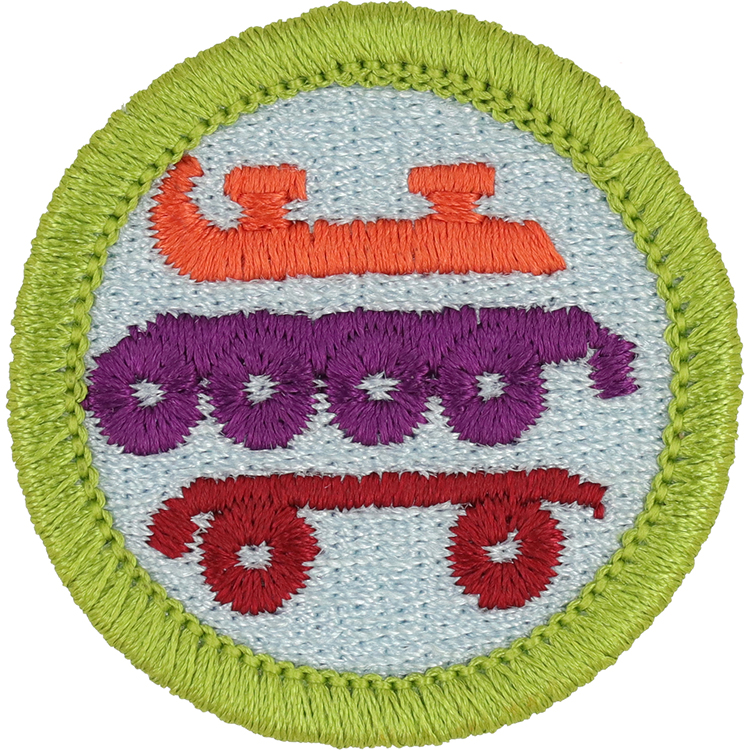
Fig. 1: Skatin-K-Front
- Embroidery: Rayon thread
- Border: Merrowed
- Design: Horizontally embroidered flask head & spout
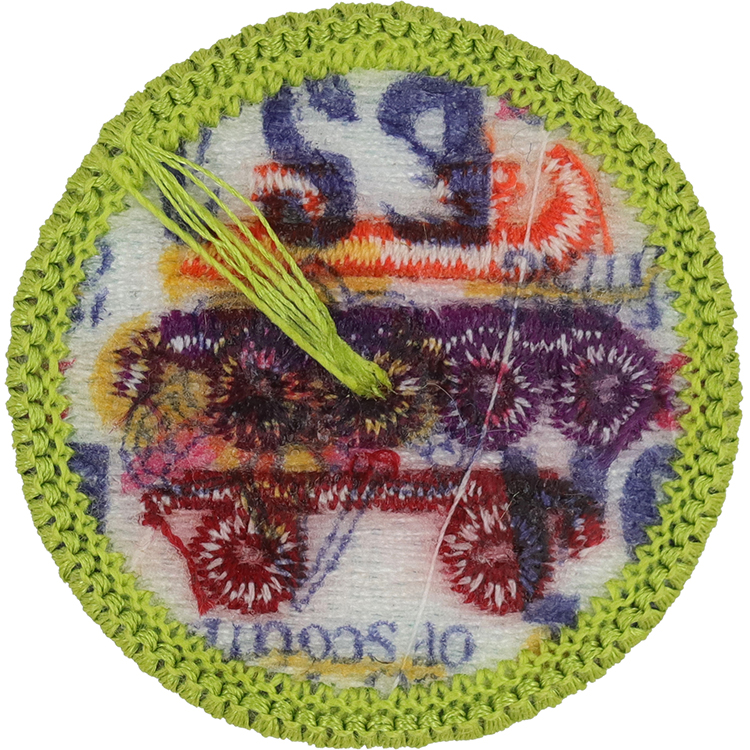
Fig. 2: Skatin-K-Reverse
- Back: 100th Anniversary imprint
Item Name: Skating 2010 - 2013
Item ID: Skatin-K
Collector Rating: 1
Pamphlets Used to Earn this Badge

Requirements January 2006 until January 2016
1. Show you know first aid for injuries or illnesses that may occur while skating, including hypothermia, frostbite, lacerations, abrasions, fractures, sprains, and strains, blisters, heat reactions, shock, and cardiac arrest.
2.Complete ALL of the requirements for ONE of the following options.
Ice Skating
(a) Do the following:
(1) Give general safety and courtesy rules for ice skating. Discuss preparations that must be taken when skating outdoors on natural ice. Explain how to make an ice rescue.
(2) Discuss the parts and functions of the different types of ice skates.
(3) Describe the proper way to carry ice skates.
(4) Describe how to store skates for long periods of time, such as seasonal storage.
(b) Do the following:
(1) Skate forward at least 40 feet and come to a complete stop. Use either a two-footed snowplow stop or a one-footed snowplow stop.
(2) After skating forward, glide forward on two feet, then on one, first right and then left.
(3) Starting from a T position, stroke forward around the test area, avoiding the use of toe points if wearing figure skates.
(c) Do the following:
(1) Glide backward on two feet for at least two times the skater’s height.
(2) Skate backward for at least 20 feet on two skates.
(3) After gaining forward speed, glide forward on two feet, making a turn of 180 degrees around a cone, first to the right and then to the left.
(d) Do the following:
(1) Perform a forward shoot-the-duck until you’re nearly stopped. Raise while still on one foot.
(2) Perform forward crossovers in a figure eight pattern.
(4) Perform a hockey stop.
Roller Skating
(a) Do the following:
(1) Give general safety and etiquette rules for roller skating.
(2) Discuss the parts and functions of the roller skate.
(3) Describe five essential steps to good skate care.
(b) Do the following:
(1) Skate forward with smooth, linked strokes on two feet for at least 100 feet in both directions around the rink and demonstrate proper techniques for stopping.
(2) Skate forward and glide at least 15 feet on one skate, then on the other skate.
(c) Do the following:
(1) Perform the crosscut.
(2) Skate backward for at least 40 feet on two skates, then for at least 15 feet on one skate.
(3) Skate forward in a slalom pattern for at least 40 feet on two skates, then for at least 20 feet on one skate.
(4) Skate backward in a slalom pattern for at least 15 feet on two skates.
(d) Do the following:
(1) Shuttle skate once around the rink, bending twice along the way without stopping.
(2) Perform a widespread eagle.
(3) Perform a Mohawk.
(4) Perform a series of two consecutive spins on skates, OR hop, skip, and jump on skates for at least 10 feet.
(e) Do the following:
(1) Race on a speed track, demonstrating proper technique in starting, cornering, passing, and pacing.
(2) Perform the limbo under a pole placed at least chest-high OR shoot –the-duck under a waist-high pole and raise while still on one foot.
(3) Perform the stepover.
(4) While skating, dribble a basketball the length of the floor, then return to your starting position, OR push a hockey ball with a stick around the entire rink in both directions.
In-Line Skating
(a) Do the following:
(1) Give general and in-line skating safety rules and etiquette.
(2) Discuss the parts and functions of the in-line skate.
(3) Describe the required and recommended safety equipmen
(4) Describe four essential steps to good skate care.
(b) Do the following:
(1) Skate forward with smooth, linked strokes on two feet for at least 100 feet.
(2) Skate forward and glide at least 15 feet on one skate, then on the other skate.
(3) Stop on command on flat pavement using the heel brake.
(c) Do the following:
(1) Perform the forward crosscut.
(2) Perform a series of forward linked swizzles for at least 40 feet.
(3) Skate backward for at least 40 feet in a series of linked, backward swizzles.
(4) From a strong, perform a lung turn around an object predetermined by your counselor.
(5) Perform a Mohawk.
(d) Do the following:
(1) Perform a series of at least four one-footed downhill slaloms on pavement with a gentle slope.
(2) Describe how to pass a pedestrian or another skater from behind.
(3) Describe at least three ways to avoid an unforeseen obstacle while skating.
(4) Describe two ways to get on and off a curb, and demonstrate at least one of these methods.