-
Merit Badges
- Legend to identify Merit Badges
- 1910 British Merit Badges
- Square 1911 - 33
- Wide Crimped 1934 & 35
-
Narrow Tan Crimped 1936 - 42
- Tan Heavyweight Cloth with Silk Embroidery and Printed Back 1936 - 37
- Tan Heavyweight Cloth with Silk Embroidery and Plain Back 1937 - 38
- Tan Lightweight Cloth with Silk Embroidery and Plain Back 1938 - 39
- Tan Lightweight Cloth with Cotton Continuous Loop Embroidery and Plain Back 1939 - 42
- Tan Lightweight Cloth with Cotton Lockstitch Embroidery and Plain Back 1939 - 42
- Blue Background 1942 - 46
- Wartime 1942 - 46
- Khaki Narrow Crimped 1946 - 59
- Green Twill Gauze Back 1960 - 68
- Fully Embroidered Merrowed Edge 1960 - 72
- Unprinted Plastic Back 1972 - 01
- Printed Plastic Back 2002 - Current
-
Merit Badge Paper
- Merit Badge Applications
- Merit Badge Cards
-
Merit Badge Pamphlets
- Type 1 White Cover - Rectangle Drawing On Cover
- Type 2 White Cover 5-375" x 8" Title at Top
- Type 3A Tan Cover - 200 Fifth Avenue
- Type 3B Tan Cover - 2 line address New York City
- Type 3C Tan Cover - 2 line address New York N.Y.
- Type 3D Tan Cover - 1 line address New York N.Y.
- Type 4 Standing Scout Cover
- Type 5A War Cover
- Type 5B Red and White
- Type 6 Photo-Red Cover
- Type 7 Full Photo Cover or Bulls-eye Cover
- Type 8 Full Photo - Green Stripe Cover
- Type 9 Full Photo - Red Stripe Cover
- Type 10A Blue Stripe - Logo above bottom blue stripe - FDL centered
- Type 10B - Blue Stripe in bottom of photo area. FDL to left of text
- Special Covers
- Boy Craft Helps
- Merit Badge Counselor's Guides
-
Youth Position
- Junior Assistant Scoutmaster
- Senior Patrol Leader
- Assistant Senior Patrol Leader
- Patrol Leader
- Assistant Patrol Leader
- Troop Guide
- Scribe
- Quartermaster
- Instructor
- Chaplain Aide
- Den Chief
- Librarian
- Musician
- Webmaster
- Bugler
- Troop Historian
- Troop Representative
- Unit Representative
- Leadership Corps
- Honor Guard
- Leave No Trace Trainer
- Outdoor Ethics Guide
-
Patrol Medallions
- Patrol Medallions Introduction
- Legend to identify Patrol Medallions
- Patrol Shoulder Knot-Ribbons
- Felt Handmade Patrol Medallions
- Square Felt Patrol Medallions
- Round Broadcloth Patrol Medallions
- Red Twill Patrol Medallions
- Multi-Color Cloth Patrol Medallions
- Tan Cloth Patrol Medallions
- Patrol Medallion Back Patches
- Woodbadge Patrol Medallion
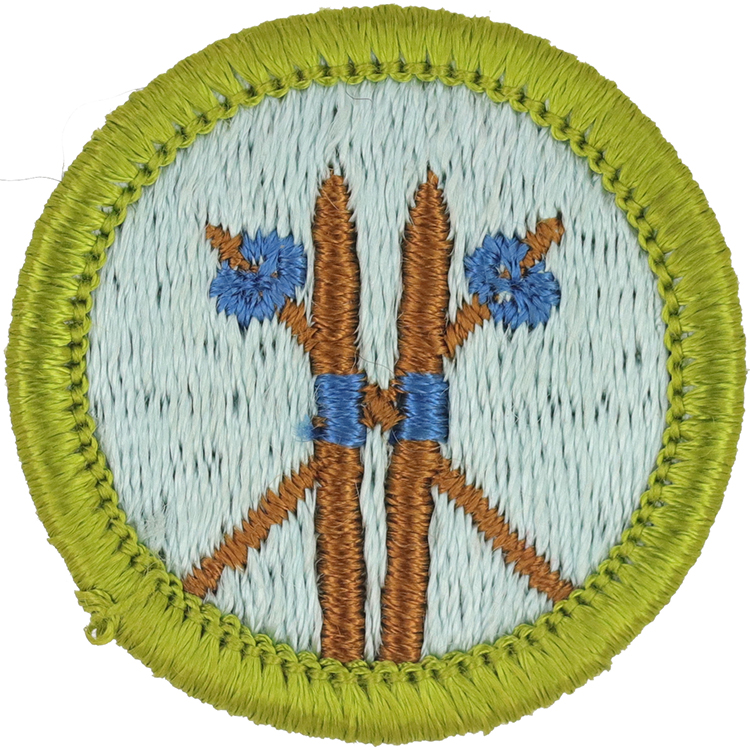
Fig. 1: Skiing-H2a-Front
- Embroidery: Cotton thread
- Border: Merrowed
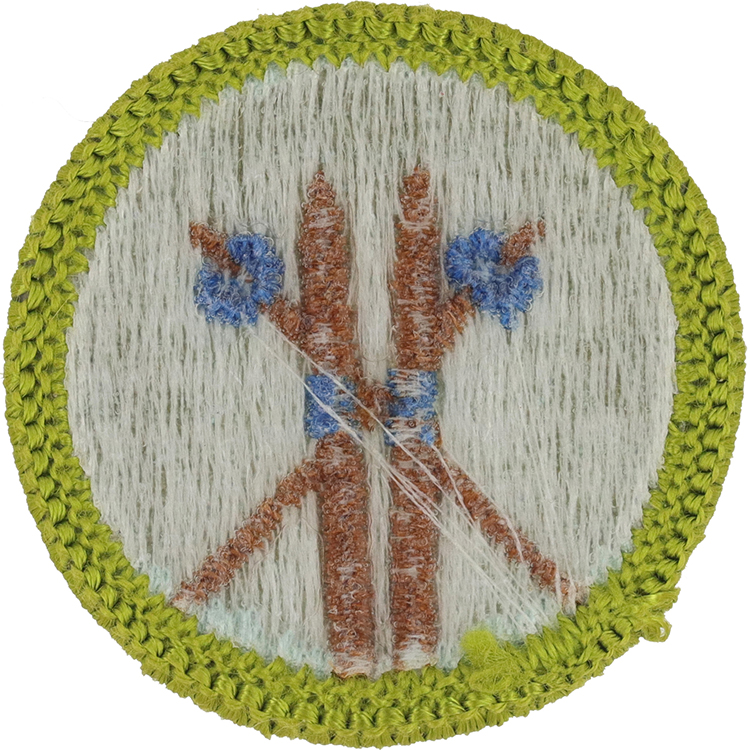
Fig. 2: Skiing-H2a-Reverse
- Back: Clear plastic with waffle pattern
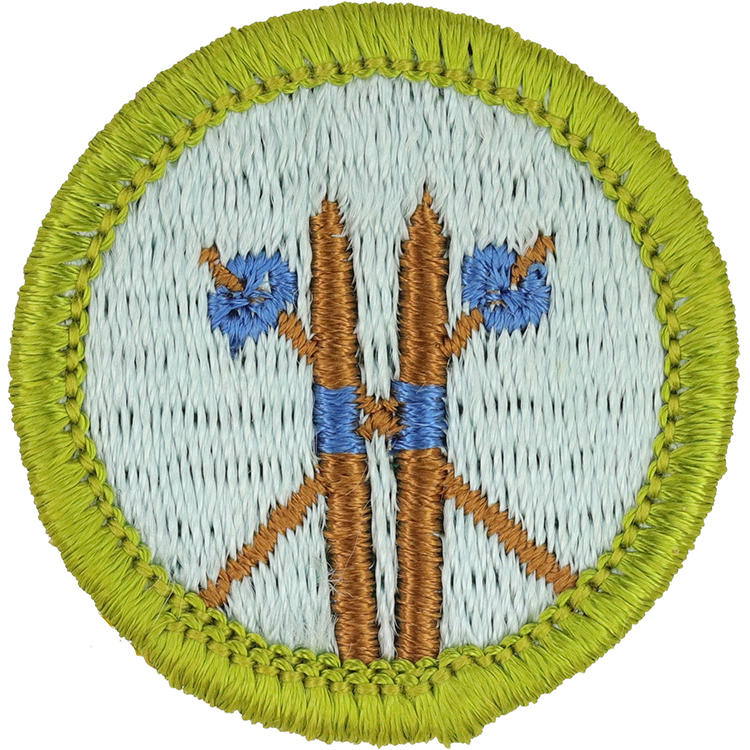
Fig. 3: Skiing-H2a-mve1-front
- Embroidery: Cotton thread
- Border: Merrowed
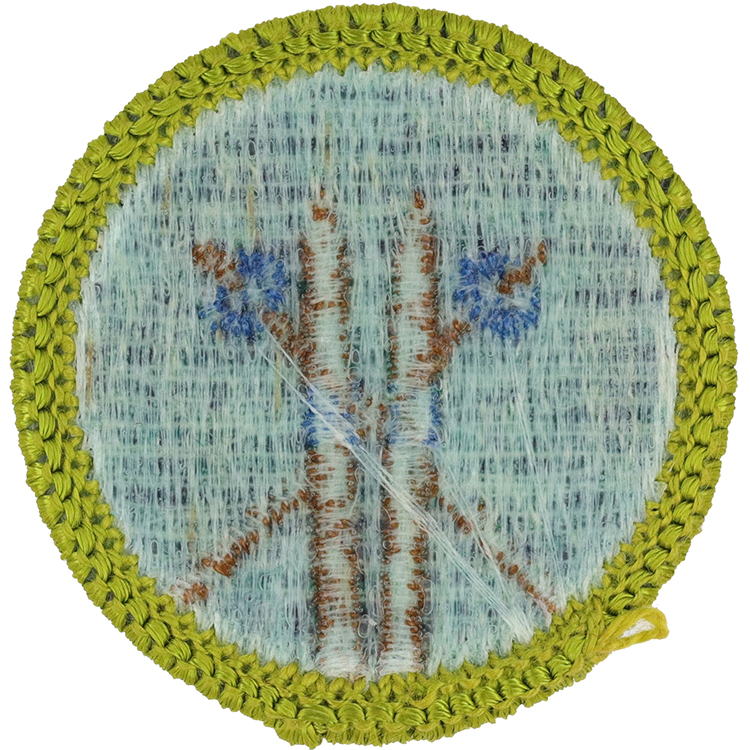
Fig. 4: Skiing-H2a-mve1-reverse
- Back: Dark base cloth, clear plastic with waffle pattern
Item Name: Skiing 1972 - 1973
Item ID: Skiing-H2a
Collector Rating: 1
Pamphlets Used to Earn this Badge
Requirements June 1972 until February 1978
1. Do the following:
(a) Give the meaning of the Skier's Safety Code. Explain how you use it.
(b) Present yourself properly equipped and clothed for skiing. Show how to adjust your gear. Describe two kinds of ski bindings (including one release type). Talk over their merits.
(c) Show four exercises that help make a person fit for skiing.
(d) Make a list of the first aid equipment, food, other gear, and clothing you would carry in your pockets and pack on a day ski trip.
2. Do the basic and standard tests of the United States Ski Association listed:
(a) Walk on skis on the level. Use a one-step and a gliding step. Use your skis properly.
(b) Show a kick turn to the left and right on the level.
(c) Show side step up hill (about 15 degrees). Using the forward side step, go up a hill of 100 feet. Use a kick turn between traverses.
(d) Herringbone 50 feet up a 10-degree hill.
(e) Show straight running in a downhill position for 50 feet or more on a 10-degree hill.
(f) Show braking speed for 50 feet on a 10-degree hill. Show a double stem from a standing start, slowing down and speeding up while remaining in the double-stem position. End at named spot.
(g) Show four linked snowplow turns.
(h) Show four linked stem turns on a hill of 15 degrees or more.
(i) Go straight down a hill of 15 to 25 degrees. Show sideslipping, first in one direction and then the other. Link such slipping with turns.
(j) Show right- and left-stop christiania and four linked christiania turns on a hill of 15 degrees or more.
3. Do ONE of the following:
(a) Run a slalom course without faltering or a fall. The course will cause you to mix turns with parallel running. The course will be simple. The gates will allow smooth running. There will be 10 or 12 turns in a drop of about 150 feet.
(b) Make a cross-country ski run of 4 miles in 1 hour. This is to be over country of different kinds of terrain. There shall be travel on the level as well as up and down.
(c) Make four jumps on an official junior ski jumping hill. Show good form. Get good distance.
4. Describe the program and services of the United States Ski Association and the National Ski Patrol. Tell how they affect your skiing activities.