-
Merit Badges
- Legend to identify Merit Badges
- 1910 British Merit Badges
- Square 1911 - 33
- Wide Crimped 1934 & 35
-
Narrow Tan Crimped 1936 - 42
- Tan Heavyweight Cloth with Silk Embroidery and Printed Back 1936 - 37
- Tan Heavyweight Cloth with Silk Embroidery and Plain Back 1937 - 38
- Tan Lightweight Cloth with Silk Embroidery and Plain Back 1938 - 39
- Tan Lightweight Cloth with Cotton Continuous Loop Embroidery and Plain Back 1939 - 42
- Tan Lightweight Cloth with Cotton Lockstitch Embroidery and Plain Back 1939 - 42
- Blue Background 1942 - 46
- Wartime 1942 - 46
- Khaki Narrow Crimped 1946 - 59
- Green Twill Gauze Back 1960 - 68
- Fully Embroidered Merrowed Edge 1960 - 72
- Unprinted Plastic Back 1972 - 01
- Printed Plastic Back 2002 - Current
-
Merit Badge Paper
- Merit Badge Applications
- Merit Badge Cards
-
Merit Badge Pamphlets
- Type 1 White Cover - Rectangle Drawing On Cover
- Type 2 White Cover 5-375" x 8" Title at Top
- Type 3A Tan Cover - 200 Fifth Avenue
- Type 3B Tan Cover - 2 line address New York City
- Type 3C Tan Cover - 2 line address New York N.Y.
- Type 3D Tan Cover - 1 line address New York N.Y.
- Type 4 Standing Scout Cover
- Type 5A War Cover
- Type 5B Red and White
- Type 6 Photo-Red Cover
- Type 7 Full Photo Cover or Bulls-eye Cover
- Type 8 Full Photo - Green Stripe Cover
- Type 9 Full Photo - Red Stripe Cover
- Type 10A Blue Stripe - Logo above bottom blue stripe - FDL centered
- Type 10B - Blue Stripe in bottom of photo area. FDL to left of text
- Special Covers
- Boy Craft Helps
- Merit Badge Counselor's Guides
-
Youth Position
- Junior Assistant Scoutmaster
- Senior Patrol Leader
- Assistant Senior Patrol Leader
- Patrol Leader
- Assistant Patrol Leader
- Troop Guide
- Scribe
- Quartermaster
- Instructor
- Chaplain Aide
- Den Chief
- Librarian
- Musician
- Webmaster
- Bugler
- Troop Historian
- Troop Representative
- Unit Representative
- Leadership Corps
- Honor Guard
- Leave No Trace Trainer
- Outdoor Ethics Guide
-
Patrol Medallions
- Patrol Medallions Introduction
- Legend to identify Patrol Medallions
- Patrol Shoulder Knot-Ribbons
- Felt Handmade Patrol Medallions
- Square Felt Patrol Medallions
- Round Broadcloth Patrol Medallions
- Red Twill Patrol Medallions
- Multi-Color Cloth Patrol Medallions
- Tan Cloth Patrol Medallions
- Patrol Medallion Back Patches
- Woodbadge Patrol Medallion
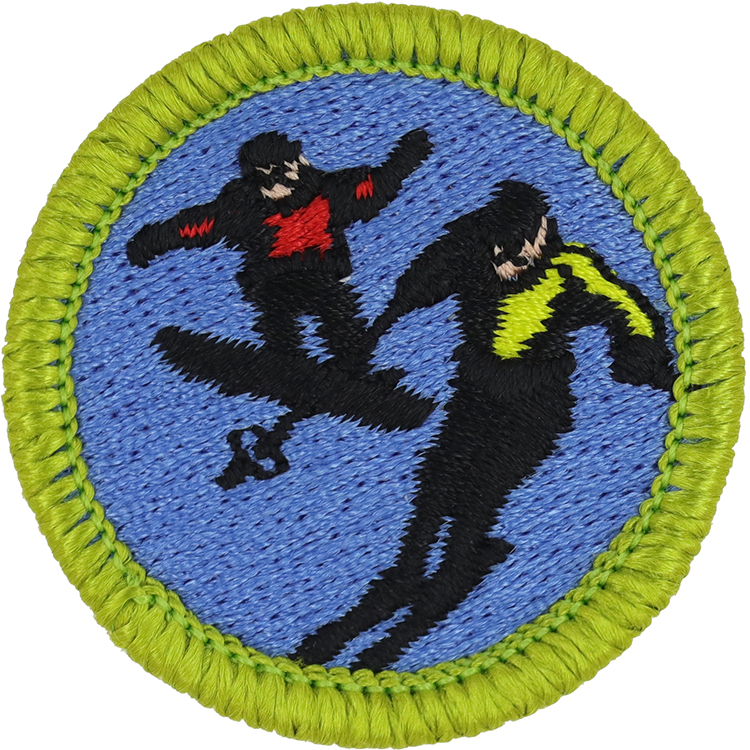
Fig. 1: SnoSpo-K-Front
- Embroidery: Rayon thread
- Border: Merrowed
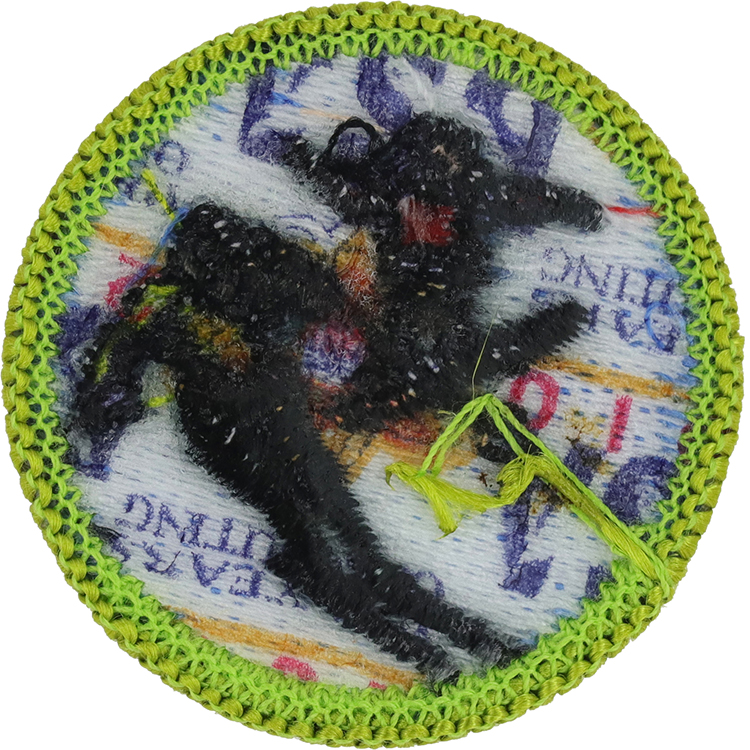
Fig. 2: SnoSpo-K-Reverse
"
- Back: 100th Anniversary imprint
Item Name: Snow Sports 2010 - 2013
Item ID: SnoSpo-K
Collector Rating: 1
Pamphlets Used to Earn this Badge

Requirements January 2007 until January 2016
1. Discuss winter sports safety, and show that you know first aid for injuries or illnesses that could occur while skiing or riding, including hypothermia, frostbite, shock, dehydration, sunburn, fractures, bruises, sprains, and strains. Tell how to apply splints.
2. Explain why every skier or snowboarder should be prepared to render first aid in the event of an accident.
3. Explain the procedure used to report an accident to the local ski patrol for the area where you usually ski or ride.
4. Do EACH of the following:
- Tell the meaning of the Your Responsibility Code for skiers and snowboarders. Explain why each rider must follow this code.
- Explain the Smart Style safety program. Tell why it is important and how it applies to skiers and snowboarders in terrain parks and pipes
- Explain the precautions pertaining to avalanche safety, including the responsibility of individuals regarding avalanche safety.
- Tell the meaning of the Wilderness Use Policy. Explain why each skier and snowboarder must adopt this policy.
- Complete all of the requirements for one of the following options: downhill (Alpine) skiing or cross-country (Nordic) or snowboarding.
DOWNHILL (ALPINE) SKIING
- Show how to use and maintain your own release bindings and explain the use of two others. Explain the international DIN standard and what it means to skiers.
- Explain the American Teaching System and a basic snow skiing progression.
- Name the major ski organizations in the United States and explain their functions
- Discuss the five types of Alpine skis. Demonstrate two ways to carry skis and poles safely and easily.
- Explain the importance of strength, endurance, and flexibility in downhill skiing. Demonstrate exercises and activities you can do to get fit for skiing.
- Present yourself properly clothed and equipped for downhill skiing. Discuss how the clothing you have chosen will keep you warm and protected.
- Demonstrate how to ride one kind of lift and explain how to ride two others.
- Explain the international trail marking system.
- On a gentle slope, demonstrate some of the beginning maneuvers learned in skiing, include the straight run, gliding wedge, wedge stop, side step, and herringbone maneuvers.
- On a slightly steeper terrain, show linked wedge turns.
- On a moderate slope, demonstrate 5 to 10 christies.
- Make a controlled run down an intermediate slope and demonstrate the following:
- Short, medium, and long radius parallel turns
- A sidestep and safety (hockey) stop to each side
- Traverse across a slope
- Demonstrate the ability to ski in varied conditions, including changes in pitch, snow conditions, and moguls. Maintain your balance and ability to turn.
CROSS-COUNTRY (NORDIC) SKIING
- Show your ability to select, use, and repair, if necessary, the correct equipment for ski touring in safety and comfort.
- Discuss classical and telemark skis. Demonstrate two ways to carry skis safely and easily.
- Discuss the basic principles of waxing for cross-country ski touring.
- Discuss the differences between cross-country skiing, ski touring, ski mountaineering, and downhill skiing.
- Explain the importance of strength, endurance, and flexibility in cross-country skiing. Demonstrate exercises and activities you can do to get fit for skiing.
- List items you would take on a one day ski tour.
- Present yourself properly clothed and equipped for a one day ski tour. Discuss the correct use of your clothing and equipment, and how the clothing you have chosen will keep you warm and protected.
- Demonstrate the proper use of a topographic map and compass.
- Show a degree of stamina that will enable you to keep up with an average ski touring group your age.
- On a gentle, packed slope, show some basic ways to control speed and direction. Include the straight run, traverse, sideslip, step turn, wedge stop, and wedge turn maneuvers.
- On a cross-country trail, demonstrate effective propulsion by showing proper weight transfer from ski to ski, pole timing, rhythm, flow, and glide.
- Demonstrate your ability, on a tour, to cope with an average variety of snow conditions.
- Demonstrate several methods of dealing with steep hills or difficult conditions. Include traverses and kick turns going uphill and downhill, side steps, pole drag, and ski pole “glissade”
SNOWBOARDING
- Discuss forward fall injuries. Tell about prevention and what action must be taken in the event of any type of injury or accident.
- Do the following:
- Demonstrate your ability to select the correct equipment for snowboarding and use it for safety and comfort.
- Present yourself properly clothed and equipped for snowboarding. Discuss how the clothing you have chosen will keep you warm and protected.
- Show how to use and maintain your own bindings, and explain the use of the different binding methods. Explain the need for leashes.
- Discuss the four types of snowboards. Demonstrate how to carry a snowboard easily and safely.
- Demonstrate exercises and activities that will get you fit for snowboarding.
- Demonstrate how to ride one kind of lift and explain how to ride two others.
- Explain the international trail marking system.
- Demonstrate the basic principles of waxing a snowboard.
- Do the following:
- On a gentle slope, demonstrate beginning snowboarding maneuvers. Show basic ways to control speed and direction. Include the slide slipping maneuver.
- On slightly steeper terrain, show traversing.
- On a moderate slope, demonstrate and ollie, a nose and grab, and a wheelie.
- Make a controlled run down an intermediate slope and demonstrate the following:
- Skidded, carved and, jump turns
- Stops
- Riding fakie
- Demonstrate your ability to ride in varied conditions, including changes in pitch, snow conditions, and moguls. Maintain your balance and ability to turn.
- Name the major snowboarding organizations in the United States and explain their functions.