-
Merit Badges
- Legend to identify Merit Badges
- 1910 British Merit Badges
- Square 1911 - 33
- Wide Crimped 1934 & 35
-
Narrow Tan Crimped 1936 - 42
- Tan Heavyweight Cloth with Silk Embroidery and Printed Back 1936 - 37
- Tan Heavyweight Cloth with Silk Embroidery and Plain Back 1937 - 38
- Tan Lightweight Cloth with Silk Embroidery and Plain Back 1938 - 39
- Tan Lightweight Cloth with Cotton Continuous Loop Embroidery and Plain Back 1939 - 42
- Tan Lightweight Cloth with Cotton Lockstitch Embroidery and Plain Back 1939 - 42
- Blue Background 1942 - 46
- Wartime 1942 - 46
- Khaki Narrow Crimped 1946 - 59
- Green Twill Gauze Back 1960 - 68
- Fully Embroidered Merrowed Edge 1960 - 72
- Unprinted Plastic Back 1972 - 01
- Printed Plastic Back 2002 - Current
-
Merit Badge Paper
- Merit Badge Applications
- Merit Badge Cards
-
Merit Badge Pamphlets
- Type 1 White Cover - Rectangle Drawing On Cover
- Type 2 White Cover 5-375" x 8" Title at Top
- Type 3A Tan Cover - 200 Fifth Avenue
- Type 3B Tan Cover - 2 line address New York City
- Type 3C Tan Cover - 2 line address New York N.Y.
- Type 3D Tan Cover - 1 line address New York N.Y.
- Type 4 Standing Scout Cover
- Type 5A War Cover
- Type 5B Red and White
- Type 6 Photo-Red Cover
- Type 7 Full Photo Cover or Bulls-eye Cover
- Type 8 Full Photo - Green Stripe Cover
- Type 9 Full Photo - Red Stripe Cover
- Type 10A Blue Stripe - Logo above bottom blue stripe - FDL centered
- Type 10B - Blue Stripe in bottom of photo area. FDL to left of text
- Special Covers
- Boy Craft Helps
- Merit Badge Counselor's Guides
-
Youth Position
- Junior Assistant Scoutmaster
- Senior Patrol Leader
- Assistant Senior Patrol Leader
- Patrol Leader
- Assistant Patrol Leader
- Troop Guide
- Scribe
- Quartermaster
- Instructor
- Chaplain Aide
- Den Chief
- Librarian
- Musician
- Webmaster
- Bugler
- Troop Historian
- Troop Representative
- Unit Representative
- Leadership Corps
- Honor Guard
- Leave No Trace Trainer
- Outdoor Ethics Guide
-
Patrol Medallions
- Patrol Medallions Introduction
- Legend to identify Patrol Medallions
- Patrol Shoulder Knot-Ribbons
- Felt Handmade Patrol Medallions
- Square Felt Patrol Medallions
- Round Broadcloth Patrol Medallions
- Red Twill Patrol Medallions
- Multi-Color Cloth Patrol Medallions
- Tan Cloth Patrol Medallions
- Patrol Medallion Back Patches
- Woodbadge Patrol Medallion
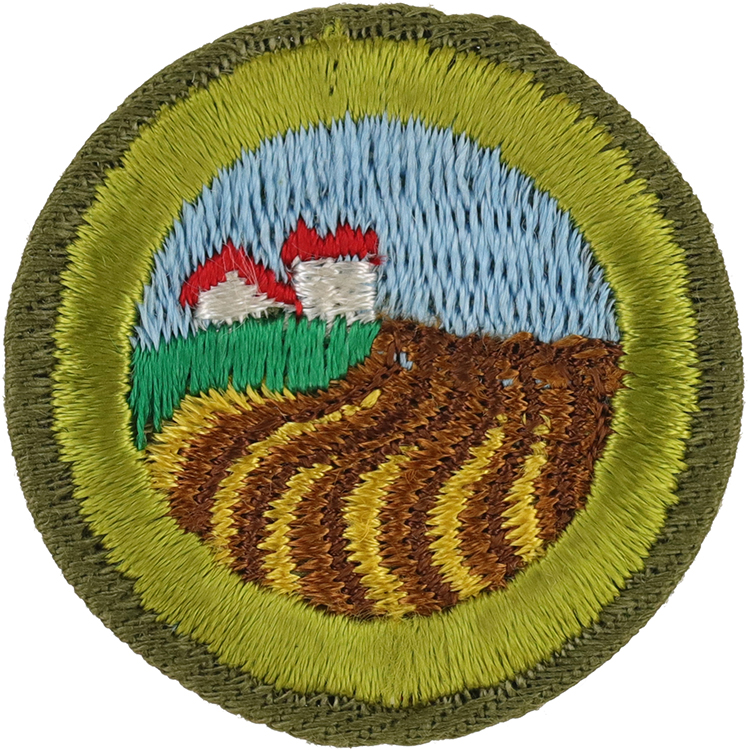
Fig. 1: SoiCon-E2-Front
- Cloth: Khaki right twill
- Embroidery: Cotton lock stitch
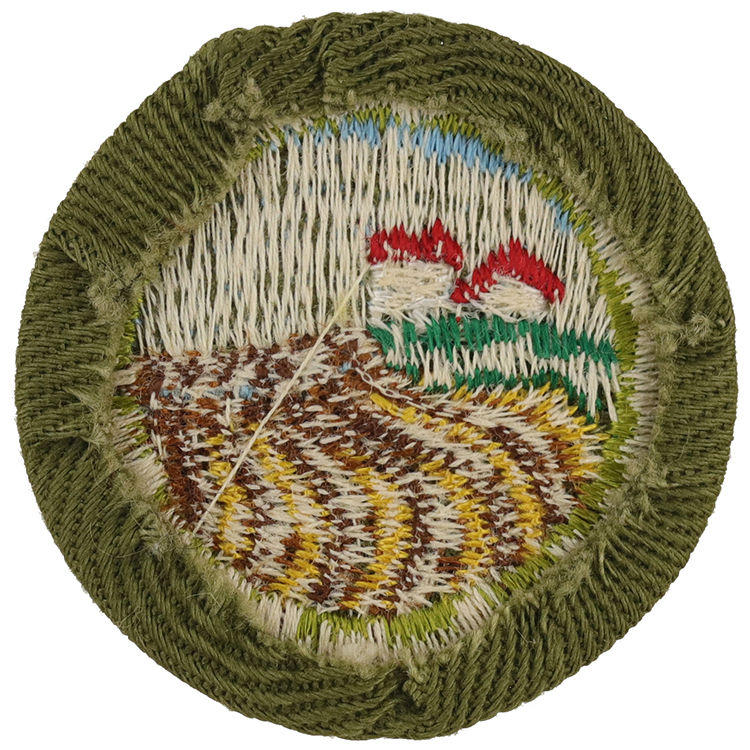
Fig. 2: SoiCon-E2-Reverse
- Back: Plain NO imprint with starch

Fig. 3: SoiCon-E2-mve1-front
- Minor variation: Building differences, wide border

Fig. 4: SoiCon-E2-mve1-reverse
- Back: Plain NO imprint with starch
Item Name: Soil and Water Conservation 1952 - 1960
Item ID: SoiCon-E2
Collector Rating: 1
Pamphlets Used to Earn this Badge

Requirements January 1952 until January 1957
1. Determine the depth of topsoil in at least two contrasting areas, such as grazed and ungrazed woods; cultivated fields and fields left in grass, grazed pastures and ungrazed haylots; well-kept lawn and heavily cropped garden; etc.
2. Plant two bean seeds in a flower pot of topsoil, and two bean seeds in a flower pot of subsoil. Tend them for a month and report on difference in rate of growth in two pots, appearance of plants, and other differences.
3. (a) Describe the different types, causes and results of soil erosion. (b) Show snapshots or rough sketches of two examples of erosion in your community. (c) Explain what is meant by soil depletion.
4. Explain the meaning of the following terms: (a) contour farming; (b) strip cropping; (c) rotation of crops; (d) terracing; (e) cover crops.
5. On a road map or similar map, point out the watershed area for your community.
6. Make a diagram-sketch showing how rain water falling to the ground eventually gets to your kitchen faucet.
7. Explain how man's use of land in the watershed affects your community's water supply.
8. Do one:
a. Help build a stock pond or farm pond.
b. Make a study of plant, animal and fish species in a pond, and necessary carry out such practices as will increase the fish population.
c. Carry out a bank erosion control or other improvement project on a stream, pond or lake.
d. Control a gully by building necessary diversion ditches and brush dams or other structures, and planting to grass and shrubs.
e. Take an active part in removing the cause of pollution of a stream, pond or lake.
f. Help to plan, survey and lay out a drainage or irrigation system for a field or other area that needs drainage or irrigation.
g. Help build drainage or irrigation ditches on a field.
h. Find out what is done with domestic and industrial waste in your community and write at least 500 words on the methods used to prevent pollution and to purify your water supply.
i. Help to plan, survey, or lay out contour furrows or water spreading dikes on pasture or range land.
j. Carry out any other water management project approved by your Counselor or representative of the local Soil Conservation District, National Forest, or Taylor grazing district.
9. Do one:
a. Help carry out a soil conservation project on a farm or Scout camp cooperating with the local soil conservation district.
b. Plant 100 tree or shrub seedlings on school grounds, park, camp, or other eroding area that is unsuited for cultivation, or as a windbreak for buildings or a blowing field.
c. Test the soil, fertilize, and as needed, lime, and plant grass or perennial legumes on 1/4 acre of law, school grounds, camp, or other eroding area that is unsuited for cultivation.
d. Take an active part in the program for a "Farmer's Field Day," "Face Listing," or other soil conservation demonstration project.
e. Trace a conservation survey map of a local farm or Scout camp and describe the different land classes found on it and tell what each different area should be used for and what conservative measures are needed on it.
f. Help survey and lay out a plot of land for terracing, or strip cropping, or contour ploughing.
g. Help construct terraces on a field.
h. Help plan, lay out or construct a grass waterway for a field or other eroding area where a waterway is needed.
i. Carry out any other soil conservation project approved by your Counselor or representative of the local Soil Conservation District, National Forest or Taylor grazing district.
j. Reseed one acre of pasture or range land on which the present grass cover is insufficient to guard the soil against erosion.
Requirements January 1957 until September 1963
1. Determine the depth of topsoil in at least two contrasting areas, such as grazed and ungrazed woods; cultivated fields and fields left in grass, grazed pastures and ungrazed haylots; well-kept lawn and heavily cropped garden; etc.
2. Plant two bean seeds in a flower pot of topsoil, and two bean seeds in a flowerpot of subsoil. Tend them for a month and report difference in rate of growth in two pots, appearance of plants, and other differences.
3. (a) Describe the different types, causes, and results of soil erosion. (b) Show snapshots or rough sketches of two examples of erosion in your community. (c) Explain what is meant by soil depletion.
4. Explain the meaning of the following terms: (a) contour farming; (b) strip cropping; (c) rotation of crops; (d) terracing; (e) cover crops.
5. On a road map or similar map, point out the watershed area for your community.
6. Make a diagram-sketch showing how rain water falling to the ground eventually gets to your kitchen faucet.
7. Explain how man's use of land in the watershed affects your community's water supply.
8. Do one:
(a) Help build a stock pond or farm pond.
(b) Make a study of plant, animal, and fish species in a pond and, if necessary, carry out such practices as will increase the fish population.
(c) Carry out a bank erosion control or other improvement project on a stream, pond, or lake.
(d) Control a gully by building necessary diversion ditches and brush dams or other structures and planting to grass and shrubs.
(e) Take an active part in removing the cause of pollution of a stream, pond, or lake.
(f) Help to plan, survey, and lay out a drainage or irrigation system for a field or other area that needs drainage or irrigation.
(g) Help build drainage or irrigation ditches on a field.
(h) Find out what is done with domestic and industrial waste in your community and write at least 500 words on the methods used to prevent pollution and to purify your water supply.
(i) Help to plan, survey, or lay out contour furrows or water-spreading dikes on pasture or range land.
(j) Carry out any other water management project approved by your counselor or representative of the local soil conservation district, national forest, or Taylor grazing district.
9. Do one:
(a) Help carry out a soil conservation project on a farm or Scout camp cooperating with the local soil conservation district.
(b) Plant 100 tree or shrub seedlings on school grounds, park, camp, or other eroding area that is unsuited for cultivation, or as a windbreak for buildings or a blowing field.
(c) Test the soil, fertilize, and, as needed, lime and plant grass or perennial legumes on 1/4 acre of lawn, school grounds, camp, or other eroding area that is unsuited for cultivation.
(d) Take an active part in the program for a Farmer's Field Day, Face Lifting, or other soil conservation demonstration project.
(e) Trace a conservation survey map of a local farm or Scout camp and describe the different land classes found on it and tell what each different area should be used for and what conservative measures are needed on it.
(f) Help survey and lay out a plot of land for terracing, or strip cropping, or contour ploughing.
(g) Help construct terraces on a field.
(h) Help plan, layout, or construct a grass waterway for a field or other eroding area where a waterway is needed.
(i) Carry out any other soil conservation project approved by your counselor or representative of the local soil conservation district, national forest, or Taylor grazing district.
(j) Reseed one acre of pasture or range land on which the present grass cover is insufficient to guard the soil against erosion.
-------
* As a 4-H'er, complete a club project in this subject. Or as an FFA member, meet these or equivalent requirements through the FFA supervised farming program.