-
Merit Badges
- Legend to identify Merit Badges
- 1910 British Merit Badges
- Square 1911 - 33
- Wide Crimped 1934 & 35
-
Narrow Tan Crimped 1936 - 42
- Tan Heavyweight Cloth with Silk Embroidery and Printed Back 1936 - 37
- Tan Heavyweight Cloth with Silk Embroidery and Plain Back 1937 - 38
- Tan Lightweight Cloth with Silk Embroidery and Plain Back 1938 - 39
- Tan Lightweight Cloth with Cotton Continuous Loop Embroidery and Plain Back 1939 - 42
- Tan Lightweight Cloth with Cotton Lockstitch Embroidery and Plain Back 1939 - 42
- Blue Background 1942 - 46
- Wartime 1942 - 46
- Khaki Narrow Crimped 1946 - 59
- Green Twill Gauze Back 1960 - 68
- Fully Embroidered Merrowed Edge 1960 - 72
- Unprinted Plastic Back 1972 - 01
- Printed Plastic Back 2002 - Current
-
Merit Badge Paper
- Merit Badge Applications
- Merit Badge Cards
-
Merit Badge Pamphlets
- Type 1 White Cover - Rectangle Drawing On Cover
- Type 2 White Cover 5-375" x 8" Title at Top
- Type 3A Tan Cover - 200 Fifth Avenue
- Type 3B Tan Cover - 2 line address New York City
- Type 3C Tan Cover - 2 line address New York N.Y.
- Type 3D Tan Cover - 1 line address New York N.Y.
- Type 4 Standing Scout Cover
- Type 5A War Cover
- Type 5B Red and White
- Type 6 Photo-Red Cover
- Type 7 Full Photo Cover or Bulls-eye Cover
- Type 8 Full Photo - Green Stripe Cover
- Type 9 Full Photo - Red Stripe Cover
- Type 10A Blue Stripe - Logo above bottom blue stripe - FDL centered
- Type 10B - Blue Stripe in bottom of photo area. FDL to left of text
- Special Covers
- Boy Craft Helps
- Merit Badge Counselor's Guides
-
Youth Position
- Junior Assistant Scoutmaster
- Senior Patrol Leader
- Assistant Senior Patrol Leader
- Patrol Leader
- Assistant Patrol Leader
- Troop Guide
- Scribe
- Quartermaster
- Instructor
- Chaplain Aide
- Den Chief
- Librarian
- Musician
- Webmaster
- Bugler
- Troop Historian
- Troop Representative
- Unit Representative
- Leadership Corps
- Honor Guard
- Leave No Trace Trainer
- Outdoor Ethics Guide
-
Patrol Medallions
- Patrol Medallions Introduction
- Legend to identify Patrol Medallions
- Patrol Shoulder Knot-Ribbons
- Felt Handmade Patrol Medallions
- Square Felt Patrol Medallions
- Round Broadcloth Patrol Medallions
- Red Twill Patrol Medallions
- Multi-Color Cloth Patrol Medallions
- Tan Cloth Patrol Medallions
- Patrol Medallion Back Patches
- Woodbadge Patrol Medallion
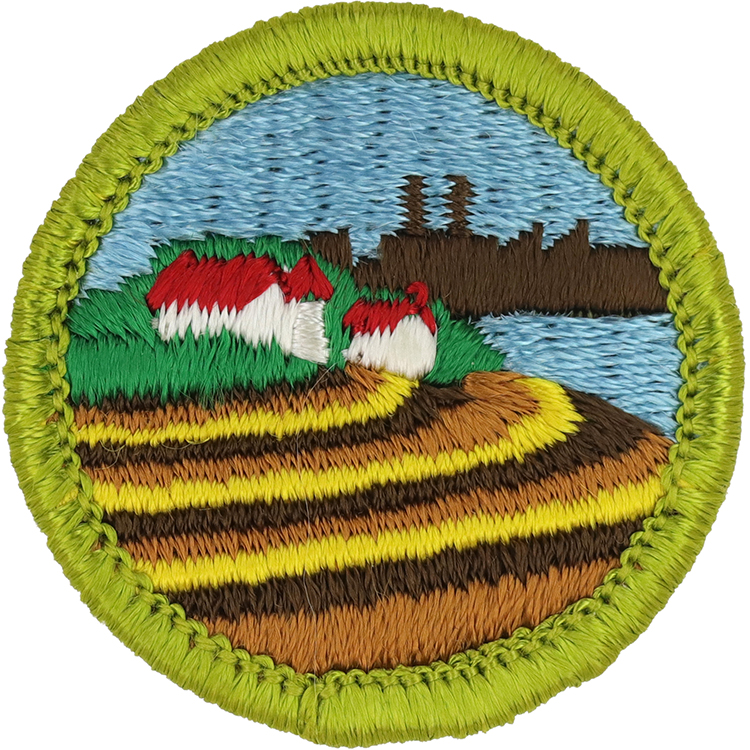
Fig. 1: SoiCon-H2-Front
- Embroidery: Cotton thread
- Border: Merrowed
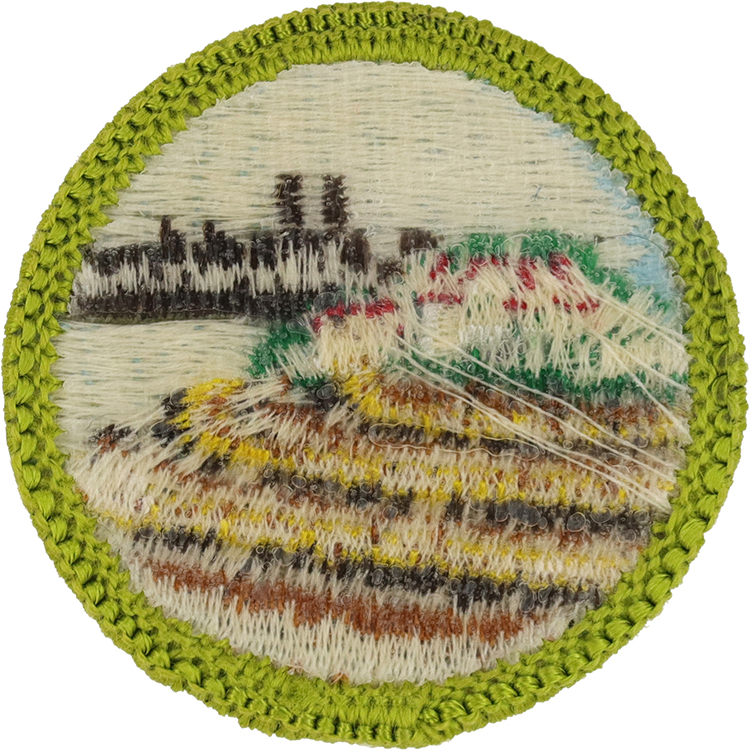
Fig. 2: SoiCon-H2-Reverse
- Back: Clear plastic with waffle pattern
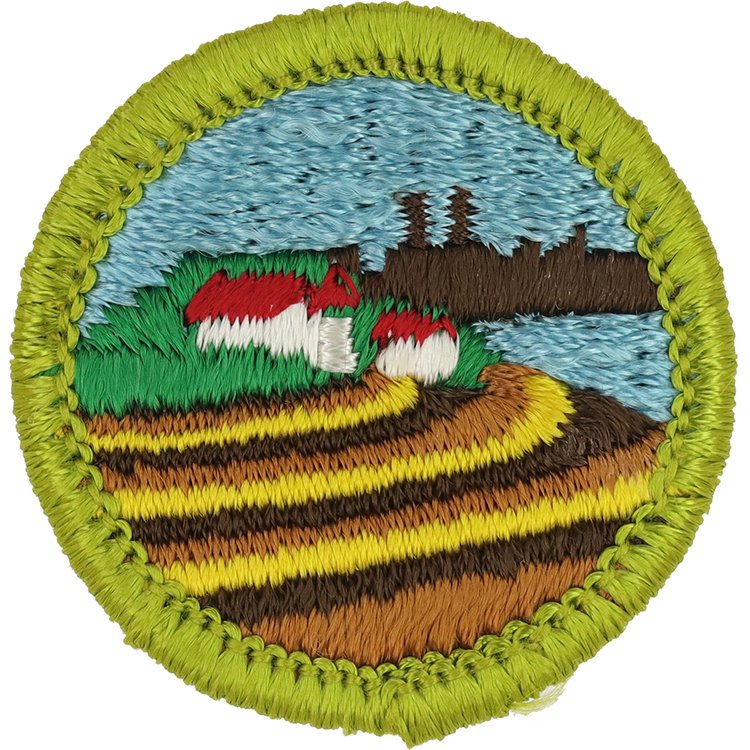
Fig. 3: SoiCon-H2-mve1-front
- Embroidery: Cotton thread
- Border: Merrowed
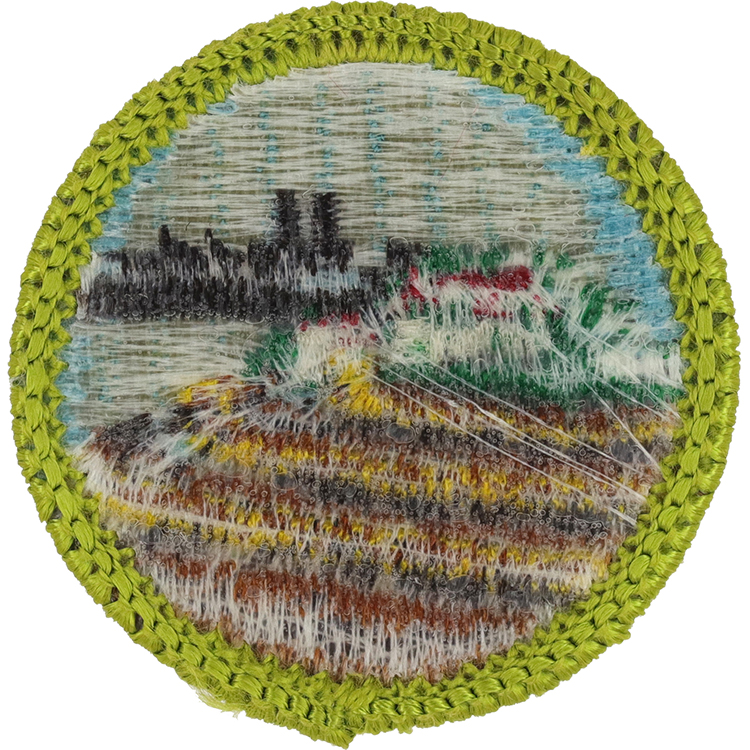
Fig. 4: SoiCon-H2-mve1-reverse
- Back: Dark base cloth, clear plastic with waffle pattern
Item Name: Soil and Water Conservation 1972 - 1975
Item ID: SoiCon-H2
Collector Rating: 1
Pamphlets Used to Earn this Badge
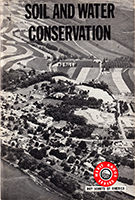

Requirements June 1972 until August 1982
1. Do the following:
(a) Tell what soil is. Tell how it is formed.
(b) Describe three kinds of soil. Tell how they are different.
(c) Name the three main plant nutrients in a fertile soil. Tell how they can be put back when used up.
2. Do the following:
(a) Define soil erosion.
(b) Tell why it is important. Tell how it affects you.
(c) Name three kinds of soil erosion. Describe each.
(d) Take pictures or draw two kinds of soil erosion.
3. Do the following:
(a) Tell what is meant by conservation practices.
(b) Describe the effect of three kinds of erosion-control practices.
4. Do the following:
(a) Explain what a watershed is.
(b) Outline the smallest watershed that you can find on a contour map.
(c) Then outline on your map, as far as possible, the next larger watershed which also has the smallest in it.
(d) Explain what a river basin is. Tell why all people living in it should be concerned about land and water use in it.
5. Do the following:
(a) Make a drawing to show the water cycle.
(b) Show by demonstration at least two of the following actions of water in relation to soil: percolation, capillary action, precipitation, evaporation, transpiration.
(c) Explain how removal of vegetation will affect the way water runs off a watershed.
(d) Tell how uses of forest, range, and farm land affect usable water supply.
(e) Explain how industrial use affects water supply.
6. Do the following:
(a) Tell what is meant by water pollution.
(b) Describe ways water is polluted in rivers or streams. Explain what pollution does to fish and wildlife, boating, and swimming. Tell what it does to water for homes, farms, and factories. (c) Tell what is meant by "primary water treatment," "secondary waste treatment," and "biochemical oxygen demand."
(d) Making a drawing showing the principles of complete waste treatment.
7. Do TWO of the following:
(a) Make a trip to one of the following places. Write a report of more than 500 words about the conservation practices you saw. (1) An agricultural experiment. (2) A managed forest or woodlot, range, or pasture. (3) A wildlife refuge or a fish or game management area. (4) A conservation-managed farm or ranch. (5) A managed watershed. (6) A waste treatment plant. (7) A public drinking water treatment facility. (8) Industry water use installation. (9) Desalinization plant.
(b) Plant 100 trees, bushes, and/or vines for a good purpose.
(c) Seed 1/5 acre for a good conservation purpose.
(d) Study a soil survey report. Describe the things in it. On tracing paper over any of the soil maps, outline an area with three or more different kinds of soil. List each kind of soil by full name and map symbol.
(e) Make a list of places in your neighborhood, camps, school ground, or park having erosion, sedimentation, or pollution problems. Describe how through individual or group action these could be corrected.
(f) Carry out any other soil and water conservation project approved in advance.