-
Merit Badges
- Legend to identify Merit Badges
- 1910 British Merit Badges
- Square 1911 - 33
- Wide Crimped 1934 & 35
-
Narrow Tan Crimped 1936 - 42
- Tan Heavyweight Cloth with Silk Embroidery and Printed Back 1936 - 37
- Tan Heavyweight Cloth with Silk Embroidery and Plain Back 1937 - 38
- Tan Lightweight Cloth with Silk Embroidery and Plain Back 1938 - 39
- Tan Lightweight Cloth with Cotton Continuous Loop Embroidery and Plain Back 1939 - 42
- Tan Lightweight Cloth with Cotton Lockstitch Embroidery and Plain Back 1939 - 42
- Blue Background 1942 - 46
- Wartime 1942 - 46
- Khaki Narrow Crimped 1946 - 59
- Green Twill Gauze Back 1960 - 68
- Fully Embroidered Merrowed Edge 1960 - 72
- Unprinted Plastic Back 1972 - 01
- Printed Plastic Back 2002 - Current
-
Merit Badge Paper
- Merit Badge Applications
- Merit Badge Cards
-
Merit Badge Pamphlets
- Type 1 White Cover - Rectangle Drawing On Cover
- Type 2 White Cover 5-375" x 8" Title at Top
- Type 3A Tan Cover - 200 Fifth Avenue
- Type 3B Tan Cover - 2 line address New York City
- Type 3C Tan Cover - 2 line address New York N.Y.
- Type 3D Tan Cover - 1 line address New York N.Y.
- Type 4 Standing Scout Cover
- Type 5A War Cover
- Type 5B Red and White
- Type 6 Photo-Red Cover
- Type 7 Full Photo Cover or Bulls-eye Cover
- Type 8 Full Photo - Green Stripe Cover
- Type 9 Full Photo - Red Stripe Cover
- Type 10A Blue Stripe - Logo above bottom blue stripe - FDL centered
- Type 10B - Blue Stripe in bottom of photo area. FDL to left of text
- Special Covers
- Boy Craft Helps
- Merit Badge Counselor's Guides
-
Youth Position
- Junior Assistant Scoutmaster
- Senior Patrol Leader
- Assistant Senior Patrol Leader
- Patrol Leader
- Assistant Patrol Leader
- Troop Guide
- Scribe
- Quartermaster
- Instructor
- Chaplain Aide
- Den Chief
- Librarian
- Musician
- Webmaster
- Bugler
- Troop Historian
- Troop Representative
- Unit Representative
- Leadership Corps
- Honor Guard
- Leave No Trace Trainer
- Outdoor Ethics Guide
-
Patrol Medallions
- Patrol Medallions Introduction
- Legend to identify Patrol Medallions
- Patrol Shoulder Knot-Ribbons
- Felt Handmade Patrol Medallions
- Square Felt Patrol Medallions
- Round Broadcloth Patrol Medallions
- Red Twill Patrol Medallions
- Multi-Color Cloth Patrol Medallions
- Tan Cloth Patrol Medallions
- Patrol Medallion Back Patches
- Woodbadge Patrol Medallion
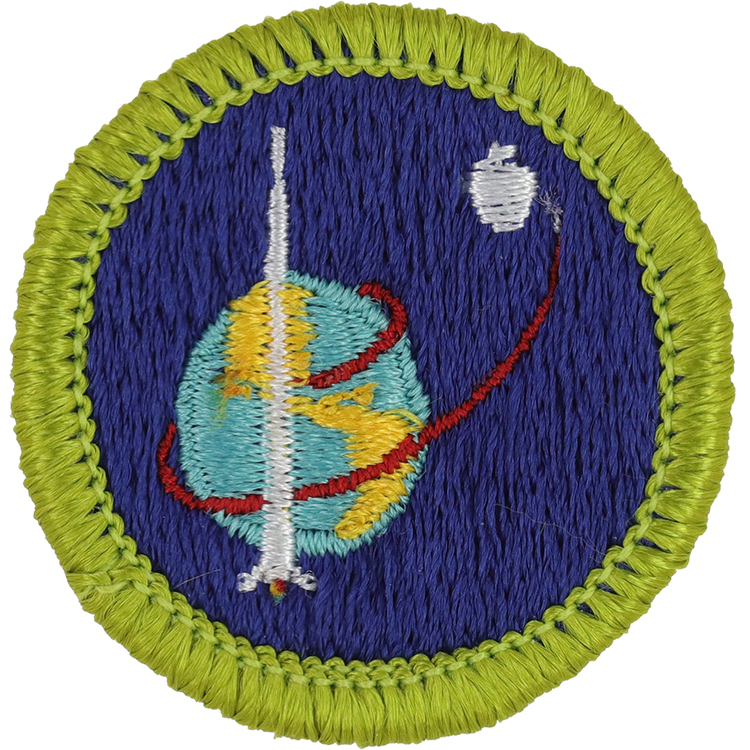
Fig. 1: SpaExp-H4-Front
- Embroidery: Cotton thread, dull sheen
- Border: Lt green merrowed
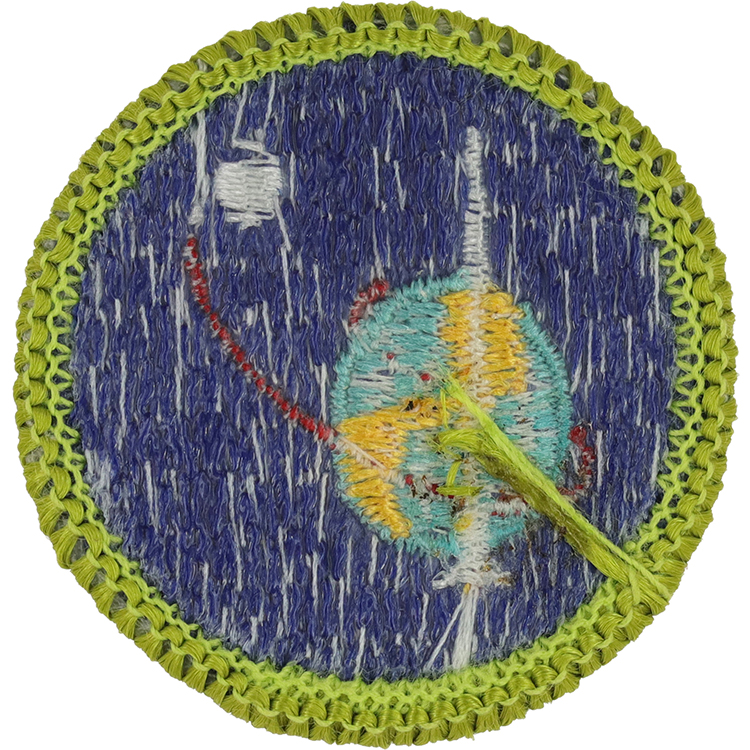
Fig. 2: SpaExp-H4-Reverse
- Back: Lt green lock stitch, molded plastic
Item Name: Space Exploration 1978 - 1990
Item ID: SpaExp-H4
Collector Rating: 1
Pamphlets Used to Earn this Badge

Requirements January 1975 until January 2005
1. *Build, launch, and recover a model rocket. Make a second launch to accomplish a specific mission objective. (Rocket must be built to meet Safety Code of the National Association of Rocketry.)
2. Tell the purpose of space exploration including (a) historical reason, (b) immediate goals in terms of specific knowledge, (c) benefits of "spin-offs," (d) values as related to earth resources, and (e) advancement of technology.
3. Tell about main steps in man's movement into space. Tell the contributions of each of these: Hermann Oberth, Jules Verne, K.E. Tsiolkovsky, Werner von Braun, Robert Goddard, and NASA.
4. Discuss and demonstrate each of the following:
(a) The Law of Action-Reaction
(b) Apogee and perigee
(c) How satellites stay in orbit
5. Explain the meaning of each of the following. Five an example for each: satellite, unmanned space probe, manned space mission, rocket engine, "air breathing" engine, remote sensing, telemetry, "spin-off," rocket propellant (fuel/oxidizer, closed environment, booster stage, payload, miniaturization, orbit, sounding rockets, burnout, weightlessness, and trajectory.
6. Describe some benefits that come from the space program and one of the following:
(a) The Appollo-Soyuz joint mission.
(b) A planetary fly-by project
(c) A planetary landing project
(d) Space shuttle
(e) An earth-orbiting application project
(f) An earth-orbiting scientific project.
7. Discuss with your counselor two possible careers in space exploration.
* If you can't do requirement 1 because of local laws, do the following: make a model of a NASA rocket. Explain the function of parts. Give the history of the rocket. (Or) Design a rocket for a space mission (to fly by, land, land and return, manned or unammed) to a planet in our solar system. Tell what the requirements would be for the mission in time, life support systems, fuel, and telemetry.
Requirements January 1984 until January 2005
1. Tell the purpose of space exploration including (a) historical reason, (b) immediate goals in terms of specific knowledge, (c) benefits related to Earth resources, technology, and new products.
2. Tell about main steps in humanity's movement into space and tell the contributions of these individuals: Jules Verne, K.E. Tsiolkovsky, Robert Goddard, Hermann Oberth, and Wernher von Braun.
3. Build, launch, and recover a model rocket.* Make a second launch to accomplish a specific objective. (Rocket must be built to meet the safety code of the National Association of Rocketry.) Identify and explain the following rocket parts:
(a) Body tube
(b) Engine mount
(c) Fins
(d) Igniter
(e) Launch lug
(f) Nose cone
(g) Payload
(h) Recovery system
(i) Rocket engine
4. Discuss and demonstrate each of the following:
(a) The law of action-reaction
(b) How rocket engines work
(c) How satellites stay in orbit
(d) How satellite pictures of the Earth and pictures of other planets are made and transmitted
5. Discuss what has been learned about the Moon and planets by manned and unmanned spacecraft exploration and the possible benefits of new knowledge. Do TWO of the following:
(a) Construct a data table of recent information about the planets. For each planet, give important facts, including distance from the sun, period of revolution, rotation, number of moons, etc.
(b) Make a scrapbook of magazine photographs and news clippings about planetary research.
(c) Design a spacecraft that will be sent on a mission to another planet to take samples of its surface and return them to Earth. Name the planet your spacecraft will visit; and, in your design, show how the spacecraft will work and cope with the environment of that planet.
6. Describe the purpose and operation of the space shuttle. Discuss the following:
(a) Main components
(b) Typical mission profile
(c) Payloads
7. Design an Earth-orbiting space station. Make drawings or a model of your station. Within your design, consider and plan for the following:
(a) Source of energy
(b) How it will be constructed
(c) Life-support systems
(d) Purpose and function.
8. Discuss with your counselor two possible careers in space exploration.
* If local laws prohibit launching model rockets, do the following activity: Make a model of a NASA rocket. Explain the functions of the parts. Give the history of the rocket.