-
Merit Badges
- Legend to identify Merit Badges
- 1910 British Merit Badges
- Square 1911 - 33
- Wide Crimped 1934 & 35
-
Narrow Tan Crimped 1936 - 42
- Tan Heavyweight Cloth with Silk Embroidery and Printed Back 1936 - 37
- Tan Heavyweight Cloth with Silk Embroidery and Plain Back 1937 - 38
- Tan Lightweight Cloth with Silk Embroidery and Plain Back 1938 - 39
- Tan Lightweight Cloth with Cotton Continuous Loop Embroidery and Plain Back 1939 - 42
- Tan Lightweight Cloth with Cotton Lockstitch Embroidery and Plain Back 1939 - 42
- Blue Background 1942 - 46
- Wartime 1942 - 46
- Khaki Narrow Crimped 1946 - 59
- Green Twill Gauze Back 1960 - 68
- Fully Embroidered Merrowed Edge 1960 - 72
- Unprinted Plastic Back 1972 - 01
- Printed Plastic Back 2002 - Current
-
Merit Badge Paper
- Merit Badge Applications
- Merit Badge Cards
-
Merit Badge Pamphlets
- Type 1 White Cover - Rectangle Drawing On Cover
- Type 2 White Cover 5-375" x 8" Title at Top
- Type 3A Tan Cover - 200 Fifth Avenue
- Type 3B Tan Cover - 2 line address New York City
- Type 3C Tan Cover - 2 line address New York N.Y.
- Type 3D Tan Cover - 1 line address New York N.Y.
- Type 4 Standing Scout Cover
- Type 5A War Cover
- Type 5B Red and White
- Type 6 Photo-Red Cover
- Type 7 Full Photo Cover or Bulls-eye Cover
- Type 8 Full Photo - Green Stripe Cover
- Type 9 Full Photo - Red Stripe Cover
- Type 10A Blue Stripe - Logo above bottom blue stripe - FDL centered
- Type 10B - Blue Stripe in bottom of photo area. FDL to left of text
- Special Covers
- Boy Craft Helps
- Merit Badge Counselor's Guides
-
Youth Position
- Junior Assistant Scoutmaster
- Senior Patrol Leader
- Assistant Senior Patrol Leader
- Patrol Leader
- Assistant Patrol Leader
- Troop Guide
- Scribe
- Quartermaster
- Instructor
- Chaplain Aide
- Den Chief
- Librarian
- Musician
- Webmaster
- Bugler
- Troop Historian
- Troop Representative
- Unit Representative
- Leadership Corps
- Honor Guard
- Leave No Trace Trainer
- Outdoor Ethics Guide
-
Patrol Medallions
- Patrol Medallions Introduction
- Legend to identify Patrol Medallions
- Patrol Shoulder Knot-Ribbons
- Felt Handmade Patrol Medallions
- Square Felt Patrol Medallions
- Round Broadcloth Patrol Medallions
- Red Twill Patrol Medallions
- Multi-Color Cloth Patrol Medallions
- Tan Cloth Patrol Medallions
- Patrol Medallion Back Patches
- Woodbadge Patrol Medallion
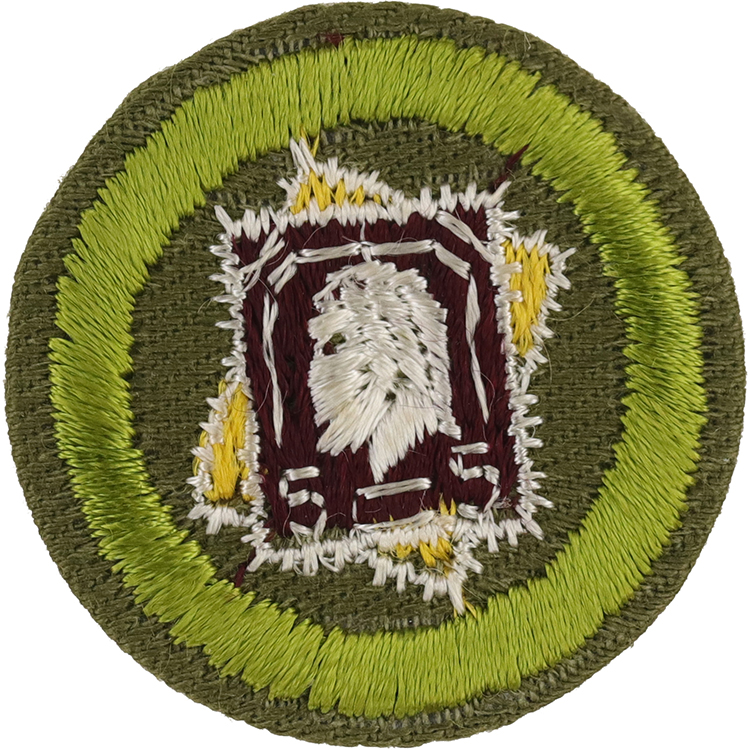
Fig. 1: StaCol-E2-Front
- Cloth: Khaki right twill
- Embroidery: Cotton lock stitch
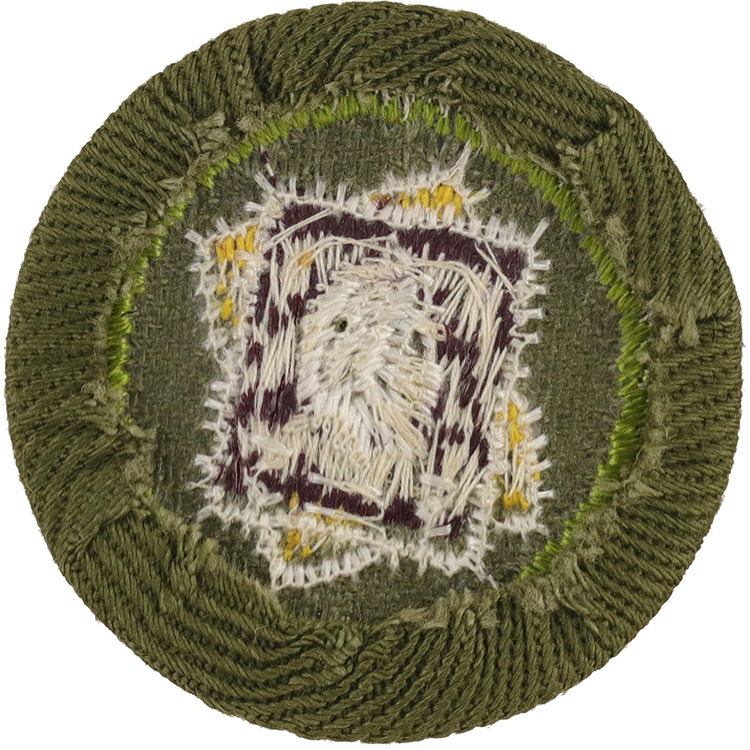
Fig. 2: StaCol-E2-Reverse
- Back: Plain NO imprint with starch

Fig. 3: StaCol-E2-mve1-front
- Minor variation: Head differences

Fig. 4: StaCol-E2-mve1-reverse
- Back: Plain NO imprint with starch
Item Name: Stamp Collecting 1947 - 1960
Item ID: StaCol-E2
Collector Rating: 1
Pamphlets Used to Earn this Badge

Requirements January 1938 until January 1952
1. Own and exhibit either of the following assortments personally collected by himself.
(a) 500 or more well-conditioned stamps including at least 50 different countries
OR
(b) 500 or more well-conditioned stamps from an individual country or group of countries in which he is specializing.
2. Exhibit one stamp from at least six of the following groups: surcharged, imperforate, perforate, precancelled, flat plate, rotary press, commemorative, envelope, semi-postal, occupation, provisional.
3. Exhibit and explain one stamp from at last six of the following classifications: postage, air mail, postage due, registration, parcel post, special delivery, revenue, private proprietary, war tax, newspaper, official.
4. Exhibit and explain cancellations and their relation to the value of a stamp, including each of the following:
(a) Pen.
(b) Office (town).
(c) Killer.
(d) Colored.
(e) "Tied to cover."
5. Explain the following terms used by stamp collectors:
(a) Wove, laid, granite, and silk paper.
(b) Water marks.
(c) Engraved, typographed, lithographed.
(d) Perforation, rouletting.
6. Exhibit the number indicated of each of the following issues of the United States: 10 different commemorative, 10 present issue, 4 present envelope, 1 memorial, 1 flat plate, 1 rotary press, and 3 different air mail stamps.
7. Demonstrate ability to "catalogue" accurately five stamps which are to be furnished by the Counselor.
8. Explain in full how the "condition" of a stamp affects its value.
Requirements January 1952 until December 1966
1. Mount and exhibit in a commercial album or an album of your own making: (a) a collection of 750 or more different stamps from at least thirty countries; or (b) a collection of 150 or more different stamps from a single country or a group of closely related countries; or (c) a collection of 75 or more different stamps on some special subject such as birds, trees, great men, music, aviation, etc. (stamps may be from any number of countries); or (d) a collection of 200 or more special items such as precanceled stamps, postage meters, revenue stamps, covers, postal stationery, etc.
2. Demonstrate the use of the Standard Postage Stamp Catalogue, or a catalogue particularly related to your collection in Requirement 1, to find at least five items selected by the counselor.
3. Show stamps to support brief definitions of the following terms: perforation, imperforate, roulette, cancellation, cover, mint stamp, coil stamp, overprint, surcharge, engraving, and printing process other than engraving.
4. Exhibit one stamp in each of the following classifications and explain the purpose of each: regular postage, commemorative, semipostal, air mail, postage due, envelope, special delivery, precancel, and revenue.
5. Explain the meaning of good condition of a stamp and show one stamp that is well centered, fully perforated, clearly cancelled, clean, and undamaged by tears or thin spots.
6. Demonstrate a knowledge of the following stamp collector's tools: (a) Use a perforation gauge to determine, on a stamp supplied by the counselor, the perforation measurement in accordance with the accepted standard. (b) Use a magnifying glass for careful examination of design and condition. (c) Use the watermark detector to show how a watermark may aid in identifying a stamp. (d) Use stamp tongs and stamp hinges correctly in mounting a stamp in an album.