-
Merit Badges
- Legend to identify Merit Badges
- 1910 British Merit Badges
- Square 1911 - 33
- Wide Crimped 1934 & 35
-
Narrow Tan Crimped 1936 - 42
- Tan Heavyweight Cloth with Silk Embroidery and Printed Back 1936 - 37
- Tan Heavyweight Cloth with Silk Embroidery and Plain Back 1937 - 38
- Tan Lightweight Cloth with Silk Embroidery and Plain Back 1938 - 39
- Tan Lightweight Cloth with Cotton Continuous Loop Embroidery and Plain Back 1939 - 42
- Tan Lightweight Cloth with Cotton Lockstitch Embroidery and Plain Back 1939 - 42
- Blue Background 1942 - 46
- Wartime 1942 - 46
- Khaki Narrow Crimped 1946 - 59
- Green Twill Gauze Back 1960 - 68
- Fully Embroidered Merrowed Edge 1960 - 72
- Unprinted Plastic Back 1972 - 01
- Printed Plastic Back 2002 - Current
-
Merit Badge Paper
- Merit Badge Applications
- Merit Badge Cards
-
Merit Badge Pamphlets
- Type 1 White Cover - Rectangle Drawing On Cover
- Type 2 White Cover 5-375" x 8" Title at Top
- Type 3A Tan Cover - 200 Fifth Avenue
- Type 3B Tan Cover - 2 line address New York City
- Type 3C Tan Cover - 2 line address New York N.Y.
- Type 3D Tan Cover - 1 line address New York N.Y.
- Type 4 Standing Scout Cover
- Type 5A War Cover
- Type 5B Red and White
- Type 6 Photo-Red Cover
- Type 7 Full Photo Cover or Bulls-eye Cover
- Type 8 Full Photo - Green Stripe Cover
- Type 9 Full Photo - Red Stripe Cover
- Type 10A Blue Stripe - Logo above bottom blue stripe - FDL centered
- Type 10B - Blue Stripe in bottom of photo area. FDL to left of text
- Special Covers
- Boy Craft Helps
- Merit Badge Counselor's Guides
-
Youth Position
- Junior Assistant Scoutmaster
- Senior Patrol Leader
- Assistant Senior Patrol Leader
- Patrol Leader
- Assistant Patrol Leader
- Troop Guide
- Scribe
- Quartermaster
- Instructor
- Chaplain Aide
- Den Chief
- Librarian
- Musician
- Webmaster
- Bugler
- Troop Historian
- Troop Representative
- Unit Representative
- Leadership Corps
- Honor Guard
- Leave No Trace Trainer
- Outdoor Ethics Guide
-
Patrol Medallions
- Patrol Medallions Introduction
- Legend to identify Patrol Medallions
- Patrol Shoulder Knot-Ribbons
- Felt Handmade Patrol Medallions
- Square Felt Patrol Medallions
- Round Broadcloth Patrol Medallions
- Red Twill Patrol Medallions
- Multi-Color Cloth Patrol Medallions
- Tan Cloth Patrol Medallions
- Patrol Medallion Back Patches
- Woodbadge Patrol Medallion
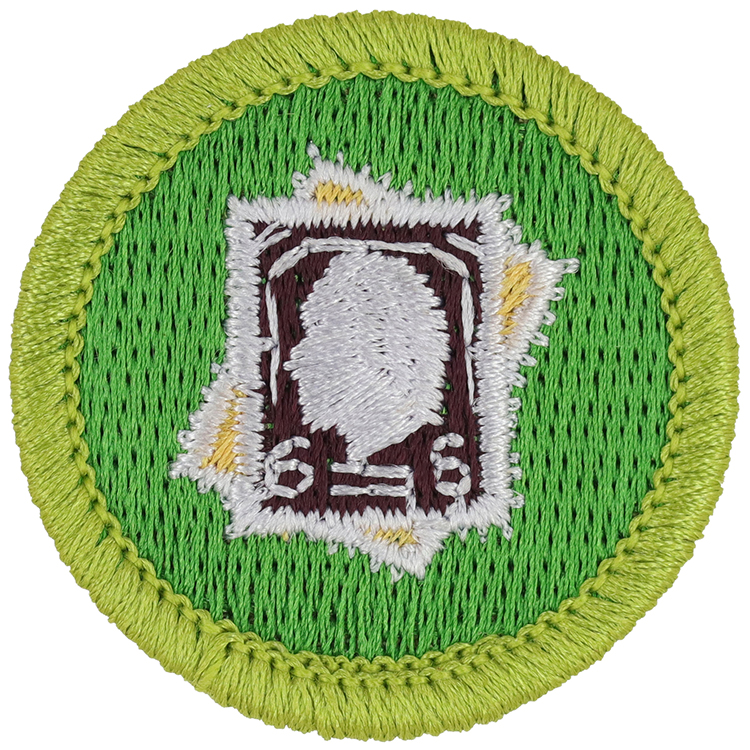
Fig. 1: StaCol-L1-Front
- Embroidery: Rayon thread
- Border: Merrowed
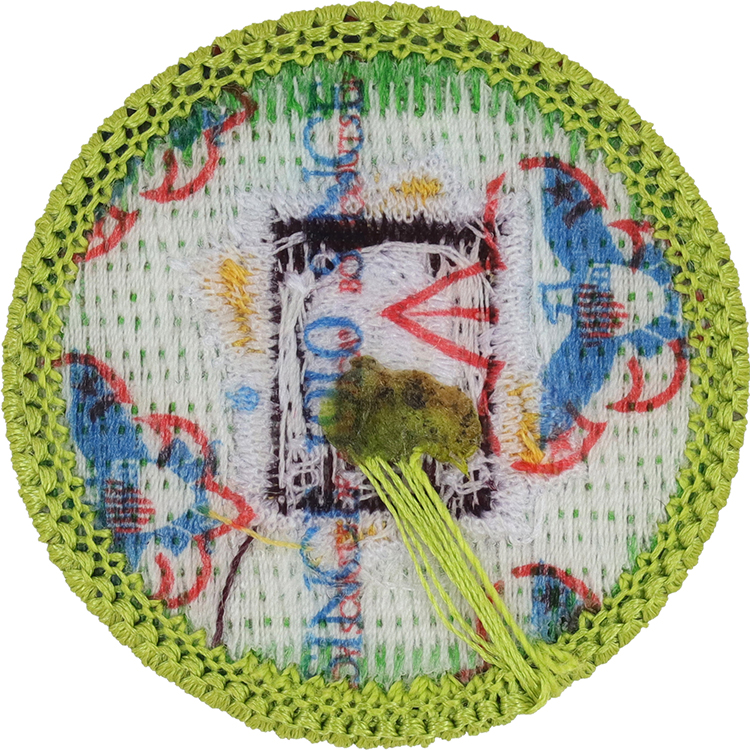
Fig. 2: StaCol-L1-Reverse
- Back: Since 1910 imprint with large Tenderfoot image
Item Name: Stamp Collecting 2014 - Current
Item ID: StaCol-L1
Collector Rating: 1
Pamphlets Used to Earn this Badge

Requirements January 2007 until Current
1. Do the following:
(a) Discuss how you can better understand people, places, institutions, history, and geography as a result of collecting stamps.
(b) Briefly describe some aspects of the history, growth, and development of the United States postal system. Tell how is it different from postal systems in other countries?
2. Define topical stamp collecting. Name and describe three other types of stamp collections.
3. Show at least ONE example of each of the following:
(a) Perforated and imperforate stamps
(b) Mint and used stamps
(c) Sheet, booklet, and coil stamps
(d) Numbers on plate block, booklet, or coil, or marginal markings
(e) Overprint and surcharge
(f) Metered mail
(g) Definitive, commemorative, semipostal, and airmail stamps
(h) Cancellation and postmark
(i) First day cover
(j) Postal stationery (aerogramme, stamped envelope, and postal card)
4. Do the following:
(a) Demonstrate the use of ONE standard catalog for several different stamp issues. Explain why catalog value can vary from the corresponding purchase price.
(b) Explain the meaning of the term condition as used to describe a stamp. Show examples that illustrate the different factors that affect a stamp's value.
5. Demonstrate the use of at least THREE of the following stamp collector's tools:
(a) Stamp tongs
(b) Water and tray
(c) Magnifier(s)
(d) Hinges
(e) Perforation gauge
(f) Envelopes and sleeves
(g) Watermark fluid
6. Do the following:
(a) Show a stamp album and how to mount stamps with or without hinges. Show at least ONE page that displays several stamps.
(b) Discuss at least THREE ways you can help to preserve stamps, covers, and albums in first-class condition.
7. Do at least TWO of the following:
(a) Design a stamp, cancellation, or cachet.
(b) Visit a post office, stamp club, or stamp show with an experienced collector. Explain what you saw and learned.
(c) Write a review of an interesting article from a stamp newspaper, magazine, book, or Web site (with your patent’s permission).
(d) Research and report on a famous stamp-related personality or the history behind a particular stamp.
(e) Describe the steps taken to produce a stamp. Include the methods of printing, types of paper, perforation styles, and how they are gummed.
(f) Prepare a two- to three-page display involving stamps. Using ingenuity, as well as clippings, drawings, etc., tell a story about the stamps and how they relate to history, geography, or a favorite topic of yours.
8. Mount and show, in a purchased or homemade album, ONE of the following:
(a) A collection of 250 or more different stamps from at least 15 countries.
(b) A collection of a stamp from each of 50 different countries, mounted on maps to show the location of each.
(c) A collection of 100 or more different stamps from either one country or a group of closely related countries.
(d) A collection of 75 or more different stamps on a single topic. (Some interesting topics are Scouting, birds, insects, the Olympics, sports, flowers, animals, ships, holidays, trains, famous people, space, medicine) Stamps may be from different countries.
(e) A collection of postal items discovered in your mail by monitoring it over a period of 30 days. Include at least five different types listed in requirement 3, above.