-
Merit Badges
- Legend to identify Merit Badges
- 1910 British Merit Badges
- Square 1911 - 33
- Wide Crimped 1934 & 35
-
Narrow Tan Crimped 1936 - 42
- Tan Heavyweight Cloth with Silk Embroidery and Printed Back 1936 - 37
- Tan Heavyweight Cloth with Silk Embroidery and Plain Back 1937 - 38
- Tan Lightweight Cloth with Silk Embroidery and Plain Back 1938 - 39
- Tan Lightweight Cloth with Cotton Continuous Loop Embroidery and Plain Back 1939 - 42
- Tan Lightweight Cloth with Cotton Lockstitch Embroidery and Plain Back 1939 - 42
- Blue Background 1942 - 46
- Wartime 1942 - 46
- Khaki Narrow Crimped 1946 - 59
- Green Twill Gauze Back 1960 - 68
- Fully Embroidered Merrowed Edge 1960 - 72
- Unprinted Plastic Back 1972 - 01
- Printed Plastic Back 2002 - Current
-
Merit Badge Paper
- Merit Badge Applications
- Merit Badge Cards
-
Merit Badge Pamphlets
- Type 1 White Cover - Rectangle Drawing On Cover
- Type 2 White Cover 5-375" x 8" Title at Top
- Type 3A Tan Cover - 200 Fifth Avenue
- Type 3B Tan Cover - 2 line address New York City
- Type 3C Tan Cover - 2 line address New York N.Y.
- Type 3D Tan Cover - 1 line address New York N.Y.
- Type 4 Standing Scout Cover
- Type 5A War Cover
- Type 5B Red and White
- Type 6 Photo-Red Cover
- Type 7 Full Photo Cover or Bulls-eye Cover
- Type 8 Full Photo - Green Stripe Cover
- Type 9 Full Photo - Red Stripe Cover
- Type 10A Blue Stripe - Logo above bottom blue stripe - FDL centered
- Type 10B - Blue Stripe in bottom of photo area. FDL to left of text
- Special Covers
- Boy Craft Helps
- Merit Badge Counselor's Guides
-
Youth Position
- Junior Assistant Scoutmaster
- Senior Patrol Leader
- Assistant Senior Patrol Leader
- Patrol Leader
- Assistant Patrol Leader
- Troop Guide
- Scribe
- Quartermaster
- Instructor
- Chaplain Aide
- Den Chief
- Librarian
- Musician
- Webmaster
- Bugler
- Troop Historian
- Troop Representative
- Unit Representative
- Leadership Corps
- Honor Guard
- Leave No Trace Trainer
- Outdoor Ethics Guide
-
Patrol Medallions
- Patrol Medallions Introduction
- Legend to identify Patrol Medallions
- Patrol Shoulder Knot-Ribbons
- Felt Handmade Patrol Medallions
- Square Felt Patrol Medallions
- Round Broadcloth Patrol Medallions
- Red Twill Patrol Medallions
- Multi-Color Cloth Patrol Medallions
- Tan Cloth Patrol Medallions
- Patrol Medallion Back Patches
- Woodbadge Patrol Medallion
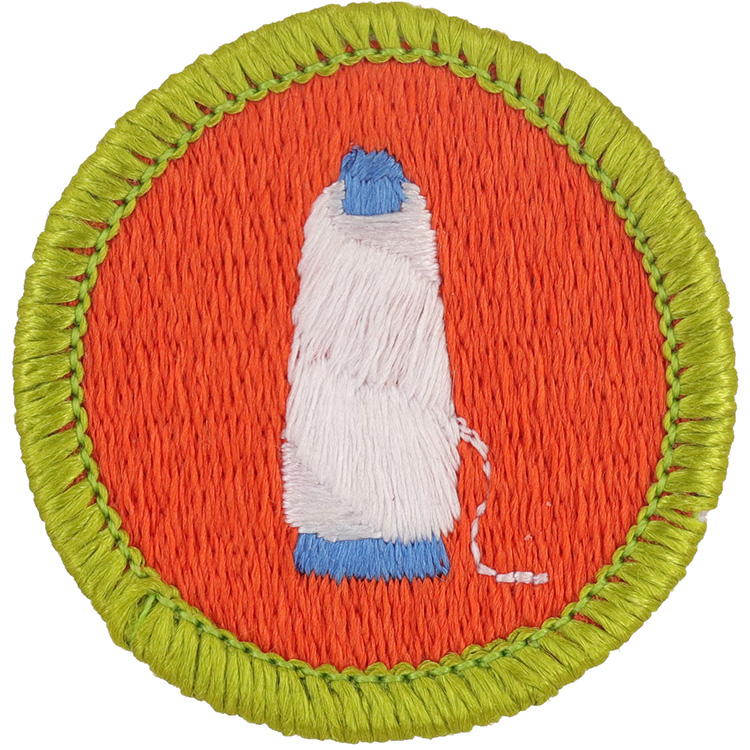
Fig. 1: Textil-J1-Front
- Embroidery: Rayon thread
- Border: Merrowed
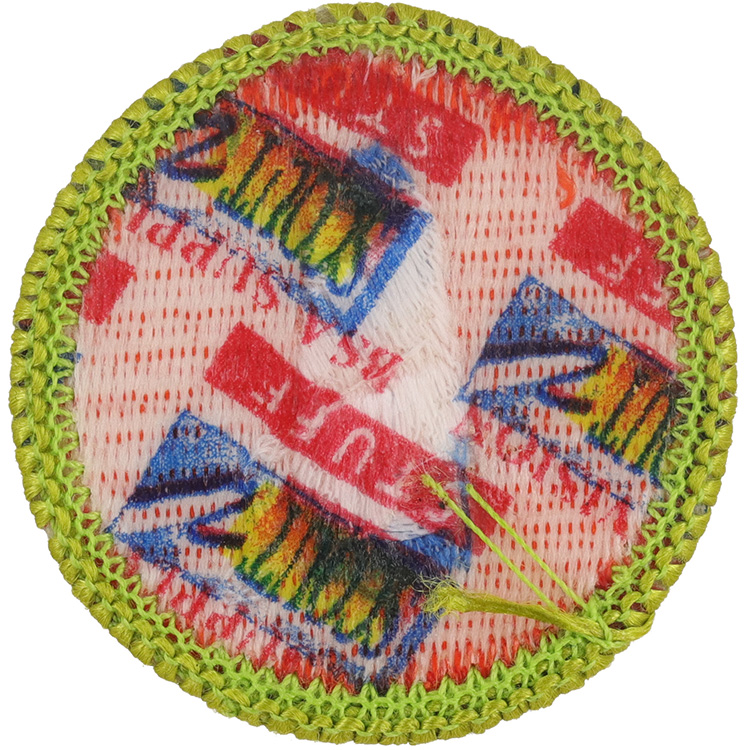
Fig. 2: Textil-J1-Reverse
- Back: Scout Stuff imprint
Item Name: Textile 2002 - 2009
Item ID: Textil-J1
Collector Rating: 1
Pamphlets Used to Earn this Badge
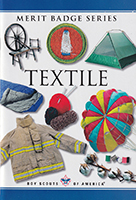
Requirements September 1985 until January 2004
1. Talk over how textiles are important to man.
2. Do ONE of the following:
(a) Visit a textile plant or school. Report on what you saw.
(b) Explain the main steps in making a fiber into cloth. Name the machines used in each step. Tell what each machine does.
(c) Describe four ways of adding colors to textiles.
3. Do ONE of the following:
(a) Get one sample in each of the three major classes of woven fabrics: (1) clothing, (2) home use, (3) industrial.
(b) Get one sample of knit or double-knit fabric. Compare these to those that were woven.
4. Do TWO of the following:
(a) Show one good way to test fibers for recognition.
(b) Waterproof a piece of cloth.
(c) Weave a piece of cloth. Use a simple loom that you have made yourself.
(d) Define 10 of the following terms: fiber, filament, yarn, tufting, nonwoven, tricot, plastic, Jacquard, full fashioned, Greige goods, bleaching, finishing, mercerization, screen printing, roller printing, durable press, sanforizing, preshrunk, water repellent, and fire retardant.
5. Get small samples of two of the following natural fibers: cotton, wool, silk, or linen. Get two of the following classes of man-made fibers: rayon, nylon, polyester, glass fiber, and acrylic. Tell how two of these are different. Give the advantages of each.
6. Talk over or make a written report on jobs in five main branches of the textile industry.
Requirements January 2004 until Current
1. Discuss with your merit badge counselor the importance of textiles. In your discussion, define the terms fiber, fabric, and textile. Give examples of textiles you use every day.
2. Do the following:
(a) Get swatches of two natural-fiber fabrics (100 percent cotton, linen, wool, or silk; no blends). Get swatches of two synthetic fiber fabrics (nylon, polyester, acrylic, olefin, or spandex). Get a sample of one cellulosic fabric (rayon, acetate, or lyocell).
(b) Give the origin, major characteristics, and general content of each type of fiber obtained for 2(a). Explain the difference between a cellulosic manufactured fiber and a synthetic manufactured fiber.
(c) Describe the main steps in making raw fiber into yarn, and yarn into fiber.
(d) Assume you will soon buy a new garment or other textile item. Tell your counselor what fiber or blend of fibers you want the item to be, and give reasons for your choice.
3. Do TWO of the following:
(a) Visit a textile plant, textile products manufacturer, or textile school or college. Report on what you saw and learned.
(b) Weave a belt, headband, place mat, or wall hanging. Use a simple loom that you have made yourself.
(c) With a magnifying glass, examine a woven fabric, a nonwoven fabric, and a knitted fabric. Sketch what you see. Explain how the three constructions are different.
(d) Make a piece of felt.
(e) Make two natural dyes and use them to dye a garment or a piece of fabric.
(f) Waterproof a fabric.
(g) Demonstrate how to identify fibers, using a microscope identification or the breaking test.
4. Explain the meaning of 10 of the following terms: warp, harness, heddle, shed, aramid, spandex, sliver, yarn, spindle, distaff, loom, cellulose, sericulture, extrusion, carbon fibers, spinneret, staple, worsted, nonwoven, greige goods.