-
Merit Badges
- Legend to identify Merit Badges
- 1910 British Merit Badges
- Square 1911 - 33
- Wide Crimped 1934 & 35
-
Narrow Tan Crimped 1936 - 42
- Tan Heavyweight Cloth with Silk Embroidery and Printed Back 1936 - 37
- Tan Heavyweight Cloth with Silk Embroidery and Plain Back 1937 - 38
- Tan Lightweight Cloth with Silk Embroidery and Plain Back 1938 - 39
- Tan Lightweight Cloth with Cotton Continuous Loop Embroidery and Plain Back 1939 - 42
- Tan Lightweight Cloth with Cotton Lockstitch Embroidery and Plain Back 1939 - 42
- Blue Background 1942 - 46
- Wartime 1942 - 46
- Khaki Narrow Crimped 1946 - 59
- Green Twill Gauze Back 1960 - 68
- Fully Embroidered Merrowed Edge 1960 - 72
- Unprinted Plastic Back 1972 - 01
- Printed Plastic Back 2002 - Current
-
Merit Badge Paper
- Merit Badge Applications
- Merit Badge Cards
-
Merit Badge Pamphlets
- Type 1 White Cover - Rectangle Drawing On Cover
- Type 2 White Cover 5-375" x 8" Title at Top
- Type 3A Tan Cover - 200 Fifth Avenue
- Type 3B Tan Cover - 2 line address New York City
- Type 3C Tan Cover - 2 line address New York N.Y.
- Type 3D Tan Cover - 1 line address New York N.Y.
- Type 4 Standing Scout Cover
- Type 5A War Cover
- Type 5B Red and White
- Type 6 Photo-Red Cover
- Type 7 Full Photo Cover or Bulls-eye Cover
- Type 8 Full Photo - Green Stripe Cover
- Type 9 Full Photo - Red Stripe Cover
- Type 10A Blue Stripe - Logo above bottom blue stripe - FDL centered
- Type 10B - Blue Stripe in bottom of photo area. FDL to left of text
- Special Covers
- Boy Craft Helps
- Merit Badge Counselor's Guides
-
Youth Position
- Junior Assistant Scoutmaster
- Senior Patrol Leader
- Assistant Senior Patrol Leader
- Patrol Leader
- Assistant Patrol Leader
- Troop Guide
- Scribe
- Quartermaster
- Instructor
- Chaplain Aide
- Den Chief
- Librarian
- Musician
- Webmaster
- Bugler
- Troop Historian
- Troop Representative
- Unit Representative
- Leadership Corps
- Honor Guard
- Leave No Trace Trainer
- Outdoor Ethics Guide
-
Patrol Medallions
- Patrol Medallions Introduction
- Legend to identify Patrol Medallions
- Patrol Shoulder Knot-Ribbons
- Felt Handmade Patrol Medallions
- Square Felt Patrol Medallions
- Round Broadcloth Patrol Medallions
- Red Twill Patrol Medallions
- Multi-Color Cloth Patrol Medallions
- Tan Cloth Patrol Medallions
- Patrol Medallion Back Patches
- Woodbadge Patrol Medallion
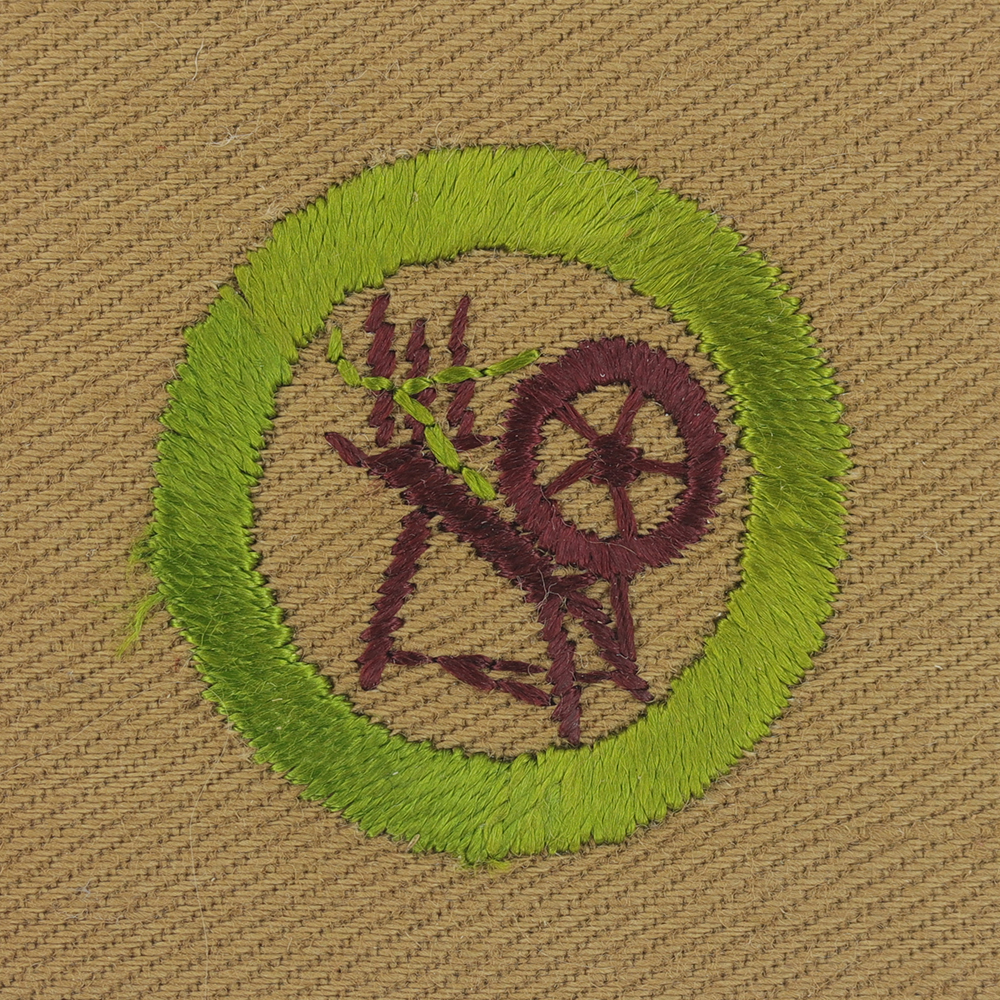
Fig. 1: Textis-AT1-Front
- Cloth: Heavyweight tan right twill
- Embroidery: Silk continuous
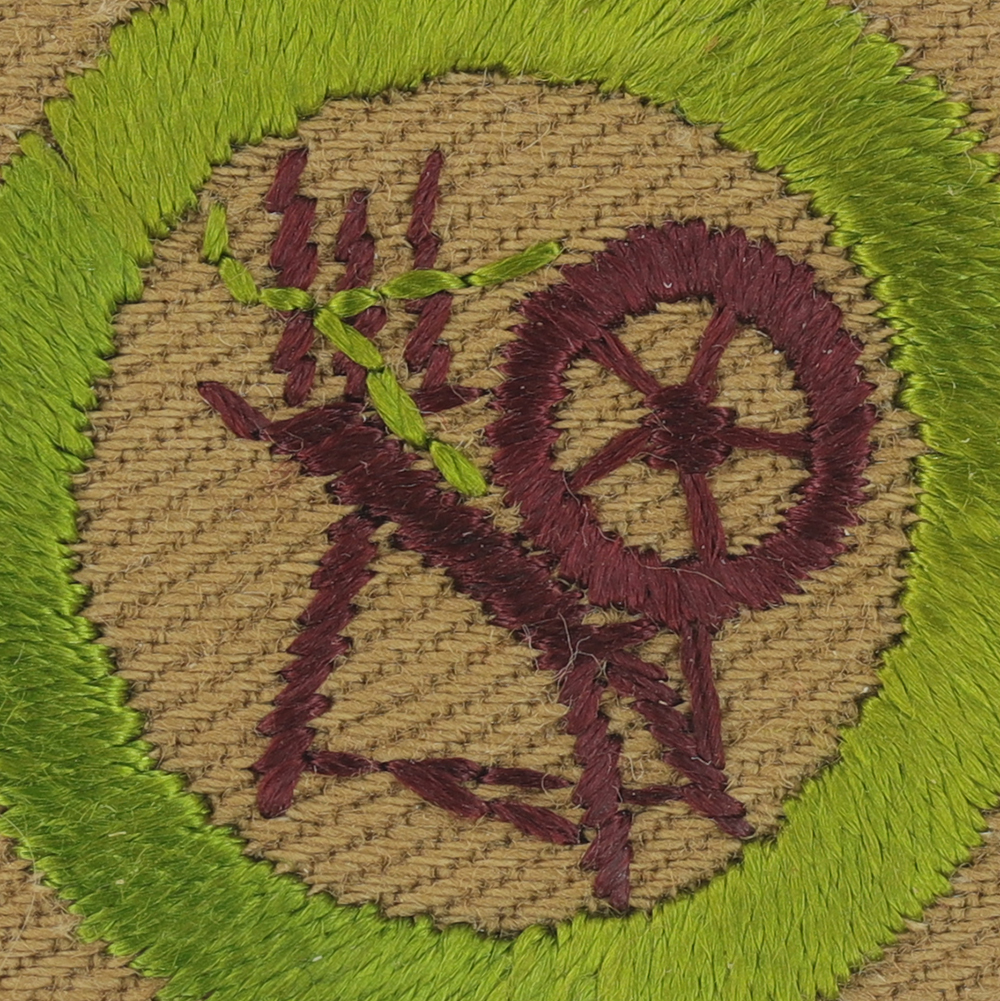
Fig. 2: Textis-AT1-Magnified
- Design: Spinning wheel
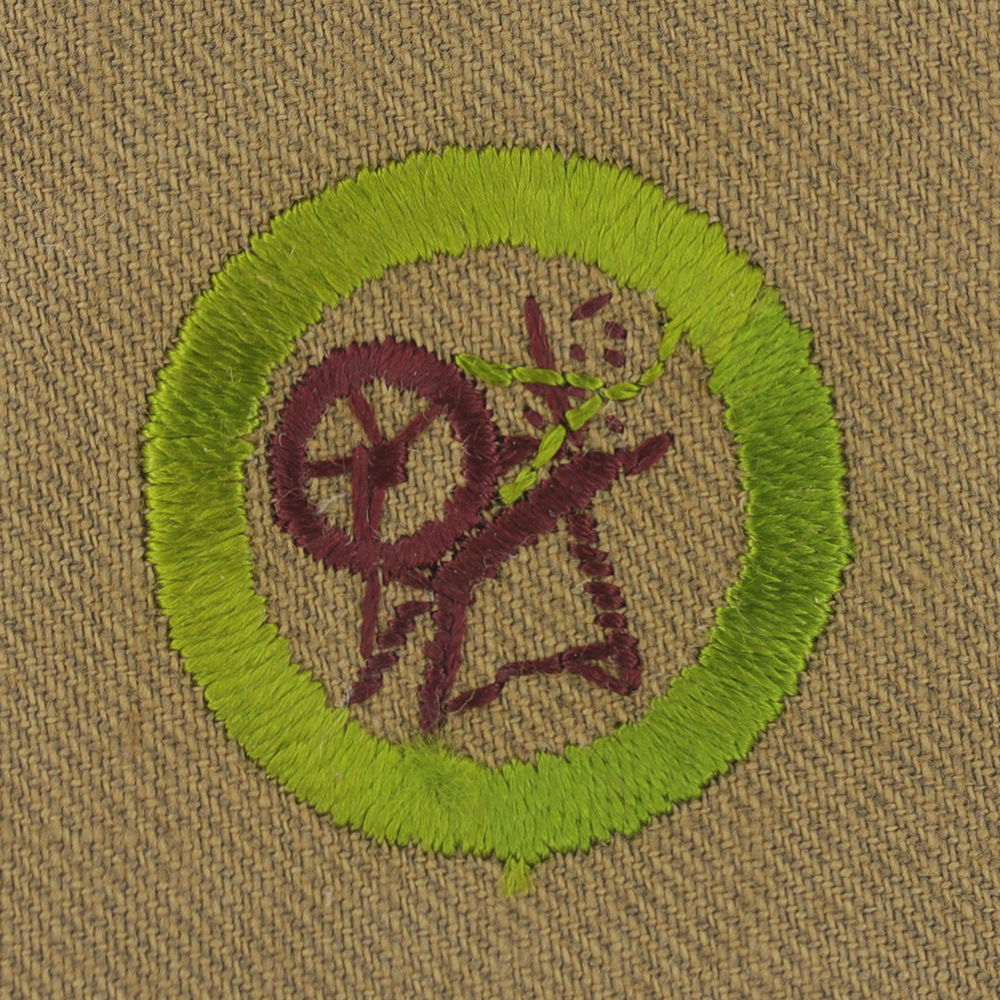
Fig. 3: Textis-AT1-Reverse
- Back: Black imprint
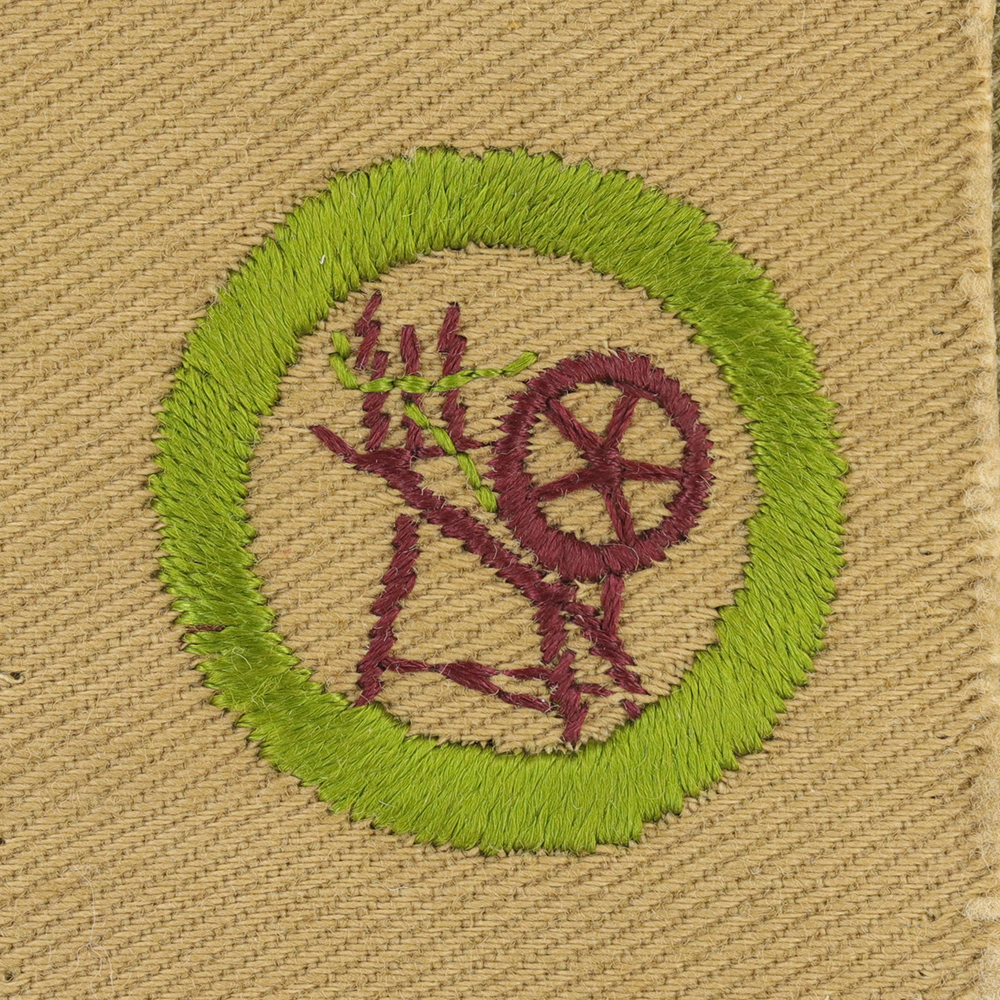
Fig. 4: Textis-AT1-mve1-front
- Minor variation: Wheel and bottom brace differences
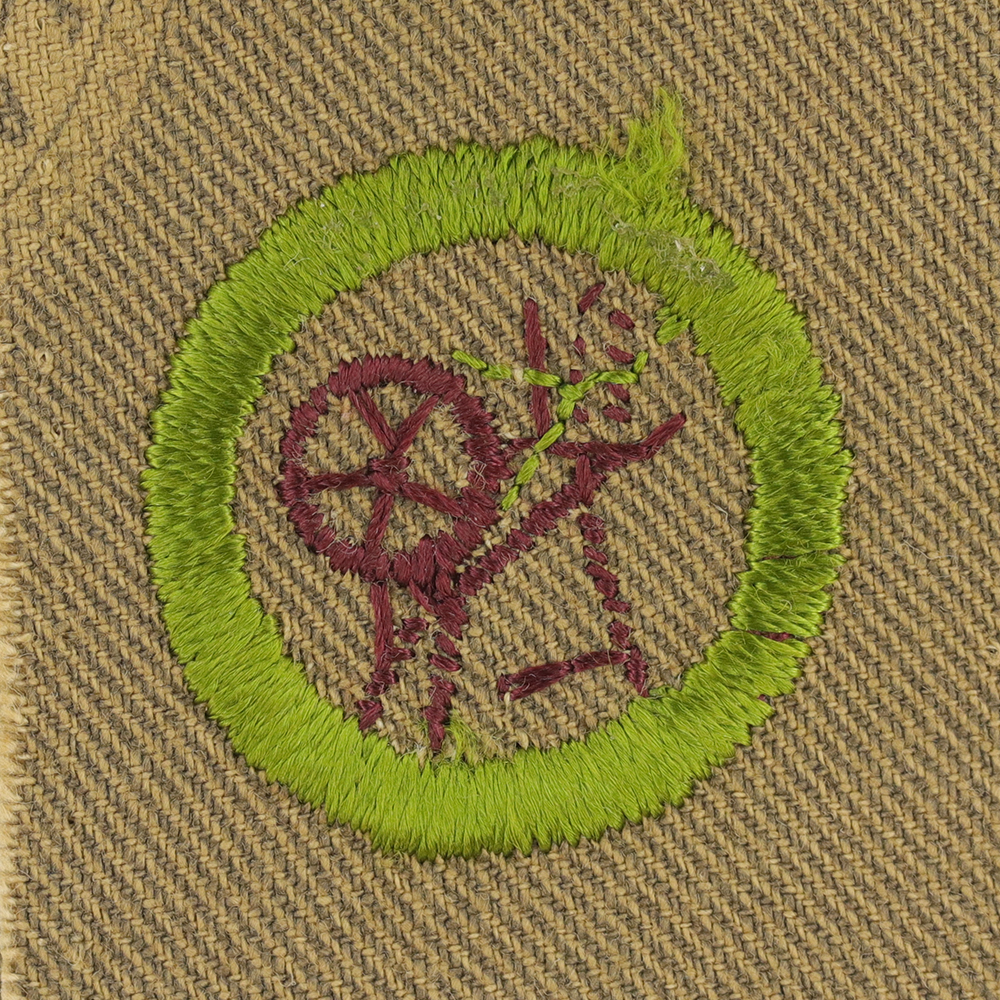
Fig. 5: Textis-AT1-mve1-reverse
- Back: Black imprint
Item Name: Textiles 1924 - 1933
Item ID: Textis-AT1
Collector Rating: 1
Pamphlets Used to Earn this Badge


Requirements May 1924 until May 1925
1. Identify a piece of woolen cloth
Identify a piece of worsted cloth
Identify a piece of cotton cloth
Identify a piece of silk cloth
Identify a piece of artificial silk cloth
Submit a collection of samples.
State how he would distinguish each of the above.
2. (a) Know the physical properties (appearance) in the raw state of wool, worsted, cotton, silk and artificial silk.
(b) Know how yarns made from these fibers differ in their character, and state the means by which he would distinguish between them.
3. Distinguish between a woven fabric and a knitted fabric, and state which wears the better and why.
4. State how wool, cotton and silk are grown, and name the principal sources of supply of each.
5. Outline the different operations that would be used in converting some fiber into cloth. Name the machines that would be used and the kind of cloth that would be made. Report whether data for this test are gathered from visits to a factory or from texts.
6. Produce a sample and tell what properties a good piece of cotton or woolen wearing apparel should possess.
7. State what the size numbers of yarn signify. Illustrate with at least two samples.
8. State which fibers are easier to dye and which are harder, and explain why in each case.
9. Name the two principal sources of dyestuffs.
Requirements May 1925 until June 1952
1. Identify a piece of woolen cloth.
Identify a piece of worsted cloth.
Identify a piece of cotton cloth.
Identify a piece of silk cloth.
Identify a piece of artificial silk cloth.
Submit a collection of samples.
State how he would distinguish each of the above.
2. (a) Know the physical properties (appearance) in the raw state of wool, worsted, cotton, silk and artificial silk.
(b) Know how yarns made from these fibers differ in their character, and state the means by which he would distinguish between them.
3. Distinguish between a woven fabric and a knitted fabric, and state which wears the better and why.
4. State how wool, cotton and silk are grown, and name the principal sources of supply of each.
5. Outline the different operations that would be used in converting some fiber into cloth. Name the machines that would be used and the kind of cloth that would be made. Report whether data for this test are gathered from visits to a factory or from texts.
6. Produce a sample and tell what properties a good piece of cotton or woolen wearing-apparel should possess.
7. State what the size numbers of yarns signify. Illustrate with at least two samples.
8. State which fibers are easier to dye and which are harder, and explain why in each case.
9. Name the two principal sources of dyestuffs.