-
Merit Badges
- Legend to identify Merit Badges
- 1910 British Merit Badges
- Square 1911 - 33
- Wide Crimped 1934 & 35
-
Narrow Tan Crimped 1936 - 42
- Tan Heavyweight Cloth with Silk Embroidery and Printed Back 1936 - 37
- Tan Heavyweight Cloth with Silk Embroidery and Plain Back 1937 - 38
- Tan Lightweight Cloth with Silk Embroidery and Plain Back 1938 - 39
- Tan Lightweight Cloth with Cotton Continuous Loop Embroidery and Plain Back 1939 - 42
- Tan Lightweight Cloth with Cotton Lockstitch Embroidery and Plain Back 1939 - 42
- Blue Background 1942 - 46
- Wartime 1942 - 46
- Khaki Narrow Crimped 1946 - 59
- Green Twill Gauze Back 1960 - 68
- Fully Embroidered Merrowed Edge 1960 - 72
- Unprinted Plastic Back 1972 - 01
- Printed Plastic Back 2002 - Current
-
Merit Badge Paper
- Merit Badge Applications
- Merit Badge Cards
-
Merit Badge Pamphlets
- Type 1 White Cover - Rectangle Drawing On Cover
- Type 2 White Cover 5-375" x 8" Title at Top
- Type 3A Tan Cover - 200 Fifth Avenue
- Type 3B Tan Cover - 2 line address New York City
- Type 3C Tan Cover - 2 line address New York N.Y.
- Type 3D Tan Cover - 1 line address New York N.Y.
- Type 4 Standing Scout Cover
- Type 5A War Cover
- Type 5B Red and White
- Type 6 Photo-Red Cover
- Type 7 Full Photo Cover or Bulls-eye Cover
- Type 8 Full Photo - Green Stripe Cover
- Type 9 Full Photo - Red Stripe Cover
- Type 10A Blue Stripe - Logo above bottom blue stripe - FDL centered
- Type 10B - Blue Stripe in bottom of photo area. FDL to left of text
- Special Covers
- Boy Craft Helps
- Merit Badge Counselor's Guides
-
Youth Position
- Junior Assistant Scoutmaster
- Senior Patrol Leader
- Assistant Senior Patrol Leader
- Patrol Leader
- Assistant Patrol Leader
- Troop Guide
- Scribe
- Quartermaster
- Instructor
- Chaplain Aide
- Den Chief
- Librarian
- Musician
- Webmaster
- Bugler
- Troop Historian
- Troop Representative
- Unit Representative
- Leadership Corps
- Honor Guard
- Leave No Trace Trainer
- Outdoor Ethics Guide
-
Patrol Medallions
- Patrol Medallions Introduction
- Legend to identify Patrol Medallions
- Patrol Shoulder Knot-Ribbons
- Felt Handmade Patrol Medallions
- Square Felt Patrol Medallions
- Round Broadcloth Patrol Medallions
- Red Twill Patrol Medallions
- Multi-Color Cloth Patrol Medallions
- Tan Cloth Patrol Medallions
- Patrol Medallion Back Patches
- Woodbadge Patrol Medallion
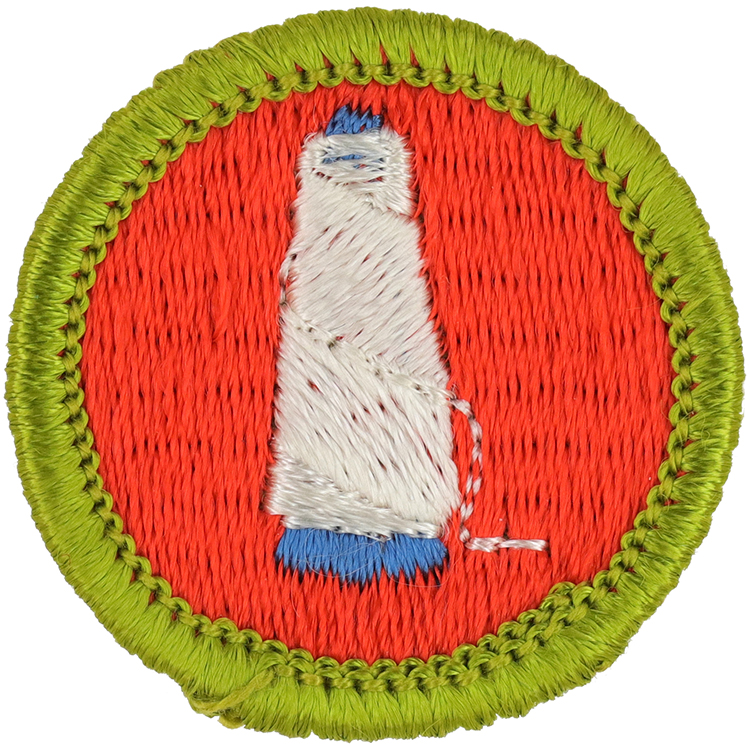
Fig. 1: Textis-G-Front
- Embroidery: Cotton thread
- Border: Merrowed
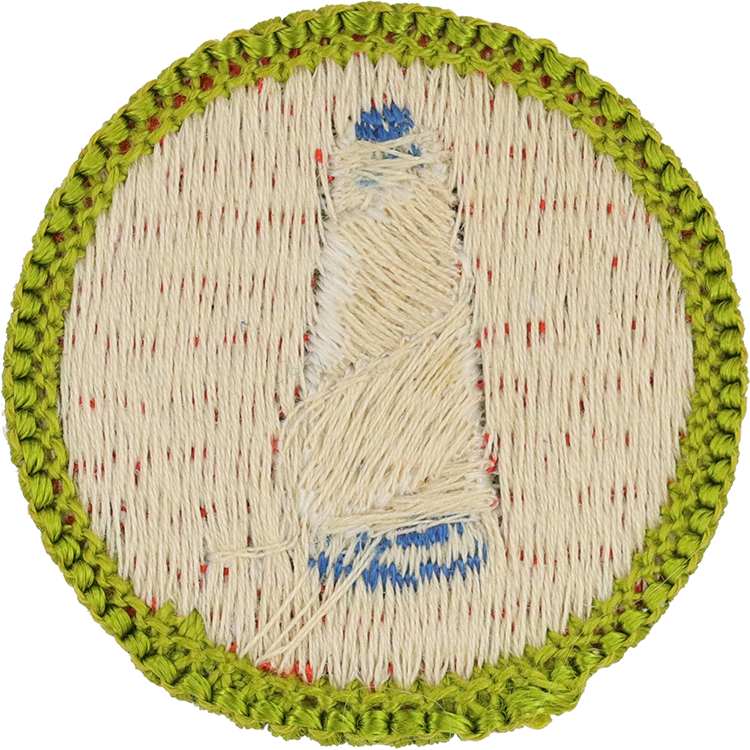
Fig. 2: Textis-G-Reverse
- Back: Starched cloth
Item Name: Textiles 1969 - 1972
Item ID: Textis-G
Collector Rating: 1
Pamphlets Used to Earn this Badge

Requirements June 1953 until June 1972
1. (a) Submit samples of the following yarn, thread, or fiber: cotton, wool, synthetic silk and linen. Discuss their sources, including the chief countries that produce them. (b) Tell how at least three of these fibers differ in character. Show one good method of testing fibers so as to recognize them.
2. Submit samples of woven fabrics containing cotton, wool, silk, linen, acetate, rayon, and nylon. Discuss the various qualities and common uses of each, including the garments you are wearing.
3. Submit two or more samples of knitted goods and discuss briefly the qualities of those as compared to woven fabrics.
4. Explain the principal operations used to manufacture any fiber into a fabric. Name the machines used and tell briefly what each machine does.
5. Discuss the types of dyes in general use and explain why some fabrics require different dyes than others. Discuss spun, stock yarn and piece dyeing. Discuss the qualities of a vat dye.
6. Do one of the following: (1) Visit a textile mill, clothing factory, or day plant and report fully to your counselor on this experience. (2) Waterproof a piece of fabric. (3) Weave an article on a simple loom that you have made yourself.
(b) Investigate and report on the career opportunities that are open to you in the textile or clothing manufacturing industries.
7. Explain ten of these textile terms: fiber, lament, yarn, short staple, ply yarn, burning test, fiber blends, warp, filling, pick, cloth count, pick glass, selvage, nap, gray goods, mercerized, color printing.
8. Show that you know something about the purchase and care of your own wearing apparel as follows: (a) Tell the meaning on labels of "reprocessed," "Sanforized," "preshrunk," and "water repellent." (b) Remove a grease spot from a piece of fabric by dry cleaning, using precautions against fire. (c) Give rules for proper cleaning and storing of your own garments. (d) Wash underwear and socks properly under camping conditions.